How United States Small Businesses Can Handle Timesheet Approval Workflows with Over 21,000 Minutes Logged
Managing timesheet approvals efficiently becomes critical for US small businesses logging large volumes of employee hours, such as over 21,000 minutes
The HelloTime team
10 min read
On this page
Managing timesheet approvals efficiently becomes critical for US small businesses logging large volumes of employee hours, such as over 21,000 minutes per pay period. A smooth timesheet approval workflow ensures accurate payroll, compliance with labor laws, and operational transparency, ultimately supporting business success and employee satisfaction.
Key takeaways
- Handling 21,000+ minutes of logged time requires streamlined and automated timesheet approval processes.
- Automating approval workflows reduces errors, saves administrative time, and speeds up payroll.
- Clear company policies and communication improve employee compliance and timesheet accuracy.
- AI-supported systems help detect anomalies and process large volumes of timesheet data effectively.
- US labor laws like the FLSA must guide timesheet approval practices to ensure compliance.
- Digital time tracking software with built-in approvals boosts productivity and reduces payroll risks.
What is a timesheet approval workflow and why does it matter for small businesses?
A timesheet approval workflow is the process by which employee-recorded work hours are reviewed, verified, and authorized by supervisors or managers before payroll processing. This step is critical to ensure that employee compensation is accurate and compliant with labor regulations.
For small businesses in the US logging over 21,000 minutes (350 hours) of work time per pay period—equivalent to 10 employees working 35 hours each—an efficient approval workflow is essential. Without it, businesses risk payroll errors, delayed payments, and compliance issues related to overtime and wage laws. Additionally, operational decisions rely on accurate labor data, so timesheet approvals safeguard not only pay accuracy but also business transparency and workforce management.
How can small businesses manage high-volume timesheet approvals efficiently?
When handling a large volume of logged work hours, manual review and approval become cumbersome. Here are practical steps small businesses can take:
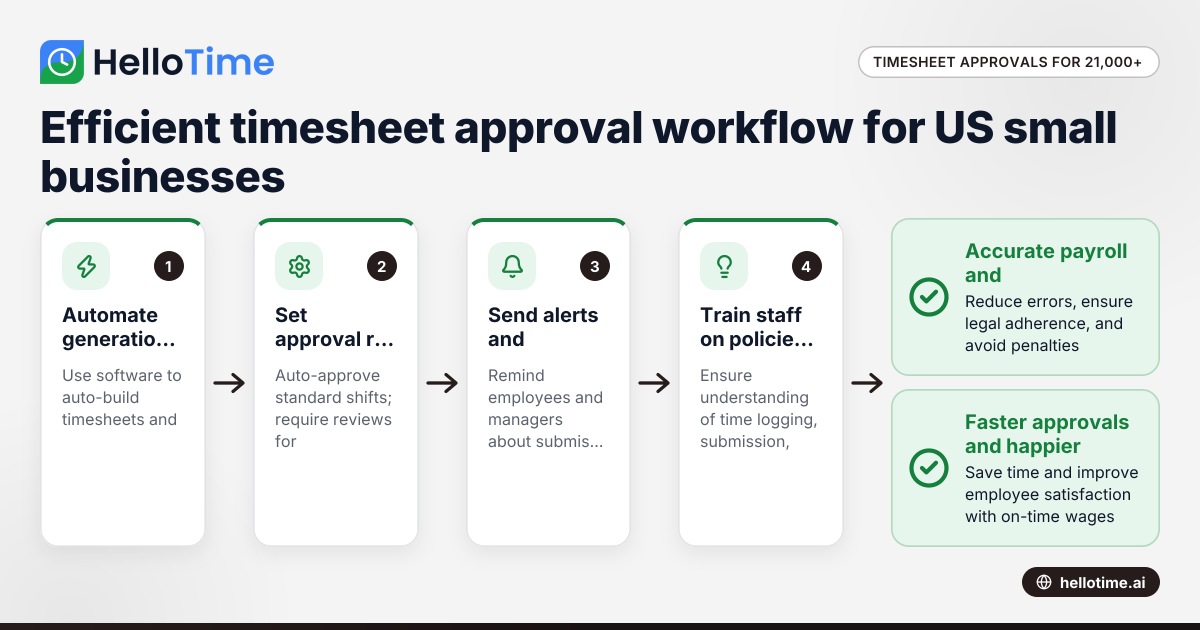
1. Automate timesheet generation and approval
Manual entry and approvals can lead to errors and delays. Use time tracking software that automatically builds timesheets from clock-in and clock-out data. Automation allows bulk approvals, flags irregularities, and reduces paperwork.
2. Implement approval rules and delegation
Set clear rules to auto-approve standard shifts and require managerial approval only for exceptions such as overtime, missing clock-outs, or unusual hours. If your business has multiple teams or departments, delegate approval authority to designated supervisors to avoid bottlenecks.
3. Use alerts and notifications
Set automated reminders for employees to submit timesheets on time and for managers to complete approvals promptly. These notifications help keep the process on track and reduce late submissions.
4. Train employees and managers
Ensure everyone understands time logging policies, deadlines, and the approval process. Clear communication reduces mistakes and incomplete submissions.
5. Regularly audit and review timesheets
Spot-check approvals to ensure compliance with labor laws like the Fair Labor Standards Act (FLSA), including overtime and break policies. Performing audits helps identify recurring issues and improve the workflow.
What does "ai 21000 minutes" mean in the context of timesheet approval?
The phrase "ai 21000 minutes" refers to leveraging artificial intelligence (AI) tools to manage and analyze 21,000 or more minutes of tracked employee time efficiently. AI-powered time tracking software can:
- Automatically verify clock-in and clock-out data.
- Detect overlapping shifts, missed punches, or suspicious entries.
- Flag anomalies such as excessive overtime or unusually short breaks.
- Generate insights about workforce trends for managers.
- Help route timesheets for approval based on predefined rules.
This capability is especially helpful for small businesses managing complex schedules, shift changes, or flex-time arrangements, where manual review of tens of thousands of minutes becomes overwhelming. By automating error detection and prioritizing exceptions, AI reduces the administrative burden and improves the accuracy of payroll processing.
How to set up a timesheet approval workflow for a US small business logging over 21,000 minutes?
Setting up an efficient approval process involves clear steps:
Select an automated time tracking software Choose a platform with one-click time capture, auto-built timesheets, and approval workflows. It should support batch approvals and provide visibility into pending submissions.
Define company policies Write detailed policies on timesheet submission deadlines, acceptable work hours, overtime rules, break requirements, and correction procedures. Include state-specific labor law considerations.
Train all staff Conduct training on how employees record time and how managers review and approve timesheets. Emphasize the importance of timely submissions and compliance.
Set up multi-level approval if needed For client-facing teams or projects that bill hours to customers, configure tiered approval processes (e.g., employee > supervisor > client billing manager).
Configure alerts and reminders Automate notifications for pending approvals, late timesheet entries, and exceptions requiring manual review.
Regularly audit timesheets Schedule monthly or quarterly spot audits to ensure adherence to labor laws, correct overtime calculations, and accurate break recording.
Integrate approval system with payroll and invoicing Connect your timesheet approval platform to payroll solutions like QuickBooks or payment gateways like Stripe to streamline wage and invoicing accuracy.
Worked example
Imagine a Chicago-based marketing agency with 15 hourly employees. Each employee logs approximately 38 hours per week, amounting to over 21,000 minutes biweekly. They use automated software that builds timesheets from GPS-enabled clock-ins.
- The system auto-approves shifts under 40 hours.
- Overtime or missing clock-outs are flagged for supervisor review.
- Managers receive email alerts every Friday to approve timesheets for payroll processing the following week.
- Late entries trigger reminders to staff.
- Approved data flows directly into QuickBooks for payroll.
This workflow minimizes errors, reduces manual effort, and ensures on-time payroll aligned with compliance.
Why are timesheet approvals important for compliance and payroll accuracy in the US?
Timesheet approvals indicate that recorded work hours have been reviewed and found accurate and lawful, helping prevent payroll errors and legal penalties.
The US Department of Labor enforces standards under the Fair Labor Standards Act (FLSA) that mandate employers keep precise records of hours worked, including overtime and breaks. Many states impose stricter rules, for example, California requiring paid rest breaks and stringent meal period enforcement.
Approving timesheets confirms:
- Overtime is paid correctly at 1.5x or 2x rates as applicable.
- Unpaid breaks are properly deducted.
- Recorded hours match authorized work schedules.
- Employees are not underpaid or overpaid, reducing disputes.
For a business in Detroit or Houston, following these rules protects against costly labor law claims and ensures trust with staff.
What challenges do US small businesses face with manual timesheet approvals when logging 21,000+ minutes?
Managing large timesheet volumes on paper or spreadsheets introduces these problems:
- Time consumption: Managers spend hours cross-checking numerous entries.
- Human errors: Misreads or typos cause incorrect payments.
- Lost or damaged records: Paper timesheets can get lost or altered.
- Lack of real-time visibility: No immediate updates on missing punches or overtime.
- Slower payroll: Manual processes delay wage calculation and payment.
- Compliance risk: Harder to verify breaks and overtime against laws, risking violations.
Each of these issues can hurt employee satisfaction and business cash flow by complicating payroll.
How does automating timesheet approvals save time and reduce errors?
Automated systems streamline the entire workflow:
- Auto-collect timesheets: Clock-in/out data populates timesheets instantly.
- Flag anomalies: Missing punches, overlapping shifts, and overtime are highlighted.
- Batch approvals: Managers approve multiple timesheets efficiently with one click.
- Audit trails: Every change and approval is logged for accountability.
- Mobile access: Managers and employees can review and approve timesheets on the go.
- Employee self-service: Staff can submit, correct, and track submissions, reducing back-and-forth.
This reduces administrative workload and ensures consistent, error-free payroll processing, even with large logged minutes.
Can AI-powered time tracking and approvals improve project profitability for billable-hours businesses?
Absolutely. Agencies, legal firms, or consultancies billing by the hour rely on precise timesheets for invoicing. AI-supported approvals help by:
- Accelerating timesheet review and approval cycles.
- Reducing disputes with transparent, accurate time records.
- Providing real-time reports on labor costs and billed hours.
- Detecting errors such as double booking or excessive non-billable time.
- Helping identify profitable projects through timely data.
This enhanced control over billable hours boosts cash flow and client trust.
What steps should a US business follow to handle break and lunch times in timesheets during approvals?
Managing legally compliant breaks is crucial:
Set break policies aligned with state laws For example, California mandates a 30-minute unpaid meal break for shifts over 5 hours.
Use software that records breaks accurately Configure automatic clock-out/in for unpaid breaks or require manual input.
Require employees to include breaks in timesheets Employees should submit timesheets that reflect break deductions.
Train managers to verify breaks during approval Managers should review flagged or missing break periods before approving.
Set system alerts for insufficient breaks The system should notify managers of potential violations.
Double-check compliance regularly Ensure adherence to the Fair Labor Standards Act and any applicable state rules.
Failing to track breaks properly risks penalties and possible wage claims.
How does HelloTime support handling large-scale timesheet approval workflows?
HelloTime offers a robust workforce management platform tailored for US small businesses managing extensive employee time logs:
- One-click time tracking with GPS and kiosk clock-ins.
- Auto-built timesheets from raw data that enable easy review.
- Streamlined batch approval workflows minimizing manager effort.
- Automated alerts and reminders for pending timesheets and approvals.
- Exception reports flagging overnight shifts, overtime, or missing punches.
- Configurable multi-level approvals for complex billing scenarios.
- Clear audit trails to meet compliance and transparency needs.
This combination helps businesses efficiently process over 21,000 minutes of employee time, improving payroll accuracy and workforce visibility.
To discover how HelloTime can transform timesheet approvals in your business, explore our features or compare plans on pricing.
Frequently asked questions
How often should timesheets be approved in small businesses?
Timesheets should ideally be approved at least once per pay period, which for most US businesses is weekly or biweekly. Timely approvals ensure accurate and punctual wage payments, helping maintain compliance and employee satisfaction.
What labor laws affect timesheet approvals in the United States?
The Fair Labor Standards Act (FLSA) governs key aspects including minimum wage, overtime pay, recordkeeping, and break requirements. Many states have additional labor laws affecting breaks and permissible work hours, so approvals must consider both federal and state regulations.
Can timesheet approval workflows integrate with payroll software?
Yes. Many digital time tracking platforms, including HelloTime, integrate natively with popular payroll and accounting software like QuickBooks and Stripe. This integration eliminates duplicate data entry and streamlines payroll and invoicing processes.
What if employees forget to log hours before approval deadlines?
Automated reminders can prompt employees to submit timesheets promptly. Managers can review and make amendments when necessary, but having clear submission deadlines and policies helps minimize late entries and disruptions.
Are digital timesheets secure and compliant?
Digital systems typically provide secure data storage with encryption and audit trails, plus role-based access controls. This enhances compliance by protecting sensitive employee data and providing verifiable records compared to paper-based systems.
How can I handle exceptions in timesheet approvals?
Set your software to automatically flag exceptions, such as missing clock-outs, excessive overtime, or overlapping shifts. These are routed for manual review before approval to ensure accurate wage calculations and compliance.
Efficient timesheet approval processes are vital for US small businesses managing large logged hours. By leveraging automation, clear policies, and AI assistance, you can reduce errors, speed payroll, and stay compliant. HelloTime’s comprehensive features make these workflows easier and more reliable.
Explore our features or compare plans on pricing to see how we can help your business thrive.
Read next
This article covers one part of a bigger topic. For the complete picture, read our guide to 21 000.
Keep reading
Related articles
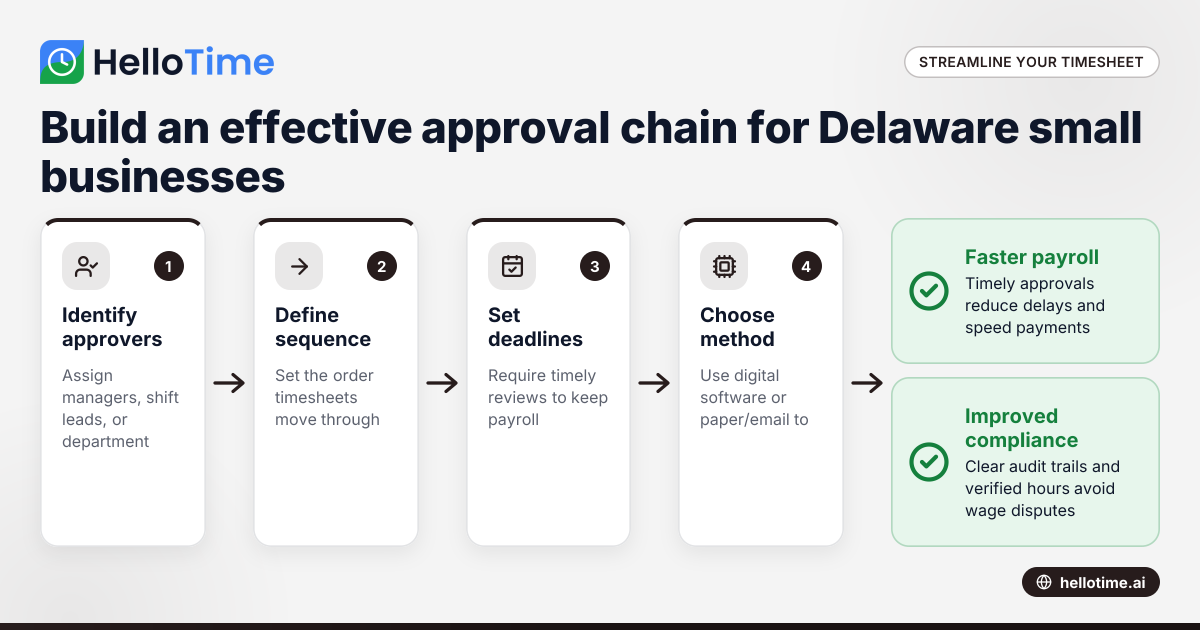
How Delaware Small Businesses Can Streamline Timesheet Approval with Effective Approval Chains in the United States
How Delaware Small Businesses Can Streamline Timesheet Approval with Effective Approval Chains in the United States Delaware small businesses can.
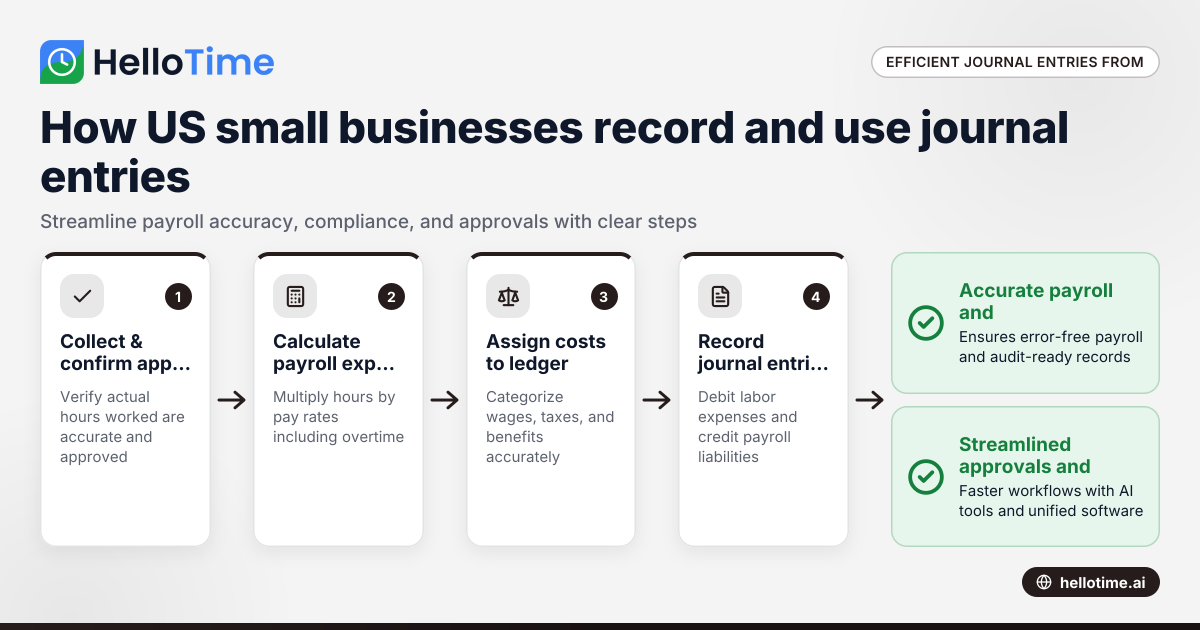
How United States Small Businesses Can Record and Use Journal Entries for Accurate Timesheet Approvals
Accurate timesheet approvals and linked journal entries are vital for US small businesses to ensure payroll accuracy, compliance with labor laws, and.
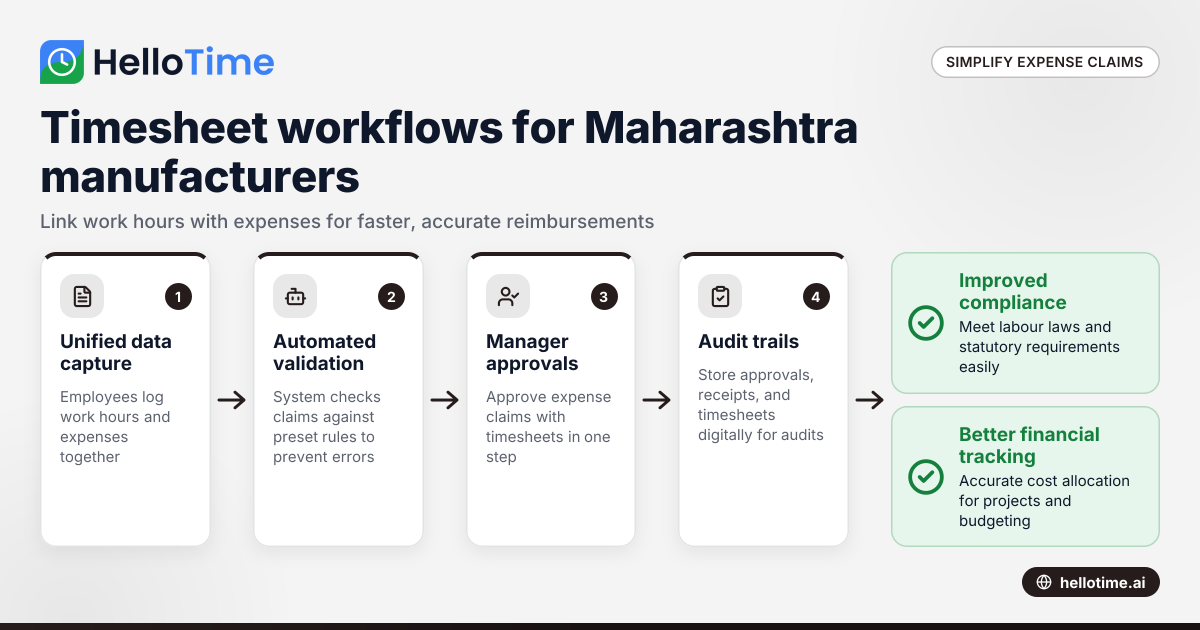
How Manufacturers in Maharashtra Can Simplify Expense Claims with Timesheet Approval Workflows
Expense claims can be complicated for manufacturers in Maharashtra, but streamlining them through timesheet approval workflows can ease the process.