Overtime Calculation Rules in United States: How Small Businesses Can Calculate OT from Timesheets and Scheduled Hours
Overtime calculation rules in United States usually start with one simple rule: many nonexempt employees must receive overtime pay at 1.5 times their.
The HelloTime team
12 min read
On this page
Overtime calculation rules in United States usually start with one simple rule: many nonexempt employees must receive overtime pay at 1.5 times their regular rate for hours worked over 40 in a workweek under federal law. For small businesses, the hard part is not the math alone. It is turning messy timesheets, edits, missed punches, and scheduled hours into a clean weekly overtime calculation you can trust.
Key takeaways
- In United States, overtime is often based on hours actually worked in a defined workweek, not just the schedule.
- Federal law commonly requires 1.5 times the regular rate after 40 hours in a workweek for covered nonexempt employees.
- Paid time off, holidays, and other non-worked hours do not always count toward federal overtime thresholds.
- The regular rate can include more than base hourly pay, such as certain nondiscretionary bonuses.
- Small businesses need a clear process for timesheets, approvals, edits, and workweek cutoffs to calculate overtime correctly.
- Software can reduce errors by comparing scheduled hours, clocked time, and approved timesheets before payroll runs.
What are overtime calculation rules in United States?
In United States, overtime calculation rules usually mean you must identify which workers are eligible for overtime, define the workweek correctly, total all hours actually worked in that week, and pay the required premium when hours cross the threshold.
That is the short version. In practice, small businesses run into problems because labor rules depend on facts. Job duties matter. Pay methods matter. State rules may add stricter requirements than federal law. This is general information, not legal or tax advice.
At the federal level, the Fair Labor Standards Act, or FLSA, is the starting point for many employers. For many nonexempt employees, overtime is due after 40 hours worked in a workweek. A workweek is a fixed and regularly recurring period of 168 hours, or seven consecutive 24-hour periods. It does not need to match the calendar week, but it should be consistently defined.
For a business owner, this means overtime is not just “anything above the schedule.” It is also not always “anything above eight hours in a day” under federal law. Your team might schedule someone for 38 hours and still end up owing overtime if they stay late, cover a shift, or work through unpaid meal periods. Another employee might be scheduled for 45 hours but use five hours of paid leave, which may not count as hours worked for federal overtime.
How do you calculate overtime from timesheets and scheduled hours?
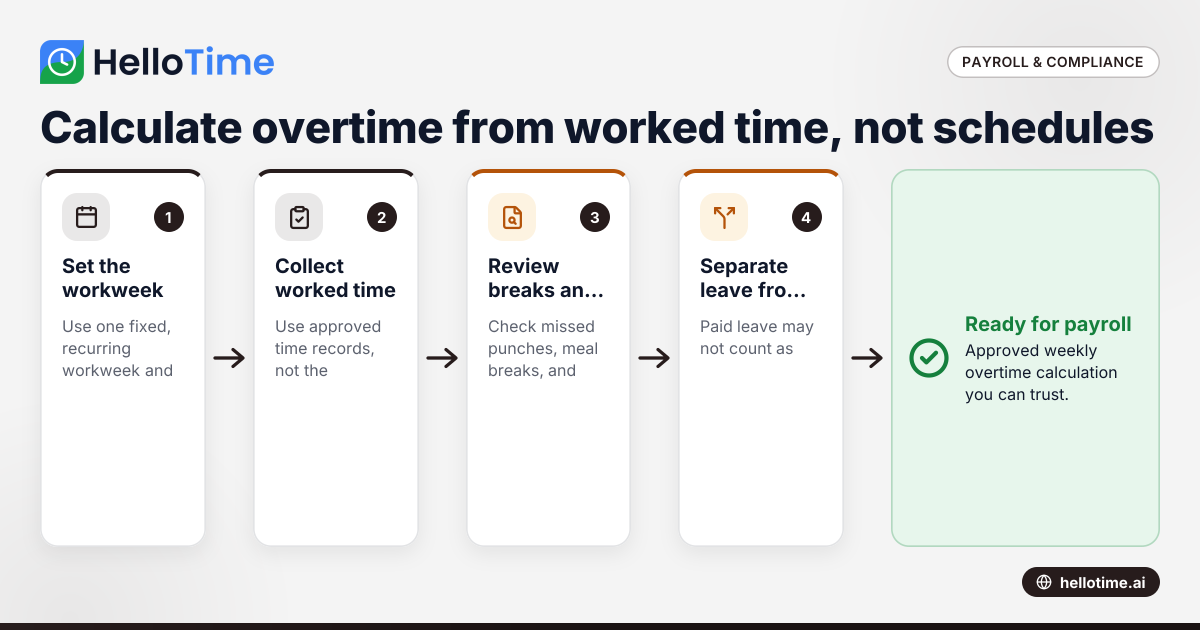
Use scheduled hours as a planning tool and timesheets as the payroll source. Overtime is usually based on hours actually worked in the workweek, after you review edits, unpaid breaks, and any state-specific rules that may be stricter than federal law.
Start with the approved time records, not the posted schedule. Schedules help managers predict labor costs. Timesheets show what happened. If your business relies on handwritten notes, texts, or verbal approvals, overtime errors become much more likely.
A simple weekly process looks like this:
Set your workweek clearly Example: Monday 12:00 a.m. through Sunday 11:59 p.m. Use one fixed workweek for each employee group unless you have a valid reason to separate groups.
Collect all hours actually worked Pull in clock-ins, clock-outs, manual entries, travel time if compensable, and any work done before or after shifts.
Review meal breaks and edits Confirm unpaid meal periods were actually uninterrupted. If an employee worked through lunch, that time may count.
Exclude non-worked paid time when appropriate Paid holidays, PTO, and sick time may be paid hours but not hours worked for federal overtime purposes. Check state rules and your policy.
Total weekly worked hours Add all compensable worked hours in the workweek.
Identify overtime hours Under federal law, overtime hours are generally hours over 40 in that workweek for covered nonexempt employees.
Calculate the regular rate This may be the hourly rate, but it can also require including certain nondiscretionary bonuses or shift differentials.
Apply the overtime premium Overtime is often paid at 1.5 times the regular rate for overtime hours.
If you use scheduling software, compare the published roster with the final approved timesheet. That helps managers spot early clock-ins, late clock-outs, and extra call-ins before payroll is processed.
Why can’t you use scheduled hours alone?
No. Scheduled hours help you forecast labor, but overtime is usually based on hours actually worked. If an employee works outside the posted schedule, those extra worked hours can still count toward overtime, even if the time was not preapproved.
This distinction matters in restaurants, retail, field service, and manufacturing. A manager in Houston may schedule a warehouse associate for 40 hours exactly. But if that person arrives 15 minutes early three days in a row and stays 20 minutes late on Friday, the scheduled total is no longer the payroll total.
Using only scheduled hours creates four common problems:
1. You miss unauthorized but worked time
If the employee performed work, that time may still be compensable. You can discipline policy violations separately, but payroll still needs to reflect worked time.
2. You overlook work between locations or tasks
Field teams often move between job sites, pick up supplies, or answer calls after hours. Some of that time can count as worked time depending on the facts.
3. You overcount paid leave as overtime-triggering time
A schedule may show 48 paid hours in a week because of a holiday plus four shifts. That does not automatically mean eight overtime hours under federal law.
4. You ignore edits that affect the regular rate
Shift premiums, nondiscretionary bonuses, or corrected rates can change the regular rate used in the overtime calculation.
The safest workflow is to use schedules for planning and approved timesheets for pay. A system with attendance, approvals, and scheduling in one place can make this much easier. If you want to see what that looks like, you can review features.
What counts as hours worked for overtime?
Hours worked usually include all time an employee is required or allowed to work for your business. That can include approved shift time, some short breaks, and work done before or after a shift if the employer knows or should know about it.
This is where many small businesses make avoidable mistakes. The timesheet may show only the official shift. The real workday may be longer.
Examples that often need review include:
- Opening or closing tasks done off the clock
- Time spent logging into systems before a shift
- Work calls or messages answered after hours
- Short rest breaks
- Required on-site waiting time
- Rework or cleanup after the shift end
- Travel during the workday between job locations
By contrast, some paid hours are not always “hours worked” for federal overtime purposes. Examples may include:
- Paid vacation
- Paid sick leave
- Paid holidays
- Other paid but non-worked leave
This is one reason overtime disputes happen. A payroll summary might show 44 paid hours. But only 39 of those may be hours worked under the federal rule. Or the reverse may happen. A timesheet might miss six short pre-shift tasks that push the employee over 40 worked hours.
How do you find the regular rate of pay?
The regular rate is the basis for overtime pay, and it is not always the same as the base hourly wage. For many employees, you must include compensation such as certain nondiscretionary bonuses and shift differentials when calculating overtime.
For example, imagine a Chicago service company pays an employee:
- Base rate: $20.00 per hour
- Weekly hours worked: 46
- Nondiscretionary attendance bonus: $60.00 for the week
A simplified approach would be:
- Straight-time earnings for 46 hours: 46 × $20.00 = $920.00
- Add bonus: $920.00 + $60.00 = $980.00
- Regular rate: $980.00 ÷ 46 = about $21.30
- Overtime premium due for 6 overtime hours: 0.5 × $21.30 × 6 = about $63.90, if straight time for those hours has already been included
The details can vary based on how pay is structured. Salaried nonexempt workers, multiple pay rates, and bonus programs add complexity fast. If your team uses different rates across jobs or locations, review your setup carefully.
This is also where ai overtime calculation tools can help. They can flag timesheets where bonuses, premiums, or multiple rates may change the regular rate. That does not replace legal review, but it can reduce missed calculations before payroll.
Step-by-step overtime calculation example for a small business
Let’s use a simple example from a Detroit machine shop.
Employee details:
- Nonexempt hourly employee
- Workweek: Sunday through Saturday
- Base pay: $22.00 per hour
- Scheduled hours: 40
- Actual worked hours from approved timesheet: 43.5
- Paid holiday in the same week: 8 hours, not worked
Example 1: Scheduled hours versus worked hours
The schedule showed 40 hours. The payroll week showed:
- 43.5 hours actually worked
- 8 paid holiday hours
For federal overtime purposes, the holiday hours may not count as hours worked. So the overtime review starts with 43.5 worked hours, not 51.5 paid hours.
Example 2: Overtime calculation
- Total worked hours: 43.5
- Overtime hours over 40: 3.5
- Straight-time pay for 43.5 hours: 43.5 × $22.00 = $957.00
- Overtime premium for 3.5 hours: 0.5 × $22.00 × 3.5 = $38.50 if straight time is already included
- Total due for worked hours: $995.50
- Add holiday pay separately according to company policy
This example is intentionally simple. Once bonuses, different rates, or state daily overtime rules enter the picture, you need a more detailed review.
Common overtime mistakes small businesses make
Most overtime errors do not come from bad intent. They come from weak process, scattered records, and assumptions.
Treating salaried employees as automatically exempt
Being paid a salary alone does not automatically remove overtime obligations. Exemption depends on more than the pay method. Duties and salary thresholds matter.
Using the pay period instead of the workweek
Biweekly payroll is common. Overtime under federal law is usually based on each workweek inside that pay period, not the two-week total.
Example: Week 1: 46 hours Week 2: 34 hours
That is still 6 overtime hours in Week 1, even though the pay period total is 80 hours.
Rounding carelessly
Time rounding can create risk if it consistently favors the employer or hides real worked time. Review rounding practices regularly.
Ignoring off-the-clock work
If supervisors know employees answer emails, prep equipment, or clean up after shifts, that time may need to be paid.
Failing to reconcile schedule changes
Shift swaps, call-ins, and missed breaks often happen outside the original schedule. If managers approve them informally, payroll still needs the final worked record.
How can software help with overtime calculation rules in United States?
Software helps by centralizing schedules, clocked time, edits, approvals, and weekly totals in one workflow. That makes it easier to catch overtime risk before payroll, not after an employee complaint or audit.
A practical setup should help you:
- Define workweeks clearly
- Track actual clock-ins and clock-outs
- Compare schedules against worked time
- Review missed punches and manual edits
- Flag weekly hour thresholds
- Route timesheets for manager approval
- Keep records for payroll and compliance review
For shift-based teams, GPS clock-in, geofenced attendance, and kiosk options can reduce buddy punching and location disputes. For office and service teams, one-click time tracking and auto-built timesheets can reduce manual spreadsheets.
HelloTime is designed for these workflows. If you operate in the United States and want a simple view of the product, see HelloTime in the US. The biggest benefit is not just speed. It is having one approved source of time data before you calculate pay.
Building a reliable overtime process from timesheets and schedules
A better overtime process does not need to be complicated. It needs to be consistent.
1. Define one workweek for each employee group
Write it down in your policy and train managers on it.
2. Use schedules for labor planning only
Do not assume the schedule equals payable time.
3. Capture actual worked time daily
The longer you wait, the more edits and disputes appear.
4. Require manager review before payroll
Managers should confirm missed breaks, extra shifts, and off-schedule work.
5. Separate paid leave from worked time
Both matter, but they are not always treated the same for overtime.
6. Review bonuses and premiums before finalizing pay
Any pay element tied to production, attendance, or performance may affect the regular rate.
7. Keep records organized
If an employee questions pay three months later, you need the schedule, timesheet, edits, and approval history.
When should a small business get professional advice?
Get professional advice when your workforce has mixed pay structures, employees working in multiple states, unclear exemption status, or frequent bonuses and rate changes. Those facts can change how overtime is calculated and increase compliance risk.
Examples include:
- Salaried nonexempt employees
- Employees paid at two or more hourly rates
- Team members who travel often
- Roles with commissions or production bonuses
- Operations in states with stricter overtime rules than federal law
- Businesses facing a wage claim or audit
A short review with qualified counsel or an experienced payroll advisor can prevent long and expensive cleanup later.
Frequently asked questions
Is overtime always required after 40 hours in a week?
For many nonexempt employees under federal law, yes. But exemption status and state law can change the answer. Review each role carefully instead of applying one rule to everyone.
Do paid holidays count toward overtime in United States?
Not always under federal law. Paid holiday hours may be paid time but not hours worked for the 40-hour overtime threshold. State law or company policy may affect how you handle the week.
Can I average two weeks together to avoid overtime?
Usually no for federal overtime purposes. Each workweek generally stands on its own, even if payroll is processed every two weeks. A 46-hour week still creates overtime even if the next week is shorter.
What if an employee worked overtime without approval?
If the employee actually worked the time, it may still need to be paid. You can enforce your overtime approval policy through discipline, but not by withholding wages for compensable time worked.
Can software fully automate overtime compliance?
Software can make time capture, approvals, and calculations much more reliable. But legal compliance still depends on correct setup, job classification, and state-specific rules. Human review is still important.
If you want to replace spreadsheets with cleaner time records, scheduling, and approvals, explore HelloTime’s pricing or browse the full features to see if it fits your team.
Keep reading
Related articles
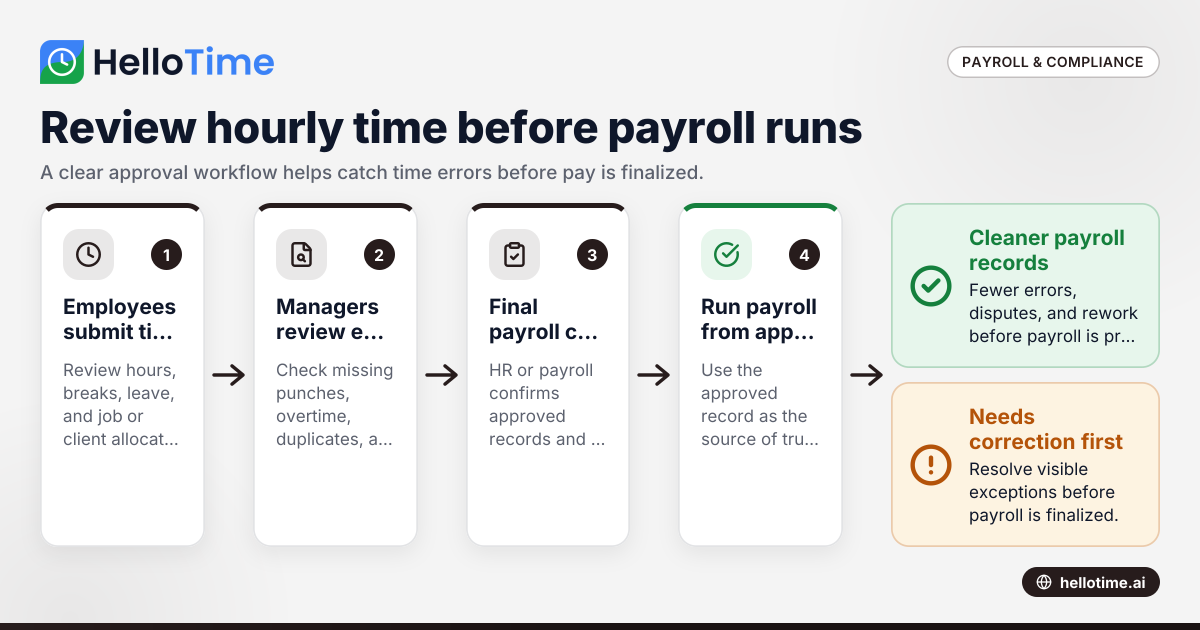
Payroll Timesheet Approval for Small Businesses in United States: How to Review Hourly Pay Before You Run Payroll
Payroll timesheet approval in United States small businesses is the process of reviewing employee hours before payroll is finalized. It helps you.
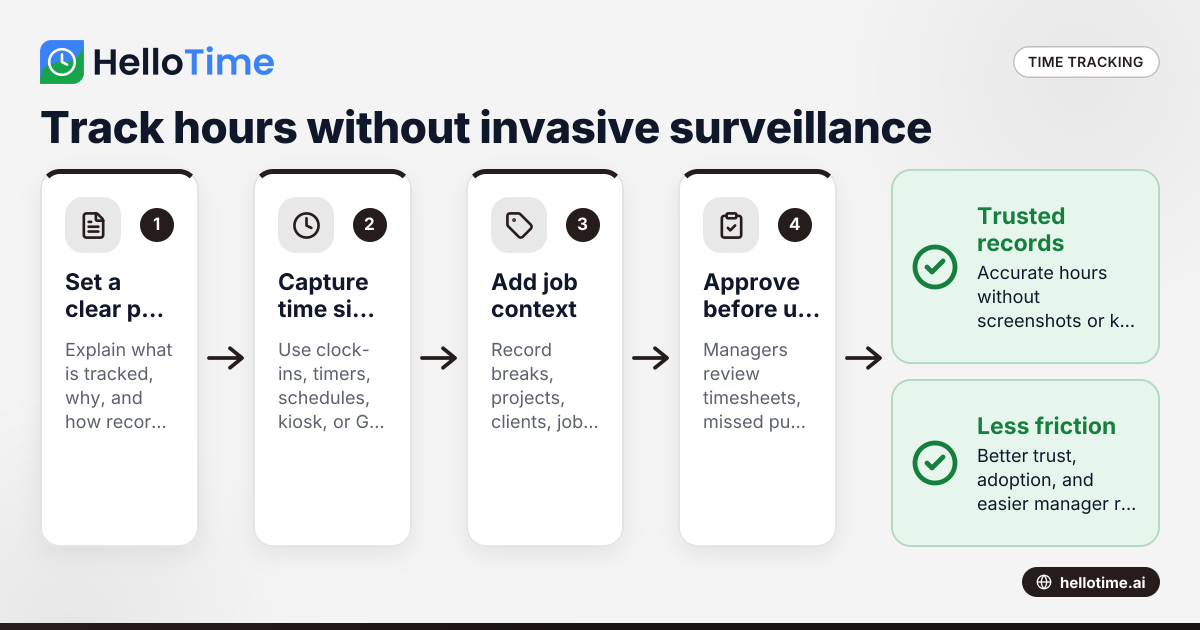
User Monitoring Alternatives in Time Tracking Software in the United States: How Small Businesses Can Track Hours Without Invasive Surveillance
If you are looking for user monitoring time tracking software in the United States , there is a better option than screenshots, keystroke logs, and.
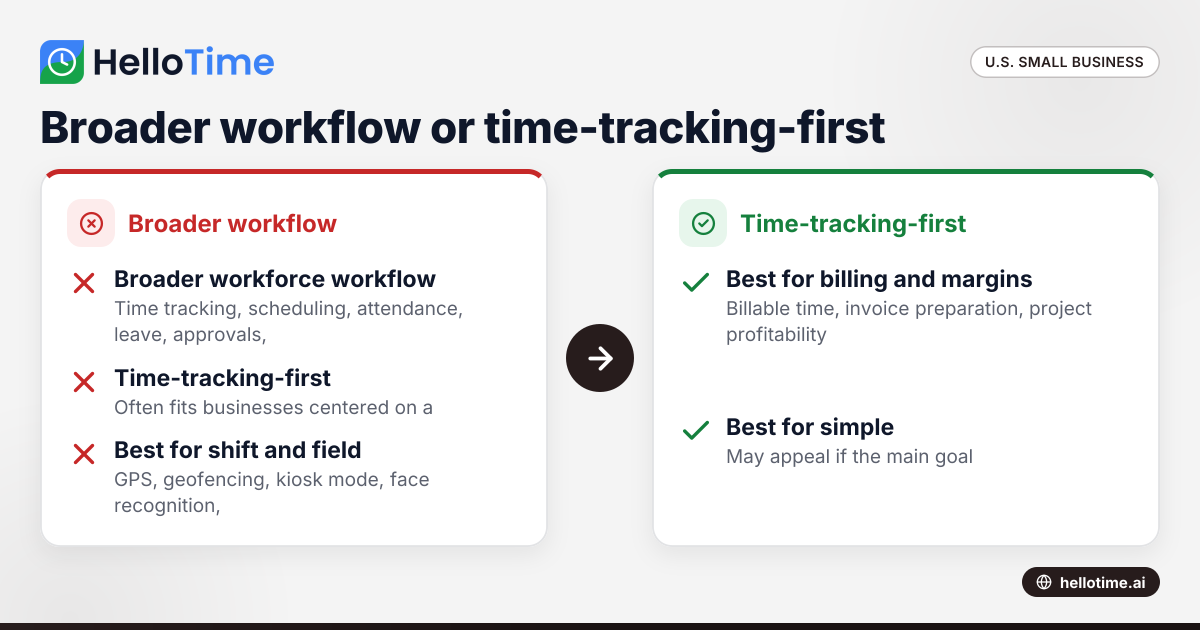
HelloTime vs QuickBooks Time in the United States: Which Is Better for Small Business Time Tracking, Scheduling, and Attendance?
If you are comparing HelloTime vs QuickBooks Time in the United States, the better fit depends on how your team works day to day. HelloTime is.