Weighted Average Overtime in United States: How Small Businesses Can Calculate OT Correctly When Employees Work at Two Pay Rates
Weighted average overtime in United States means you calculate overtime from an employee’s regular rate for the week, not by simply using one job rate
The HelloTime team
12 min read
On this page
Weighted average overtime in United States means you calculate overtime from an employee’s regular rate for the week, not by simply using one job rate at random. When a nonexempt employee works at two or more hourly rates in the same workweek, the regular rate is usually a weighted average based on total straight-time earnings divided by total hours worked.
Key takeaways
- In the United States, overtime for employees who work at two pay rates is often based on a weighted average regular rate.
- The basic formula is total straight-time earnings divided by total hours worked in the workweek.
- Overtime premium is usually an extra 0.5 times the regular rate for overtime hours if straight-time for all hours was already paid.
- The workweek is the unit that matters. You do not average rates across two different workweeks.
- Good time records matter. Small errors in hours, rates, or job codes can create underpayments.
- This article is general information, not legal or tax advice. Federal and state wage rules can differ.
What is weighted average overtime calculation in United States?
Weighted average overtime calculation in United States is the common method used when a nonexempt employee works at different hourly rates during one workweek. You add up the employee’s straight-time earnings from all rates, divide that amount by total hours worked, and use the result as the regular rate for overtime.
This issue comes up often in small businesses. A worker may spend part of the week on front-desk coverage at $18 per hour and part on warehouse work at $22 per hour. A field technician in Houston may do shop work at one rate and emergency callouts at another. A restaurant employee in Chicago may split time between host shifts and training shifts with different hourly rates.
If that employee works more than 40 hours in the workweek under federal law, you usually do not pick one rate and apply it to every overtime hour. Instead, you calculate the regular rate for that week based on all eligible earnings and all hours worked.
The key point is simple. Overtime follows the workweek. It does not follow whichever rate feels easiest to use.
When does this issue come up for small businesses?
Small businesses run into this problem more often than they expect. It appears anywhere employees wear more than one hat.
Common examples include:
- Retail staff who work sales floor shifts and stockroom shifts at different rates
- Hospitality teams who work banquets, setup, and maintenance at different rates
- Construction crews where shop hours and site hours have separate rates
- Manufacturing workers who rotate between machine operation and quality checks
- Agencies where nonexempt production staff work standard and specialized assignments
- Field service teams who have regular route work and after-hours work at different base rates
It also comes up when managers change rates midweek. For example, an employee in Detroit works Monday through Wednesday at $20 per hour, then gets moved to a temporary role at $24 per hour for Thursday and Friday. If total weekly hours go over 40, the overtime calculation needs to reflect both rates.
This is where spreadsheets become risky. One missing line item or one wrong job code can change the regular rate and the overtime amount.
How do you calculate weighted average overtime in United States?
Add total straight-time earnings for the week, divide by total hours worked to get the regular rate, then pay the extra overtime premium on hours over 40. If straight time for all hours was already paid, the extra premium is usually 0.5 times the regular rate for each overtime hour.
Here is the standard approach many small businesses use for a weighted average overtime calculation United States scenario.
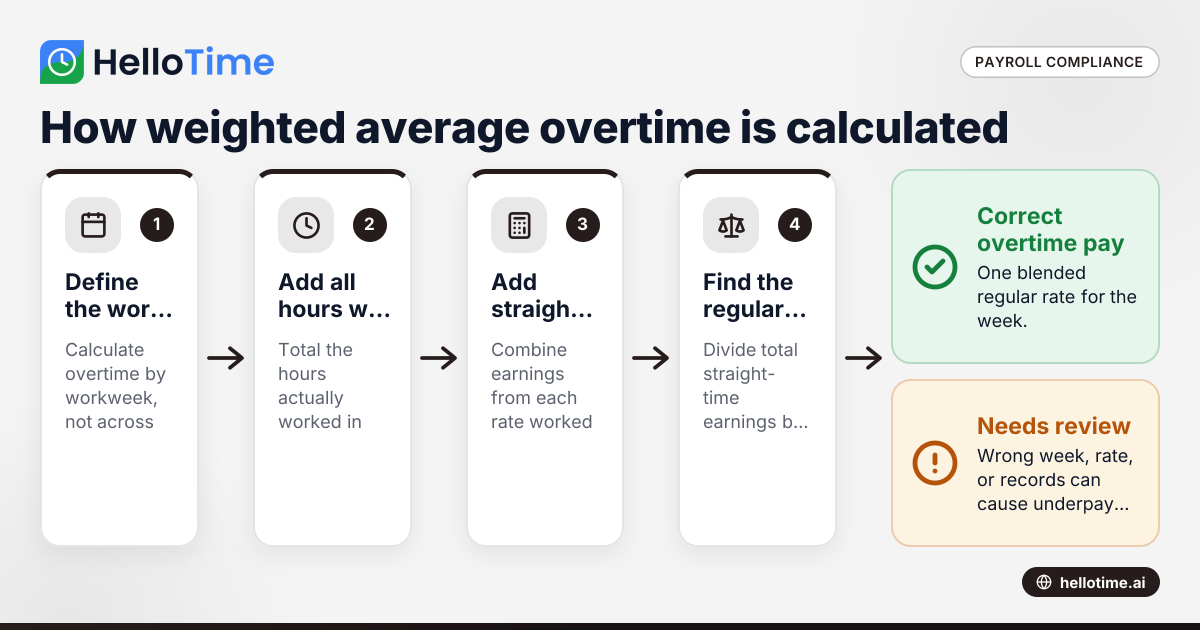
Step 1: Define the workweek
Start with the employee’s fixed workweek. Under federal wage rules, overtime is generally measured by the workweek, not by the pay period. A biweekly paycheck can include two separate overtime calculations, one for each week.
Do not combine hours from two different workweeks.
Step 2: Add all hours worked in that workweek
Include all hours the employee actually worked. If the employee worked 28 hours in one role and 18 hours in another role, total hours worked are 46.
Step 3: Add straight-time earnings from each rate
Multiply each set of hours by the applicable base hourly rate.
Example:
- 28 hours at $18 = $504
- 18 hours at $22 = $396
Total straight-time earnings = $900
Step 4: Find the regular rate using the weighted average
Divide total straight-time earnings by total hours worked.
- $900 ÷ 46 = $19.57 regular rate
That $19.57 is the weighted average regular rate for the workweek.
Step 5: Calculate overtime hours
Under federal law, overtime is generally hours worked over 40 in the workweek.
- 46 total hours - 40 = 6 overtime hours
Step 6: Calculate the overtime premium
If you already paid straight time for all 46 hours through payroll, then the employee still needs the extra half-time premium for the 6 overtime hours.
- 0.5 × $19.57 = $9.785
- $9.785 × 6 = $58.71
Rounded according to your payroll process, the overtime premium is $58.71.
Step 7: Find total weekly pay
Add the overtime premium to the straight-time earnings already calculated.
- Straight-time earnings: $900
- Overtime premium: $58.71
- Total weekly gross wages: $958.71
That is the full result for this weighted average overtime calculation United States example.
Why can’t you just pay overtime at the higher rate?
Usually, because overtime is based on the regular rate for the week, not whatever rate was worked last. When an employee works at two or more hourly rates in one workweek, the regular rate is often a weighted average of total straight-time earnings over total hours worked.
Some employers assume using the highest rate is always safest. It can be more generous in some cases, but it is not automatically the right legal method for every payroll setup. Others use the last rate worked, which can underpay overtime and create wage risk.
The weighted average method exists because it reflects what the employee actually earned across the week. It is designed to create one blended regular rate for overtime purposes.
There are exceptions and special arrangements in some situations, including certain advance agreements under federal rules. But small businesses should be careful here. If you rely on an alternative method, confirm it is allowed for your workforce and state.
A common mistake: paying 1.5 times only one job rate
Let’s say an employee worked:
- 30 hours at $16
- 15 hours at $24
Total hours = 45
Some employers pay 5 overtime hours at 1.5 times $24 because that was the higher rate. Others use 1.5 times $16 because that was the main role. Both shortcuts can produce the wrong answer.
The better process is to calculate total straight-time earnings first:
- 30 × $16 = $480
- 15 × $24 = $360
- Total = $840
Then calculate the regular rate:
- $840 ÷ 45 = $18.67
Then apply the additional overtime premium:
- 5 overtime hours
- 0.5 × $18.67 × 5 = $46.68
Total weekly pay becomes:
- $840 + $46.68 = $886.68
That is why the blended rate matters.
Which earnings should be included in the regular rate?
Most hourly earnings for work performed are included when calculating the regular rate, but not every type of payment is treated the same way. The exact answer depends on federal and state rules and the nature of the payment.
For many small businesses, the starting point is to include:
- Hourly earnings at each base rate
- Shift differentials
- Nondiscretionary bonuses that must be included in the regular rate
- Some other work-related pay that counts toward regular rate calculations
Be careful with bonuses. A promised production bonus or attendance bonus may need to be included in the regular rate. A truly discretionary bonus may be treated differently. The label alone does not decide the issue.
This is also where payroll data quality matters. If a worker clocks hours to the wrong department, the wrong rate may feed into the regular rate. If managers make off-cycle pay adjustments without documentation, payroll may miss earnings that affect overtime.
What about paid time off?
Paid leave, holidays, and similar non-worked hours are often treated differently from hours actually worked for overtime purposes. In many cases, overtime is based on hours worked, not paid hours. But policies and state rules can add complexity.
If your team uses manual timesheets, separate worked time from non-worked paid time clearly. That makes it easier to compute overtime and to explain payroll later.
Can software help with weighted average overtime?
Yes. Time tracking and payroll software can reduce errors by tying hours, job codes, rates, and approvals together in one workflow. The best setup makes it easy to review the workweek before payroll closes and spot blended-rate overtime automatically.
For a small business, the hardest part is often not the math. It is collecting clean inputs. You need accurate start and stop times, the right role or job assignment, approved edits, and a clear audit trail.
A useful process looks like this:
- Employees clock time against the correct role, shift, or job.
- Supervisors review and approve hours before payroll.
- Rate changes are recorded with effective dates.
- Overtime is calculated by workweek, not by pay period total.
- Payroll reviews exceptions before wages are finalized.
This is where an ai weighted average workflow can help flag weeks where employees worked across multiple rates. The goal is not to replace payroll judgment. The goal is to catch issues early, before underpayments or corrections pile up.
For businesses that still use paper cards or spreadsheets, even basic automation can make a big difference. Time records become easier to audit. Rate histories stay attached to the employee record. Managers spend less time reconstructing who worked where.
If you want to see how this kind of workflow fits into scheduling, attendance, and approvals, you can explore HelloTime’s features.
What records should you keep?
Keep enough records to show how hours, rates, and overtime were calculated for each workweek. If a wage question comes up later, the record is often as important as the calculation.
At a practical level, keep:
- Daily and weekly hours worked
- The workweek start day and time
- The hourly rate tied to each job or task
- Any effective-dated pay changes
- Overtime hours and method used
- Manager approvals and payroll adjustments
- Bonus or differential records that may affect regular rate
For example, if a manufacturing business in Ohio rotates workers between assembly and inspection, payroll should be able to show how many hours were worked in each role and what rate applied during that week. If a field service company in Phoenix changes a technician’s rate midweek, that effective date should be documented.
Clean records also help when buyers or larger customers ask about operational maturity. Many growing businesses now face basic security and process questions from customers, including whether their systems and approvals are organized well enough to support accurate billing and labor records.
A simple checklist for payroll review
Before you run payroll, use a quick review checklist for employees who may have blended rates.
1. Check who worked in more than one role
Look for employees with two job codes, departments, or rates in the same workweek.
2. Confirm the workweek boundaries
Make sure overtime was calculated inside the correct seven-day workweek.
3. Verify all straight-time earnings
Review base pay, differentials, and required bonus amounts that may affect the regular rate.
4. Recalculate regular rate
Use total eligible straight-time earnings divided by total hours worked.
5. Add only the extra overtime premium if straight time is already included
This is a common source of duplicate payments or underpayments.
6. Save the calculation trail
Keep enough detail for payroll, HR, and managers to explain the result later.
Common errors small businesses should avoid
Even simple payroll teams can make mistakes here. The usual problems are operational, not mathematical.
Averaging across the pay period instead of the workweek
A biweekly or semi-monthly pay cycle does not change the need to calculate overtime by workweek.
Using the wrong overtime multiplier
If straight time for all hours is already included, the additional overtime due is often the extra 0.5 of the regular rate, not a fresh 1.5 times the whole amount.
Ignoring bonuses or differentials
Some extra earnings must be included in the regular rate. Review them carefully.
Missing midweek rate changes
If an employee’s rate changes during the week, payroll needs the effective date and the correct split of hours.
Relying on memory instead of records
Supervisors may remember where someone worked, but payroll needs a documented trail.
Should your business use spreadsheets or dedicated software?
Spreadsheets can work for a very small team, but the risk rises quickly once employees move across rates, shifts, and locations. One broken formula can affect wages, job costing, and billable time.
Dedicated software helps when you need to:
- Track time by project, customer, role, or location
- Review approvals before payroll
- Store rate changes cleanly
- Build timesheets from actual clocks
- Compare labor cost against schedules or jobs
That matters for agencies billing by the hour and for shift-based businesses alike. It also helps owners understand labor cost by job instead of only seeing one payroll total after the fact.
HelloTime does not currently offer US payroll, but US businesses can still use it for time tracking, approvals, scheduling, attendance, and the records that make overtime review easier. If you want country-specific product context, see HelloTime in the US.
If you are comparing options for your team size and process needs, review the available plans on the pricing page.
Frequently asked questions
Is weighted average overtime always required when an employee works at two pay rates?
Often, yes, but not always in every possible arrangement. Under federal law, the weighted average regular rate is a common default method when a nonexempt employee works multiple rates in one workweek. Some alternative setups may exist, but they should be reviewed carefully.
Do you calculate weighted average overtime by pay period or by week?
By workweek. Even if you pay employees every two weeks or twice a month, overtime is generally determined separately for each workweek.
Keep reading
Related articles
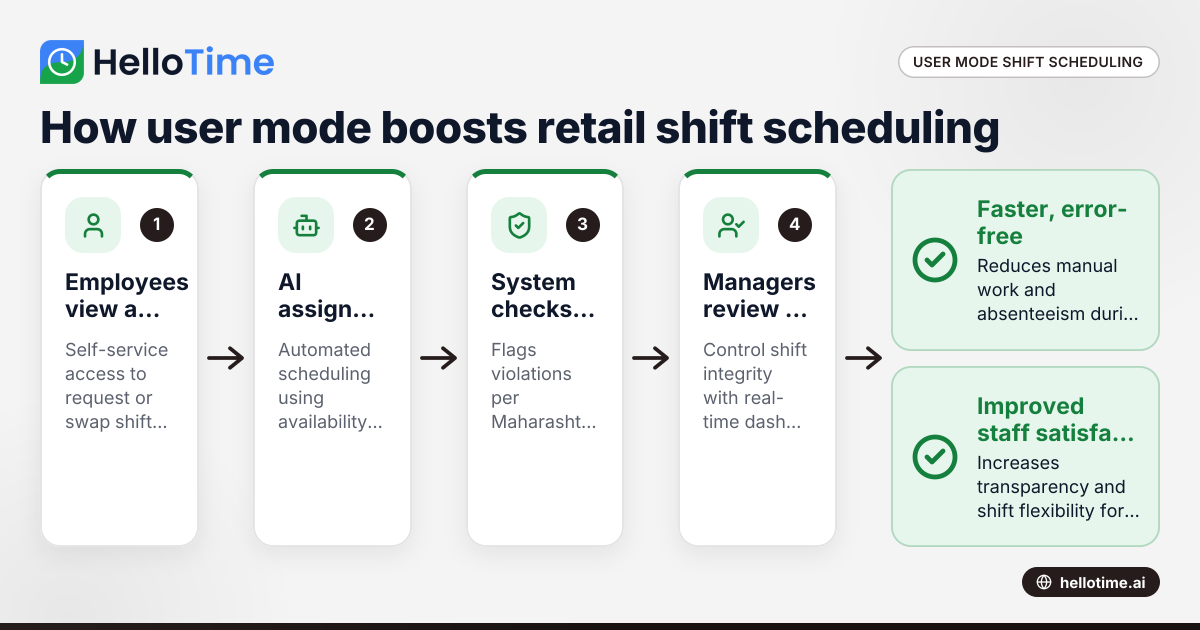
How User Mode Enhances Shift Scheduling Efficiency for Retail Stores in Mumbai, India
User mode shift scheduling in Mumbai retail stores means giving employees controlled access to view, request, or swap shifts themselves, while.
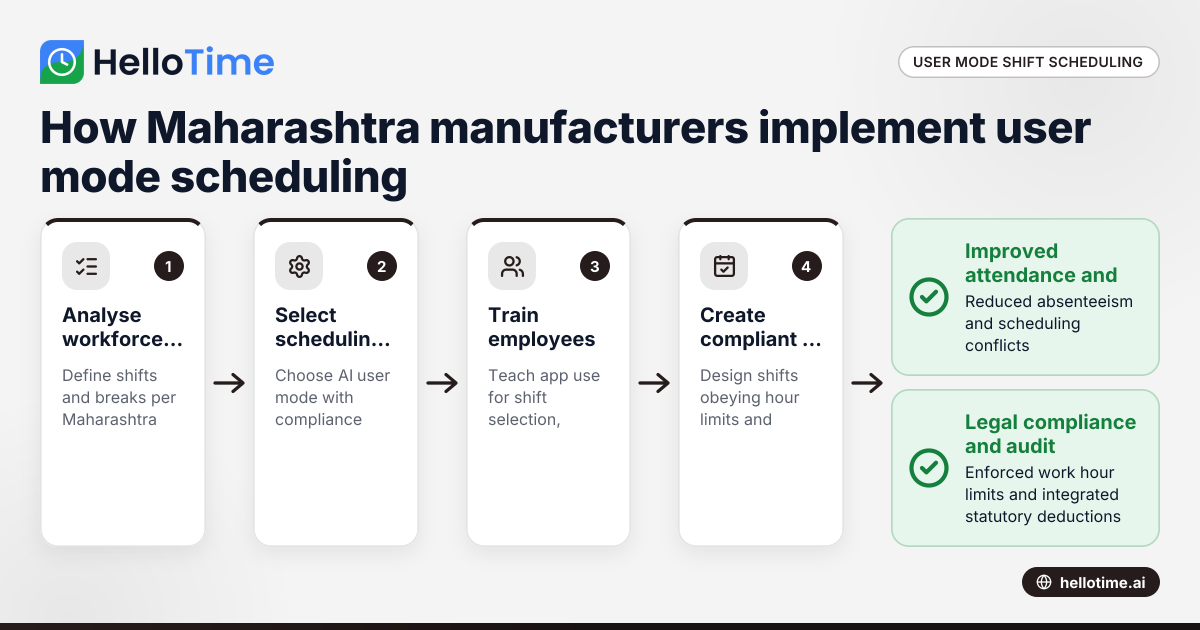
How User Mode Simplifies Shift Scheduling for Manufacturers in Maharashtra, India
User mode shift scheduling lets manufacturers in Maharashtra give workers control to pick or swap shifts via an app. This improves attendance.

How Delaware Small Businesses Can Choose the Best Attendance App to Improve Workforce Management
How Delaware Small Businesses Can Choose the Best Attendance App to Improve Workforce Management Tracking employee attendance is essential for.