HelloTime vs Adapt in the United States for Roster Planning Across Multiple Retail Locations: Which Simplifies Multi-Site Staff Scheduling?
Managing staff schedules effectively across multiple retail locations in the United States requires more than just assigning shifts. It involves.
The HelloTime team
6 min read
On this page
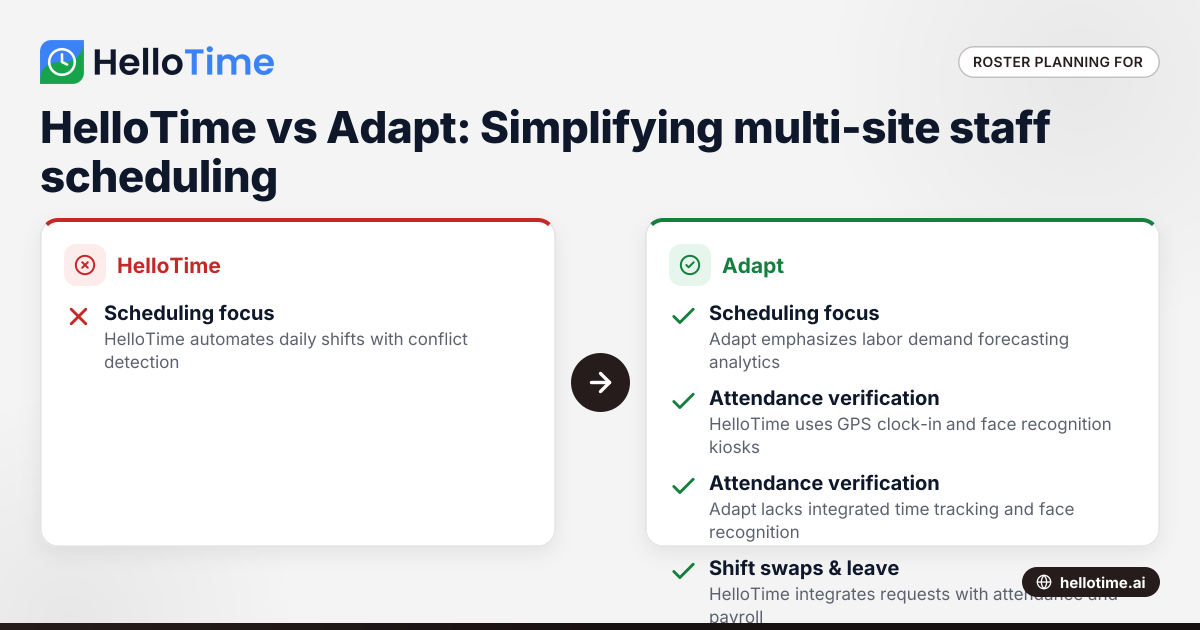
Managing staff schedules effectively across multiple retail locations in the United States requires more than just assigning shifts. It involves balancing customer demand, labor laws, employee preferences, and operational efficiency. Comparing AI HelloTime vs Adapt roster planning United States reveals different strengths: HelloTime emphasizes easy daily scheduling with attendance verification, while Adapt focuses on labor forecasting analytics for strategic planning.
Key takeaways
- HelloTime provides centralized roster planning with GPS clock-in and tablet kiosk attendance, ideal for managing multi-location retail teams.
- Adapt specializes in labor compliance and labor demand forecasting but may not include integrated time tracking and face recognition.
- Both platforms support shift scheduling, but HelloTime adds auto-built timesheets and approvals linked directly to payroll readiness.
- HelloTime’s geofenced clock-in and face recognition attendance help prevent time theft and ensure accurate tracking across stores.
- Adapt’s strength lies in advanced labor forecasting analytics, while HelloTime excels at simplifying daily shift and leave management.
- Your choice depends on whether you prioritize deeper labor demand forecasting or streamlined scheduling with attendance verification.
What is roster planning and why is it important for retail businesses?
Roster planning creates employee schedules that match retail stores’ operational needs, considering shifts, availability, and laws. For U.S. retailers, especially in cities like Chicago or Houston, it ensures proper staffing during busy and slow periods to meet customer demand and control costs.
Roster planning balances labor supply with demand, respecting break laws and accommodating employee preferences. Without it, stores may face poor service from understaffing or wasted wages from overstaffing.
Why roster planning matters in retail
Effective roster planning reduces no-shows, limits overtime costs, and ensures legal compliance. It allows flexibility through shift swaps and manages employee leave efficiently, all contributing to smooth store operations and happier workers.
Example scenario
A retail chain in Detroit manually scheduling stores may miss busy evening rushes, causing understaffing. Automated roster planning uses past sales and staff availability to allocate hours better, avoiding costly mistakes and improving customer satisfaction.
How does AI enhance HelloTime vs Adapt roster planning United States?
AI HelloTime vs Adapt differs primarily in focus. HelloTime’s AI automates daily scheduling, detecting shift conflicts and predicting attendance. Adapt uses AI to forecast labor demand and test what-if staffing scenarios.
HelloTime’s AI makes scheduling fast and accurate, ideal for multi-site U.S. retailers juggling many shifts. Adapt’s AI suits businesses needing detailed labor analytics for strategic workforce control.
How does HelloTime simplify multi-site staff scheduling with attendance verification?
HelloTime centralizes schedules across all locations on one dashboard. Attendance is verified by face recognition kiosks or GPS clock-in on mobile devices, ensuring employees are on-site. Timesheets auto-sync for payroll, minimizing administrative work.
Employees can request shift swaps and leave through HelloTime’s mobile app, with approvals updating schedules and records automatically. This reduces manager workload and errors in multi-location retail scheduling.
Worked example: Scheduling a week for three Chicago stores
- Collect employee availability through the app.
- Import store sales data for demand estimates.
- Generate AI-powered AI HelloTime vs Adapt roster avoiding conflicts.
- Notify employees of shifts via app alerts.
- Track attendance with face recognition kiosks.
- Monitor hours to avoid overtime before next schedule.
This cuts manual scheduling time dramatically while improving accuracy.
What specific labor compliance tools do HelloTime and Adapt provide for U.S. retailers?
HelloTime tracks state-specific overtime and break rules, flags schedule conflicts, and logs all changes for audits. Adapt focuses on enforcing union agreements and complex labor contracts, alongside demand forecasting within legal limits.
Both help avoid costly violations, but retailers should combine software use with expert legal advice due to varied state laws like California’s meal break requirements.
How does the user experience differ between HelloTime and Adapt in daily operations?
HelloTime offers an intuitive interface requiring minimal training, one-click clock-ins, real-time shift updates, and mobile access for employees. It suits busy retail managers needing quick scheduling adjustments.
Adapt’s interface targets HR analysts focusing on long-term labor analytics with a steeper learning curve, which might be challenging for day-to-day shift management.
How do shift swapping and leave management compare between HelloTime and Adapt?
Both platforms support shift swaps and PTO requests, but HelloTime integrates these directly with attendance and payroll, updating schedules automatically. Adapt’s process may need manual reconciliation and lacks integrated attendance verification.
This makes HelloTime more efficient for retailers wanting seamless operational workflows and reduced admin.
What integrations support multi-site retail operations?
HelloTime integrates easily with QuickBooks for payroll and Stripe for invoicing, plus provides project profitability reports tied to labor costs. Adapt connects to manufacturing ERP systems and may require custom setups for retail payroll.
For U.S. retailers prioritizing smooth payroll and financial workflows, HelloTime offers ready-to-use options.
Common pitfalls in multi-location retail scheduling — and how to avoid them
- Ignoring state labor laws—use software supporting custom rules for states like Illinois or Texas.
- Relying on spreadsheets—centralized, real-time dashboards prevent errors.
- Overlooking attendance fraud—geofenced clock-in and face recognition curb buddy punching.
- Poor employee communication—push notifications reduce no-shows.
- Missing demand forecasting—align staffing using sales and foot-traffic data.
Conclusion
Effective roster planning for multi-site U.S. retail businesses requires smart scheduling, attendance verification, and legal compliance. AI HelloTime vs Adapt shows HelloTime excels at daily scheduling automation combined with GPS and face recognition attendance, while Adapt focuses on strategic labor forecasting. Retailers seeking simplicity and accuracy should explore HelloTime’s features and find plans tailored to their needs at pricing.
Frequently asked questions
Can HelloTime help with labor law compliance in multiple U.S. states?
HelloTime tracks employee hours with state-specific overtime rules and flags scheduling conflicts. It helps enforce break times but is not a substitute for tailored legal advice.
Is shift swapping available on both HelloTime and Adapt?
Yes, both enable employees to request swaps and time off. HelloTime integrates these directly with payroll and attendance for seamless updates.
Does HelloTime support attendance verification for remote or field retail staff?
Yes. HelloTime offers GPS clock-in and geofencing on mobile apps plus face recognition kiosks, ensuring precise attendance tracking across sites.
How do HelloTime and Adapt handle multi-location scheduling visibility?
HelloTime provides a centralized dashboard with all store rosters, allowing managers to balance staffing easily. Adapt is more focused on analytics than daily visibility.
Can HelloTime integrate with QuickBooks for retail payroll?
Yes, HelloTime syncs timesheets and attendance data with QuickBooks, simplifying payroll and ensuring accurate wage payments.
Read next
This article covers one part of a bigger topic. For the complete picture, read our guide to hellotime vs.
Keep reading
Related articles
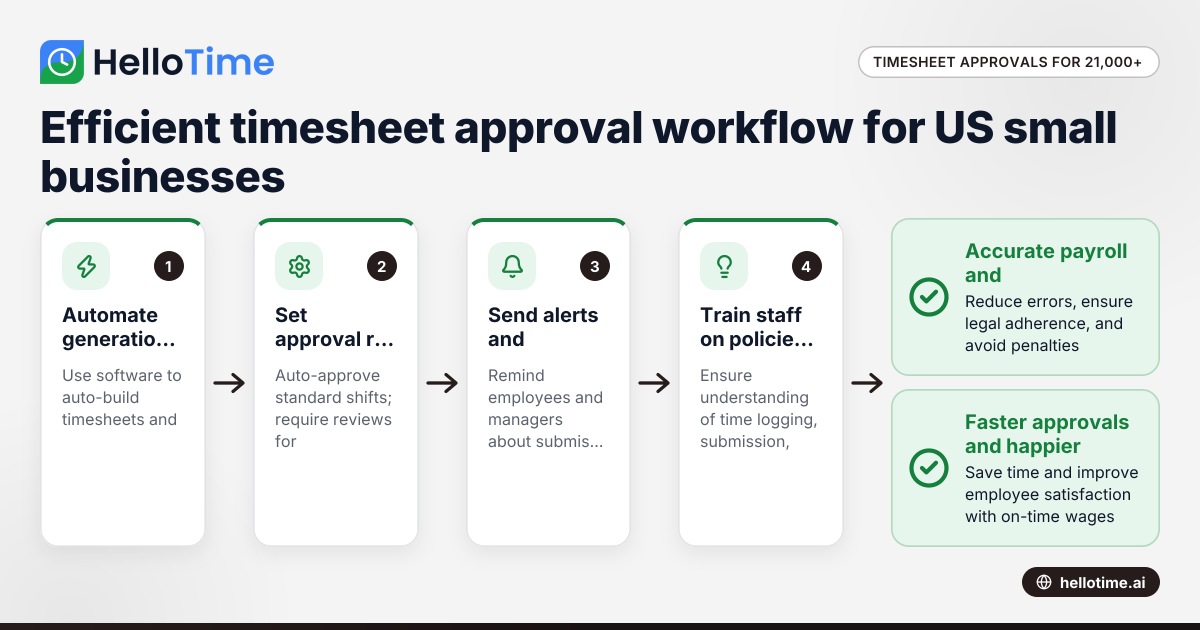
How United States Small Businesses Can Handle Timesheet Approval Workflows with Over 21,000 Minutes Logged
Managing timesheet approvals efficiently becomes critical for US small businesses logging large volumes of employee hours, such as over 21,000 minutes
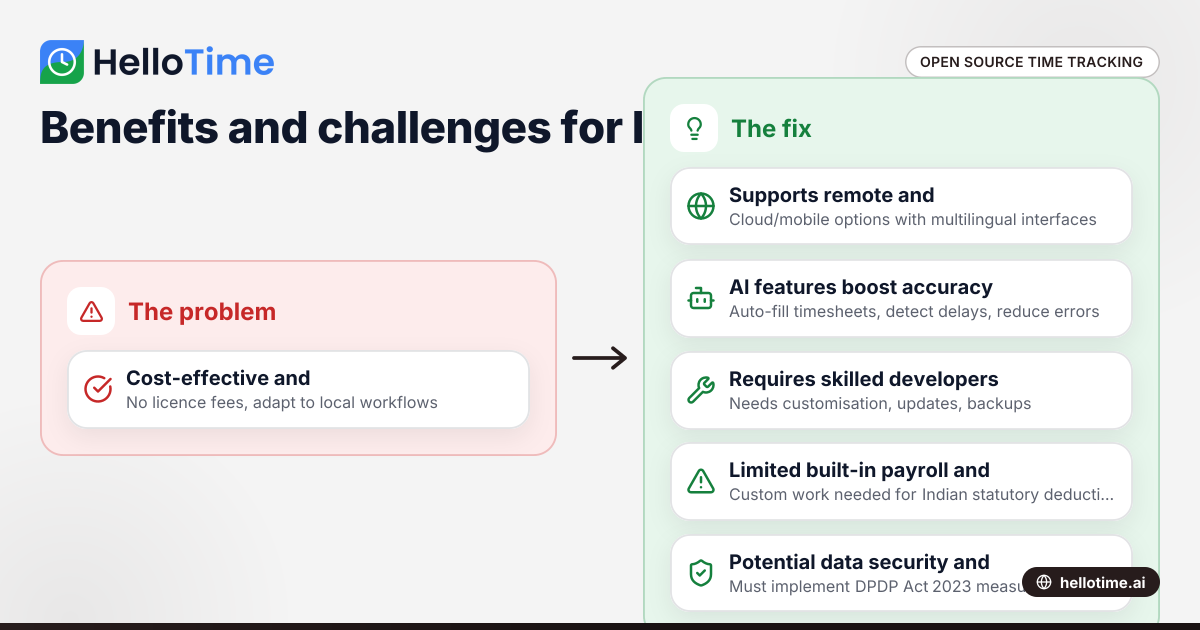
Open Source Time Tracking Tools for Indian Agencies: Benefits and Considerations
Open source time tracking tools are software with publicly accessible code, letting Indian agencies use and customise them without licence fees. They.
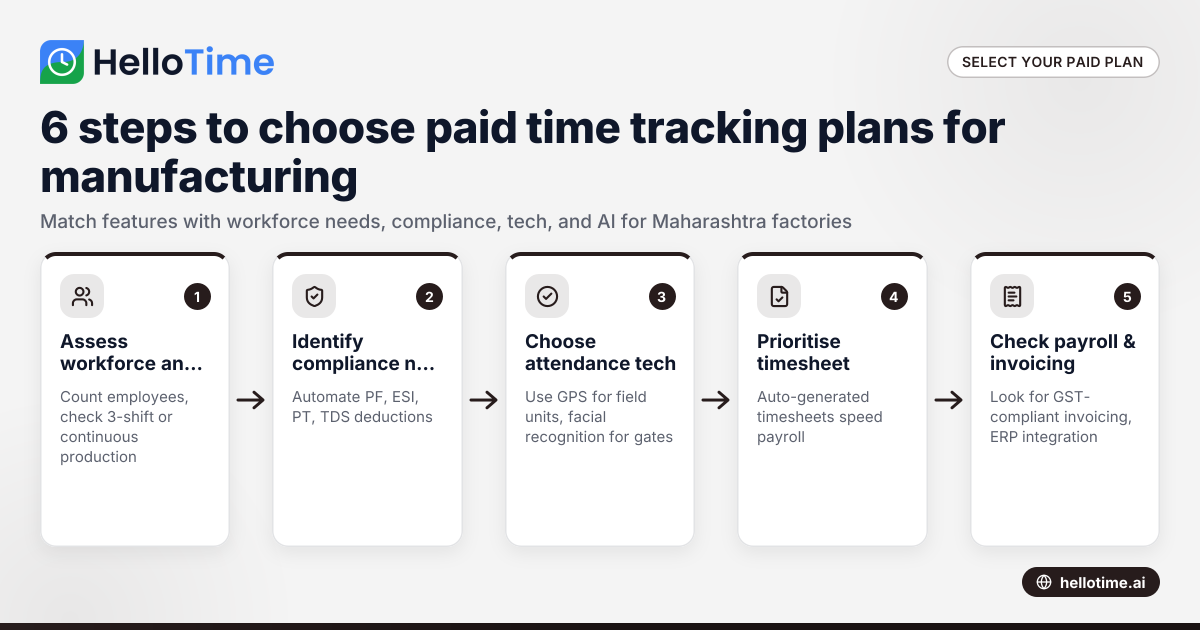
Choosing the Best Paid Plans for Manufacturing Time Tracking Software in Maharashtra, India
Choosing the right paid plan for manufacturing time tracking software in Maharashtra helps your factory optimise labour costs, streamline shift.