How United States Small Businesses Can Use Time Tracking to Improve Payroll Accuracy and Compliance
United States small businesses can improve payroll accuracy and compliance by implementing reliable time tracking systems. Time tracking helps capture
The HelloTime team
6 min read
On this page
United States small businesses can improve payroll accuracy and compliance by implementing reliable time tracking systems. Time tracking helps capture employee hours precisely, streamlines payroll processing, and supports adherence to labor laws and tax requirements, reducing costly errors and disputes.
Key takeaways
- Time tracking ensures precise capture of hours worked, reducing payroll errors.
- Accurate time records support compliance with the Fair Labor Standards Act (FLSA) and state labor laws.
- Automated time tracking with AI features speeds up timesheet approvals and data accuracy.
- Proper tracking helps prevent wage disputes and improves employee trust.
- Integrating time tracking with payroll systems simplifies tax withholding and reporting.
- Shift scheduling and leave management tools further enhance workforce management.
Why is time tracking important for payroll accuracy?
Time tracking is vital because it provides an accurate record of employee work hours, ensuring payroll calculations are correct. Manual methods like paper timesheets risk errors and data loss, leading to incorrect payments and disputes. Digital time tracking automates hour capture and ensures reliable data for payroll processing.
For example, a retail store in Chicago using paper logs faced overtime discrepancies that caused payment errors and confusion during tax filing. Digital solutions eliminate these problems by automatically calculating hours, reducing errors and saving administrative time.
How does time tracking support compliance with US labor laws?
Digital time tracking helps businesses comply with the Fair Labor Standards Act (FLSA) and state labor laws by providing precise records of hours worked, breaks, and overtime. Automated alerts flag issues like missed breaks or excessive overtime, allowing timely corrections before payroll runs.
For instance, a hospitality business in Detroit with rotating shifts used time tracking software to identify missing clock-ins, avoiding payroll disputes. Maintaining accurate timesheets reduces risks of fines or legal action during audits by the Department of Labor.
What role does AI time tracking play in improving payroll?
AI time tracking automates detection of anomalies such as unusual breaks or out-of-shift clock-ins. It speeds up timesheet creation and can auto-approve standard entries, ensuring accuracy and reducing managerial workloads.
An agency in New York used AI features to flag overlapping clock-ins for review, correcting errors before payroll. AI’s ability to learn typical work patterns helps catch irregularities early, preventing payroll mistakes and wage claims.
How can small businesses implement time tracking effectively?
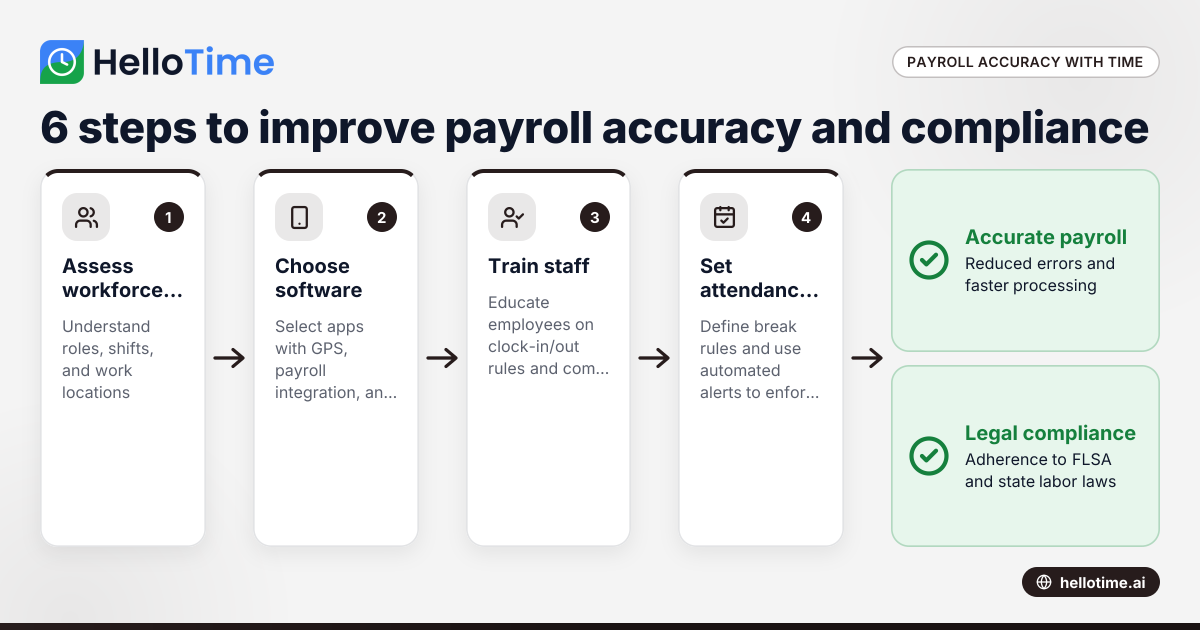
Implementing time tracking successfully involves:
- Assessing workforce needs: Understand roles, shifts, and work locations, for example, a Detroit manufacturer with multiple shifts requires shift scheduling features.
- Choosing the right software: Select solutions with user-friendly mobile apps, GPS verification, and payroll integration like QuickBooks.
- Training staff: Clear guidance on clock-in/out rules and compliance reduces errors.
- Defining attendance and break policies: Set rules based on legal requirements and use automated alerts for enforcement.
- Regularly reviewing timesheets: Managers should monitor flagged issues weekly.
- Integrating with payroll: Ensure smooth data transfer to payroll accounting systems to prevent errors.
A Houston landscaping company improved payroll by using GPS clock-ins and break reminders within time tracking software, cutting processing time by 30%.
How does time tracking help with tax compliance and withholding?
Accurate time tracking ensures correct wage calculations, which affects payroll tax withholdings for Social Security, Medicare, and income taxes. Integrated systems generate reliable reports for tax filings and year-end forms like W-2 and 1099.
For example, a Chicago consulting firm used time tracking to capture billable hours and payroll data precisely, minimizing errors in tax submissions and client invoicing. Automated time tracking also helps maintain data required for state unemployment and workers’ compensation reporting.
What common mistakes should US small businesses avoid with time tracking?
Avoid these pitfalls to prevent payroll and compliance issues:
- Neglecting to record breaks and meal periods as legally required.
- Allowing unchecked manual timesheet editing, which can cause errors.
- Using outdated methods like paper or spreadsheets prone to mistakes.
- Failing to train employees on clock-in/out policies.
- Skipping pre-payroll timesheet reviews.
- Overlooking different state overtime rules, risking non-compliance.
Steering clear of these errors safeguards your business from disputes, penalties, and administrative hassle.
How to choose the right time tracking software for your business?
Consider these factors:
- Mobile tools: Essential for remote or field teams; GPS and offline capabilities help.
- Verification: Features like facial recognition or geofencing prevent time theft.
- Integration: Compatibility with payroll and accounting software such as QuickBooks and Stripe.
- Scheduling and leave management: Built-in tools ease workforce planning.
- Reporting: Detailed insights enable project billing and profitability analysis.
HelloTime offers a comprehensive solution tailored to US small businesses, combining ai time tracking with shift scheduling and leave management for efficient and compliant operations.
Explore HelloTime’s features to see how it fits your needs.
How does HelloTime support US-based businesses in time tracking?
HelloTime enables one-click time tracking that auto-builds timesheets and simplifies approvals. It supports GPS clock-ins with geofencing, verifying employee presence at job sites. Tablet kiosk attendance with face recognition suits retail, warehouse, and manufacturing settings, ensuring only authorized staff clocks in.
The platform includes:
- Shift scheduling and rostering tools for flexible workforce management.
- Leave management aligning with company policies.
- Payroll data exports compatible with existing US payroll systems.
These features help businesses in cities like Chicago and Detroit reduce payroll errors, enforce compliance with US laws, and save time with automated processes.
Discover HelloTime’s capabilities on HelloTime in the US.
Experience precision in payroll operations and legal compliance with modern time tracking. To learn more about how HelloTime can fit your company’s needs, review our pricing and features pages.
Frequently asked questions
What is the Fair Labor Standards Act (FLSA) requirement for time tracking?
The FLSA mandates employers keep accurate records of all hours worked by non-exempt employees, including clock-in/out times, breaks, and overtime, to ensure fair pay and legal compliance.
Can artificial intelligence improve time tracking accuracy?
Yes, AI improves accuracy by detecting anomalies, preventing errors, and accelerating timesheet generation. It alerts managers to irregularities and helps streamline payroll processing.
How can time tracking prevent wage disputes?
By maintaining clear and accurate records of hours and breaks, time tracking provides verifiable proof of wages, reducing misunderstandings and facilitating prompt dispute resolution.
Are there penalties for poor payroll compliance related to time tracking?
Yes, employers may face fines, penalties, and required back pay if they fail to maintain proper time records or comply with wage laws. Accurate tracking helps avoid these risks.
How does time tracking integrate with payroll systems?
Modern time tracking software exports accurate hours to payroll and accounting tools like QuickBooks, automating wage and tax calculations and minimizing manual entry errors.
Is time tracking useful for both hourly and salaried employees?
Time tracking is essential for hourly workers to log actual hours. While salaried employees may not require detailed logs, attendance and leave tracking support compliance and workforce management.
Read next
This article covers one part of a bigger topic. For the complete picture, read our guide to time tracking.
Keep reading
Related articles
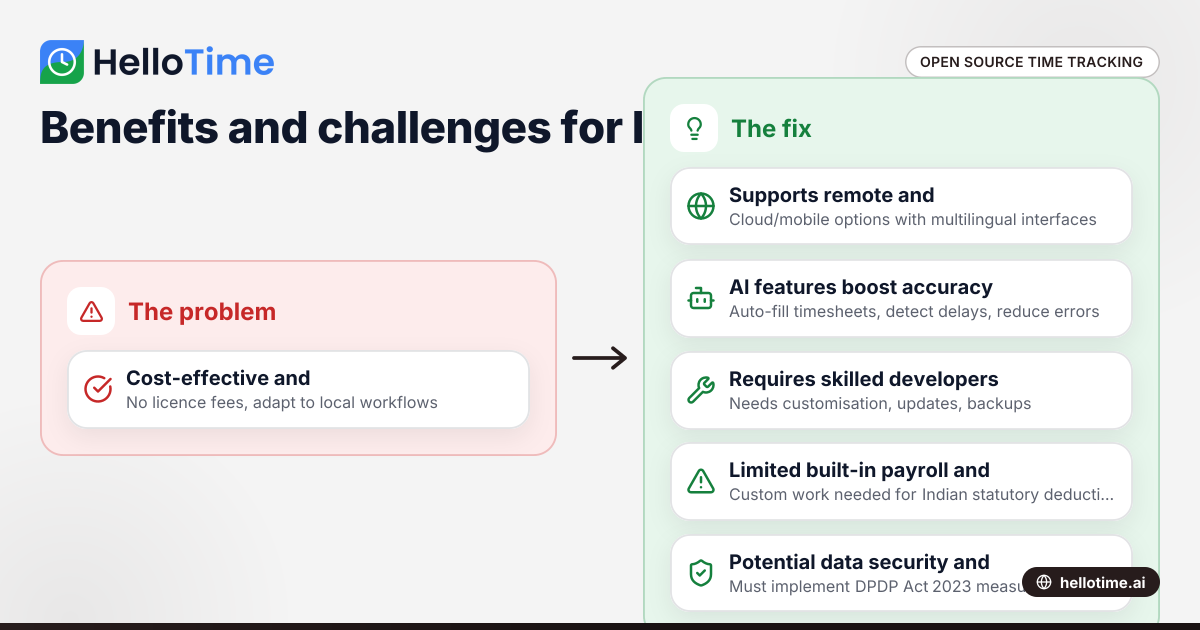
Open Source Time Tracking Tools for Indian Agencies: Benefits and Considerations
Open source time tracking tools are software with publicly accessible code, letting Indian agencies use and customise them without licence fees. They.
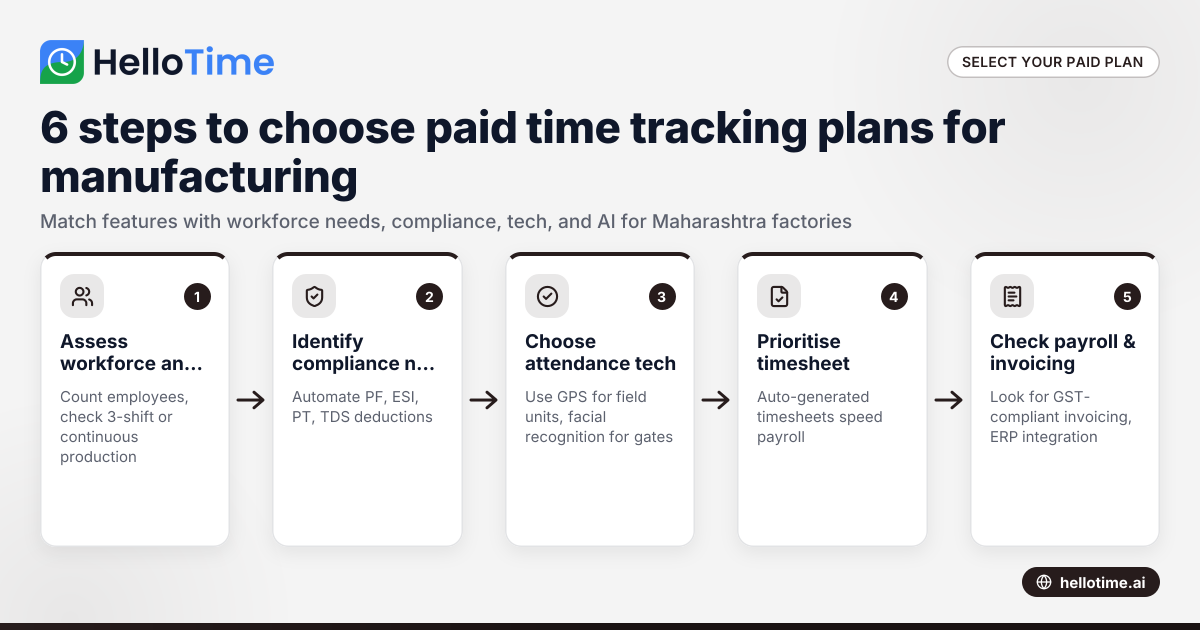
Choosing the Best Paid Plans for Manufacturing Time Tracking Software in Maharashtra, India
Choosing the right paid plan for manufacturing time tracking software in Maharashtra helps your factory optimise labour costs, streamline shift.
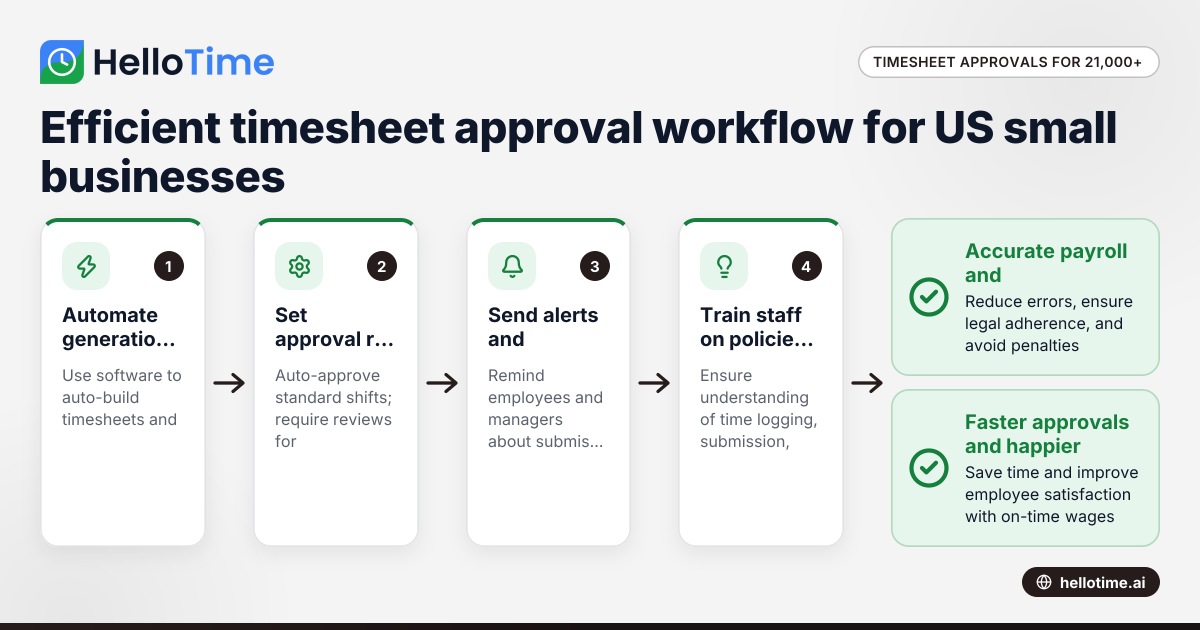
How United States Small Businesses Can Handle Timesheet Approval Workflows with Over 21,000 Minutes Logged
Managing timesheet approvals efficiently becomes critical for US small businesses logging large volumes of employee hours, such as over 21,000 minutes