How US Agencies Can Use Time Tracking Software to Boost Billable Hours and Client Reporting
Time tracking software helps US agencies monitor, record, and manage work hours efficiently. It increases billable hours visibility, streamlines.
The HelloTime team
7 min read
On this page
Time tracking software helps US agencies monitor, record, and manage work hours efficiently. It increases billable hours visibility, streamlines client reporting, and enhances workforce productivity. Using AI-powered tools can simplify time capture, reduce errors, and improve invoicing accuracy for agencies billing hourly.
Key takeaways
- Time tracking improves accuracy for billable hours, ensuring full client invoicing.
- Automated timesheets and approvals cut administrative overhead for agency teams.
- AI time tracking helps identify unbilled work and optimize resource allocation.
- Detailed reports build client trust and support transparent project billing.
- Integrating with agency finance tools like QuickBooks streamlines invoicing.
- Shift to digital time tracking reduces errors common in manual spreadsheet methods.
Why do US agencies need time tracking software?
Managing billable hours is a major challenge for agencies, especially those with multiple clients and projects. Without accurate tracking, agencies risk underbilling or disputes over client invoices. Manual tracking methods like spreadsheets or paper timesheets are error-prone and time-consuming.
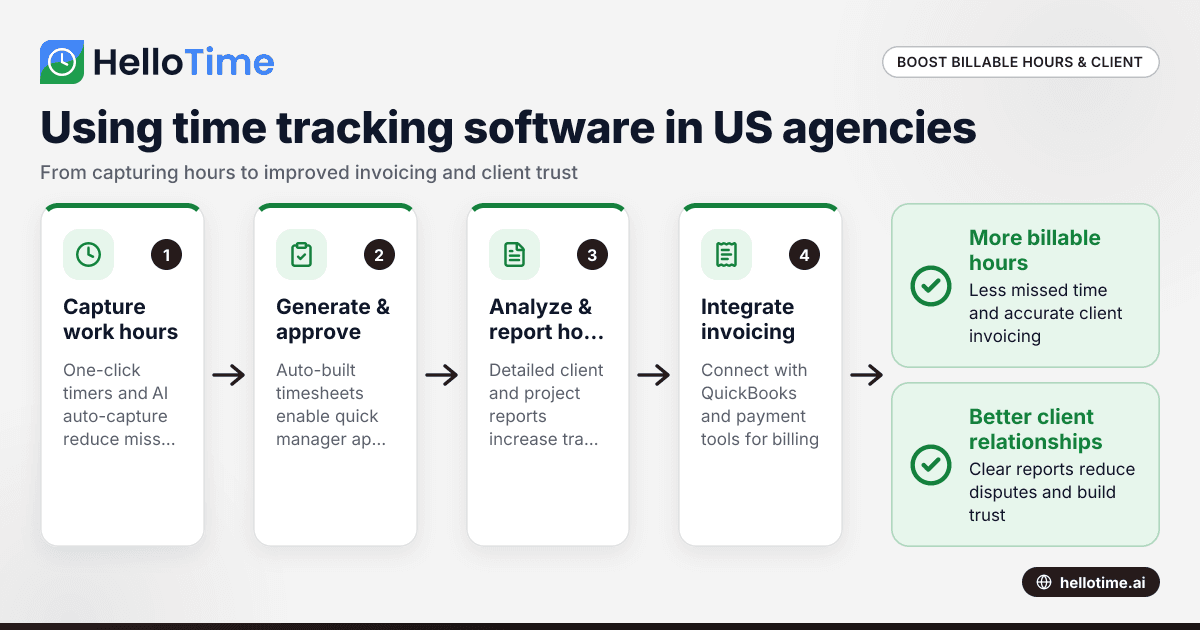
Time tracking software automates capturing hours worked by employees or contractors at the click of a button. It generates timesheets automatically and supports quick approvals, saving administrative time. This ensures each billable minute is recorded and invoiced, protecting agency revenue.
Moreover, agencies can use data from time tracking tools to analyze how team hours are spent across projects. This enables managers to balance workloads, spot inefficiencies, and boost on-time project delivery.
How does AI time tracking improve agency workflows?
AI time tracking uses algorithms and machine learning to automatically capture and categorize work activities with minimal user input.
For example, AI can recognize when an employee switches from one project task to another or detect idle versus active computer use. This reduces the risk of missed time entries and guesswork.
In practice, AI time tracking lets agency staff focus on creative work rather than administrative tasks. It also surfaces insights such as which clients or projects consume the most resources, helping agencies prioritize efforts for maximum profitability.
Combined with features like GPS clock-in or face recognition tablet kiosks, AI-powered tools modernize attendance and attendance validations for onsite and remote team members.
What time tracking features should US agencies look for?
Choosing the right software depends on an agency's size, client billing models, and operational complexity. Key features to consider include:
- One-click time capture: Employees can start/stop timers easily from desktop or mobile apps.
- Auto-built timesheets: Consolidate daily work hours into timesheets ready for review or approval.
- Approval workflows: Managers approve hours to ensure billing accuracy.
- Detailed client and project reporting: Summaries and breakdowns of billable vs non-billable hours.
- Payroll support: For agencies with full-time staff, basic payroll features or integrations matter.
- Integration with accounting tools: Compatibility with QuickBooks, Stripe, or other finance stacks.
- Shift scheduling and leave management: Optimize resource availability and track time off.
- GPS and geofenced clock-ins: Verifies location for field or remote teams.
- Security and compliance: Data privacy and SOC 2-level protections for agency and client trust.
HelloTime offers many of these features designed for US agencies and professional services teams. Check out its features page to see the full list.
How to implement time tracking without disrupting agency productivity?
Adopting software requires a thoughtful approach to get buy-in from employees and managers:
- Communicate benefits clearly: Show how time tracking leads to fair billing, more efficient scheduling, and less manual work.
- Provide training and support: Run demos and share how-to guides that cover one-click tracking, timesheet reviews, and approvals.
- Start with a pilot team: Roll out the tool department by department or with a small group to gather feedback.
- Use AI time tracking features: Minimize manual input to ease adoption.
- Monitor usage and support corrections: Regularly review timesheet accuracy and resolve questions promptly.
- Integrate with current finance systems: Automate invoicing to reduce double work.
By using these steps, agencies in cities like Chicago, Houston, or Detroit can enjoy smooth adoption of time tracking with immediate benefits.
How does time tracking software support better client reporting?
Time tracking tools create detailed reports on the hours spent per client and task. This transparency can improve client relationships by:
- Showing clients exactly how billable hours add up.
- Justifying costs and reducing disputes.
- Demonstrating project progress and resource allocation.
- Providing insights for future project estimates.
Many agencies send these reports along with invoices or during status calls to build client confidence. Some tools also export reports in customizable formats for brand consistency.
What about agencies billing by project or retainer – is time tracking still useful?
Yes. While some agencies use flat fees or retainers, time tracking still offers value:
- Helps benchmark actual hours versus estimated scope.
- Detects scope creep early by showing overages.
- Supports hybrid billing models combining fixed fees with hourly tasks.
- Enables internal measurement of team productivity and profitable accounts.
Accurate time data ultimately empowers agencies to price services more competitively and improve profitability.
How do agencies integrate time tracking with invoicing?
Invoicing clients from billable hours tracked is a critical workflow:
- Time tracking software aggregates approved hours by client and project.
- Software calculates billable amounts using hourly rates or billing rules.
- Many tools export invoices directly into QuickBooks or integrate with Stripe for payment processing.
- Some solutions provide pre-built invoice templates to speed up billing.
- Agencies review invoices for accuracy before sending to clients.
Automation reduces errors seen in manual invoicing and shortens cash flow cycles by speeding up the billing process.
How can agency owners measure ROI from time tracking?
Return on investment comes from:
- Increasing total billable hours through fewer missed entries.
- Reducing admin time spent compiling timesheets and invoices.
- Improving resource allocation to avoid overstaffing or missed deadlines.
- Enhancing invoice accuracy and reducing client payment disputes.
- Providing data to price projects competitively and profitably.
Estimates often show time savings of 20-40% on billing processes. Improved cash flow and client satisfaction add further value.
Efficient time tracking is a foundation for sustainable growth in agencies serving US clients.
Conclusion
Time tracking software is vital for US agencies managing billable hours and client reporting. Leveraging AI for automatic time capture, integrating with finance tools, and providing clear reports boosts accuracy and profitability. Agencies can transition from manual methods to scalable digital solutions smoothly with the right approach.
Explore HelloTime’s features to learn how time tracking can transform your agency’s billing and reporting. Compare plans to find the best fit at pricing.
Frequently asked questions
How does AI time tracking work?
AI time tracking uses machine learning to detect and record work activities automatically. It minimizes manual input by recognizing when team members switch between tasks or projects. This increases accuracy and reduces forgotten hours.
Can time tracking software handle multiple clients and projects?
Yes, most time tracking tools allow users to log hours against different clients and projects. This helps agencies allocate costs accurately and generate client-specific reports for billing and analysis.
Is time tracking software compatible with QuickBooks?
Many time tracking solutions offer direct integration or export options compatible with QuickBooks, simplifying invoice creation and accounting. This is essential for agencies that use QuickBooks for bookkeeping.
How can time tracking improve employee productivity?
By providing visibility into how time is spent, tracking tools help identify bottlenecks and areas of wasted effort. Managers can then optimize workflows and resource distribution to increase efficiency.
Is GPS clock-in useful for agencies?
GPS clock-in verifies employee location when starting work, especially for remote or field teams. It ensures authenticity of attendance records, which supports accurate billing and compliance.
What privacy protections should agencies consider?
Agencies should choose time tracking software with strong data security measures, including encryption and SOC 2-level compliance. Protecting employee and client information builds trust and meets regulatory standards.
For agencies looking to enhance billing accuracy and client transparency, time tracking software is a practical investment. Discover more about how HelloTime can support your agency’s needs at HelloTime in the US.
Read next
This article covers one part of a bigger topic. For the complete picture, read our guide to time tracking.
Keep reading
Related articles
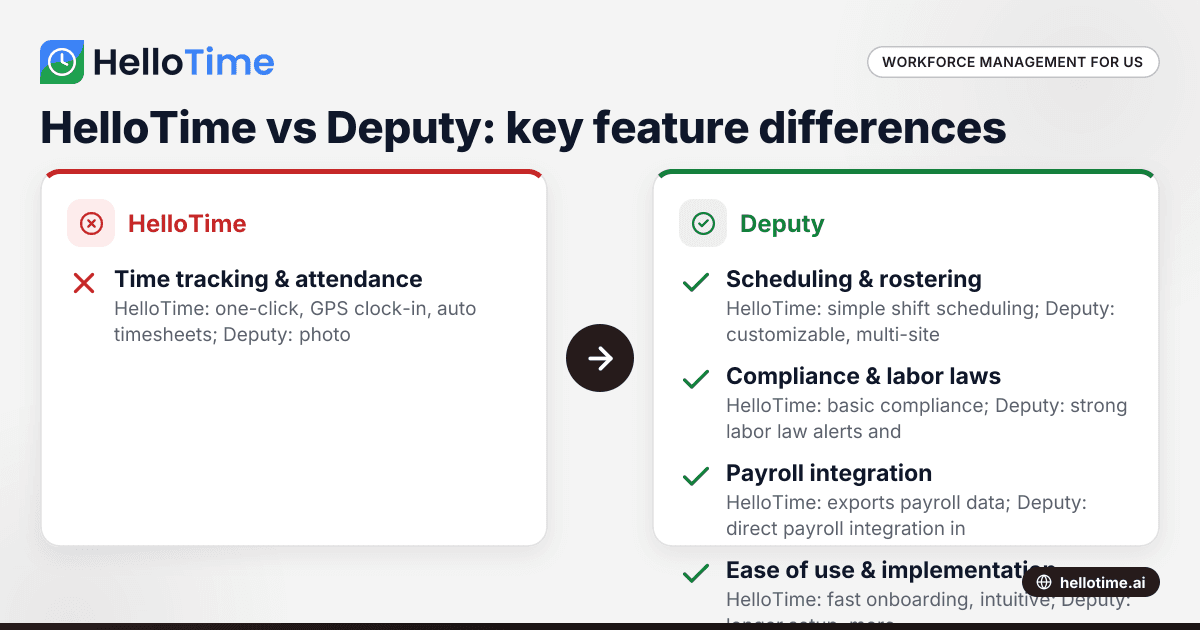
HelloTime vs Deputy: Which Workforce Management Software is Best for United States Small Businesses?
HelloTime and Deputy are popular workforce management tools offering employee scheduling, time tracking, and attendance solutions for US small.
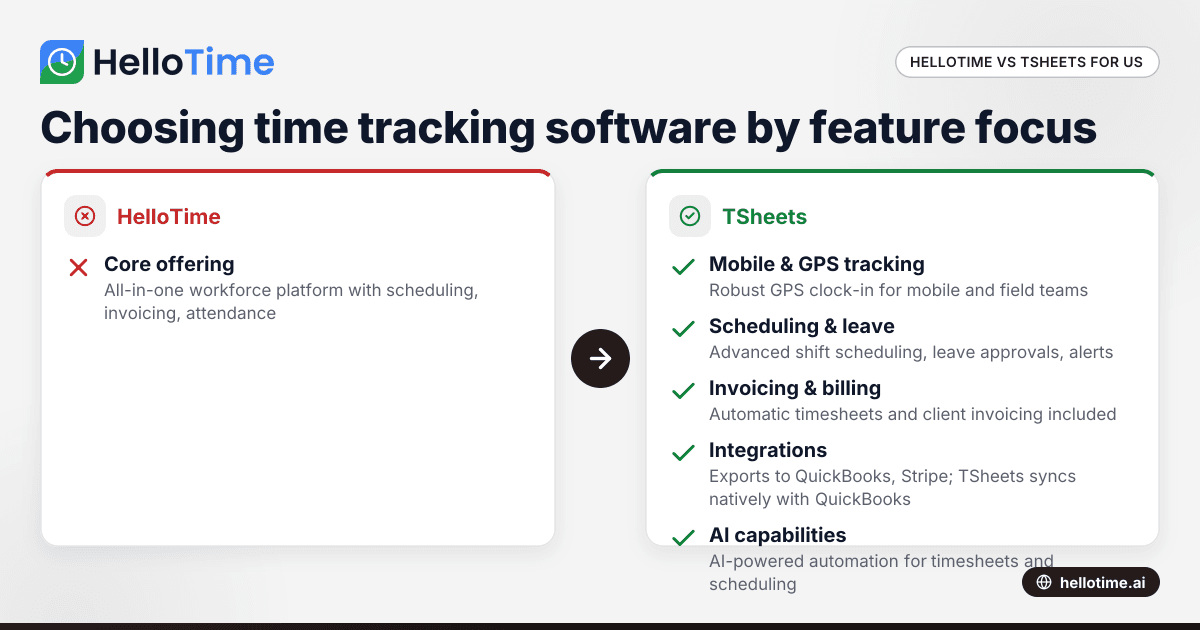
HelloTime vs TSheets: Choosing the Best Time Tracking Software for United States Agencies
HelloTime and TSheets are popular time tracking solutions for agencies and professional services in the United States. Comparing HelloTime vs TSheets.
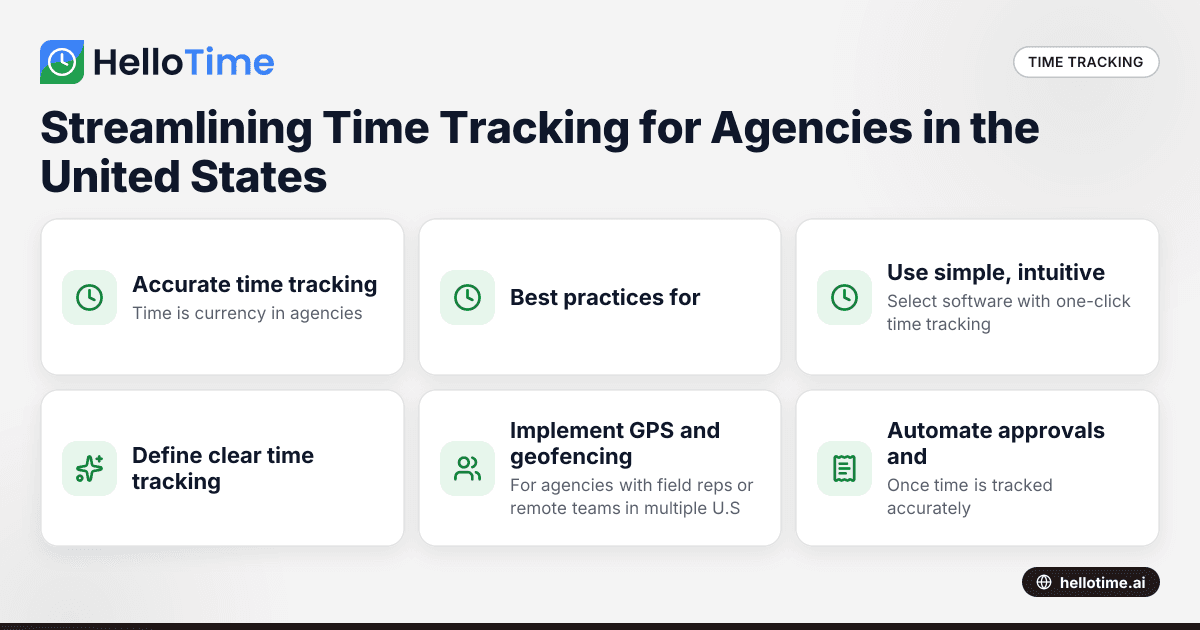
Streamlining Time Tracking for Agencies in the United States: Best Practices to Boost Client Billing Accuracy
Streamlining time tracking for agencies in the United States is essential for ensuring accurate client billing and maximizing profitability. By.