How to Set Up an Efficient Timesheet Approval Chain for Indian SMEs
How to Set Up an Efficient Timesheet Approval Chain for Indian SMEs This guide is for owners, HR, and operations managers at Indian small and.
The HelloTime team
8 min read
On this page
How to Set Up an Efficient Timesheet Approval Chain for Indian SMEs
This guide is for owners, HR, and operations managers at Indian small and mid-sized businesses who want to streamline their timesheet approval process. By the end, you will have a clear, step-by-step plan to create an effective approval chain that saves time, reduces errors, and improves payroll accuracy.
Before you start
- A clear organisational structure with designated roles and reporting lines.
- Access to existing timesheets, attendance records, and payroll data.
- A chosen time tracking or workforce management tool that supports approval workflows.
- Basic understanding of Indian labour laws and payroll deductions (TDS, PF, ESI, etc.).
Step 1: Why do you need an approval chain for timesheets?
An approval chain ensures that every employee’s recorded hours are verified for accuracy and compliance before payroll processing. In India, where statutory deductions like Provident Fund (PF), Employee State Insurance (ESI), and Tax Deducted at Source (TDS) must be calculated precisely, accurate timesheets are crucial. An approval chain reduces payroll errors, fraudulent claims, and late salary payments. Without a proper chain, timesheets often remain unchecked or get lost, causing delays and disputes.
For example, if a field service team in Pune logs hours manually without verification, discrepancies may arise due to forgotten clock-ins or incorrect break times. An approval chain catches such errors early.
Common mistake: Skipping intermediate approvals, which causes managers to get overwhelmed and miss errors. This often happens when payroll officers are expected to verify all timesheets directly, leading to bottlenecks and mistakes.
Step 2: Who should be involved in the approval chain?
Identify the key approvers based on your team structure. Typically:
- Team leads or supervisors: They verify attendance and task completion daily. They know the ground realities and can spot anomalies like unexpected overtime or absences.
- Department heads: They check overall work hours and project allocations weekly or monthly. Their approval ensures alignment with budgets and client billing.
- HR or payroll officers: They finalise the timesheet for salary processing, ensuring statutory compliance such as PF, ESI, Professional Tax (PT), and Labour Welfare Fund (LWF) deductions.
Each approver should have a clear role and responsibility. Avoid involving too many people to keep the process lean and efficient.
Common mistake: Including approvers without proper authority, leading to delays and confusion. For instance, involving multiple managers for the same team’s approval can cause conflicting feedback and slow down payroll.
Step 3: How does an AI approval chain help?
An AI approval chain automates routing timesheets to the right approvers based on predefined rules and flags inconsistencies automatically. For example, if an employee logs more than 12 hours in a day or has missing clock-ins, AI can alert the supervisor immediately.
This reduces manual work, speeds up approvals, and improves accuracy. AI can learn common errors and suggest corrections, saving managers’ time that they would otherwise spend cross-checking spreadsheets or WhatsApp messages.
In India, where teams might be spread across cities like Mumbai, Bengaluru, and tier-2 towns, AI-powered approvals help maintain consistency and compliance remotely. It also supports data privacy requirements under the DPDP Act 2023 by securely handling sensitive attendance data.
Common mistake: Relying solely on manual approvals, which increases human error and slows down payroll. For example, manually chasing timesheets via email or paper leads to lost records and payroll delays.
Step 4: What is the best sequence for your approval chain?
Design the approval flow logically. Usually:
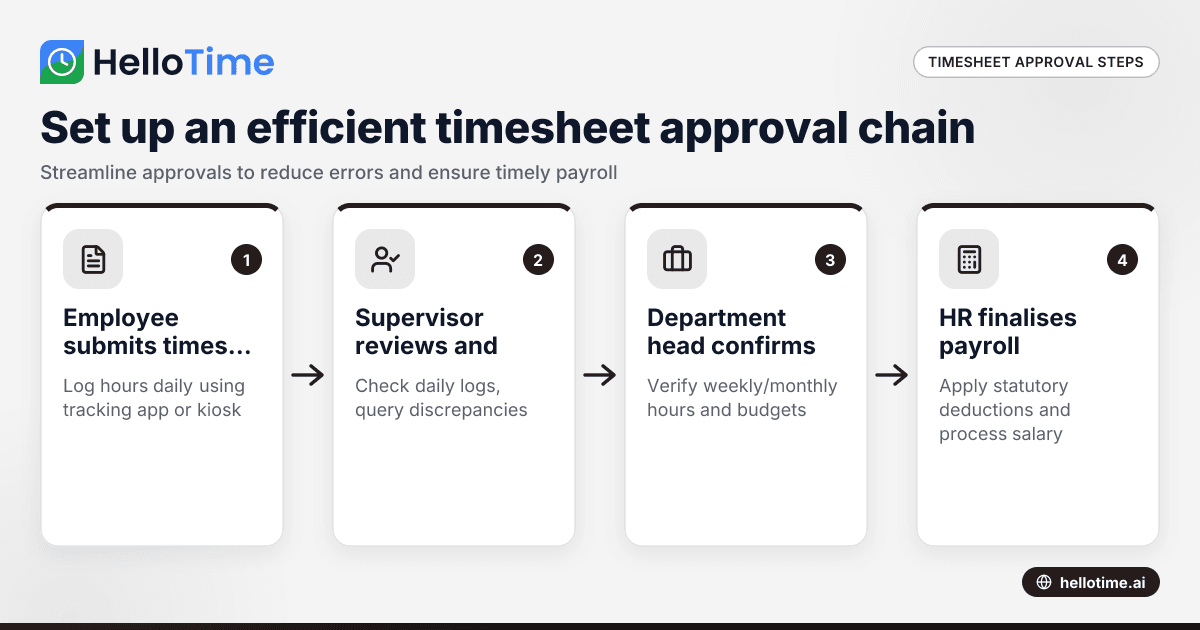
- Employee submits timesheet: Employees log hours daily or per shift using a time tracking app or kiosk with GPS or face recognition.
- Immediate supervisor approves or queries discrepancies: Supervisors review daily logs for accuracy, query anomalies like missed clock-ins, and approve correct entries.
- Department head reviews and confirms: Department heads check weekly or monthly summaries, ensuring project hours match client billing and budgets.
- HR or payroll finalises and processes salary: HR runs payroll with statutory deductions (TDS, PF, ESI, PT, LWF) based on the approved timesheets and generates payslips.
For shift-based teams, consider adding a roster manager or attendance officer early in the chain to verify clock-in data from tablets or mobile apps. This reduces disputes about actual hours worked.
Common mistake: Creating loops or multiple simultaneous approvals that cause bottlenecks. For instance, sending timesheets back and forth between supervisors and HR without clear deadlines delays payroll.
Step 5: How to communicate and train your team on the new process?
Clear communication is essential. Share the new approval steps, timelines, and responsibilities with all employees and approvers. Use WhatsApp groups or internal emails to announce changes and deadlines.
Provide training on the time tracking tool and approval features to avoid confusion. For example, organise a demo session showing how to submit, approve, or query timesheets on mobile and desktop.
Set expectations for timely approvals to prevent payroll delays. Communicate cut-off dates clearly — for example, employees must submit timesheets by the 25th of the month, supervisors approve by the 27th, and payroll processes by the 30th.
Common mistake: Rolling out the process without training, leading to resistance and errors. Employees might submit incomplete timesheets or miss deadlines if not properly guided.
Worked example: Setting up an approval chain for a Bengaluru digital marketing agency
Suppose you run a 25-person agency billing clients by the hour. Your team includes 5 project managers, each managing 5 team members. You want to ensure timesheets are accurate before billing and payroll.
- Step 1: Define the approval chain as: Employee → Project Manager → Agency Head → Payroll Officer.
- Step 2: Configure your time tracking software to route each timesheet to the project manager first. For instance, when a junior designer submits hours, the project manager receives a notification for approval.
- Step 3: Project managers review hours daily and approve or raise queries. If a designer logs 10 hours for a day, the manager checks if overtime approval exists or if there was a data entry error.
- Step 4: Approved timesheets go to the agency head weekly for overall review and client billing alignment. The agency head verifies that total hours match client contracts before sending invoices.
- Step 5: Finally, the payroll officer receives the consolidated timesheets to generate salary slips with proper TDS, PF, and ESI deductions. Payroll is processed on the 1st of every month, ensuring timely payments.
This setup reduces errors, speeds billing, and ensures timely salary payments. It also supports compliance with Indian labour laws and statutory reporting like Form 24Q.
What if my team is shift-based and spread across multiple cities?
Shift-based teams in retail, hospitality, or field services often work across Mumbai, Pune, and tier-2 cities. For them, add a roster manager or attendance verifier early in the approval chain to check attendance data from GPS or tablet kiosk clock-ins. This ensures accurate hours before higher-level approvals.
For example, a retail chain with stores in Mumbai and Pune uses tablet kiosks with face recognition to record clock-ins. The roster manager reviews daily attendance to flag absences or late arrivals. This verified data then moves up to store managers and regional HR.
Having local approvers closer to the team helps handle discrepancies faster. It also reduces errors from manual timesheet entries and avoids payroll disputes.
How long should each approval step take?
A good rule is to allow 24-48 hours per approval step. This balances thorough review with payroll deadlines. For example:
- Employees submit timesheets by the 25th of each month.
- Supervisors approve by the 27th.
- Department heads review by the 28th.
- HR finalises payroll by the 30th.
Setting clear cut-off dates for timesheet submission and approvals avoids last-minute rushes before salary runs. Use reminders and escalation alerts to keep approvers on track, especially in busy months or during festivals when staff availability may be low.
Delays in any step can cascade, causing late salary payments and employee dissatisfaction.
Next steps
Start by mapping your current timesheet approval process and identifying bottlenecks. Then design a clear approval chain with defined roles and timelines. Choose a time tracking tool that supports automated workflows and consider options with AI approval chain features to reduce manual work.
Explore features and compare pricing to find a solution that fits your business size and needs. A well-structured approval chain will save you time, improve payroll accuracy, and help your SME grow confidently.
Related reading
- How to Set Up User Access Levels in Timesheet Approval Workflows for US Small Businesses
- How User Mode Enhances Timesheet Approval Workflow for Indian Small Businesses
Read next
This article covers one part of a bigger topic. For the complete picture, read our guide to approval chain.
Keep reading
Related articles
How User Mode Enhances Timesheet Approval Workflow for Indian Small Businesses
How User Mode Enhances Timesheet Approval Workflow for Indian Small Businesses.
HelloTime vs Traditional Timesheet Approval Systems: Advantages for United States Small Businesses
HelloTime vs Traditional Timesheet Approval Systems: Advantages for United States Small Businesses When comparing HelloTime vs traditional timesheet.
How to Manage Holiday Calendars for Multi-State Teams in India
Managing holiday calendars for multi-state teams in India can be complex due to different state-specific holidays and observances. By the end of this.