Maximizing Utilization Rate for US Agencies: Practical Time Tracking Strategies for Profitability
Maximizing utilization rate is essential for US agencies that want to increase profitability and optimize workforce productivity. Utilization rate.
The HelloTime team
8 min read
On this page
Maximizing utilization rate is essential for US agencies that want to increase profitability and optimize workforce productivity. Utilization rate measures the percentage of available working time that employees spend on billable tasks. Tracking and improving this metric helps agencies identify inefficiencies and allocate resources more effectively, ultimately boosting revenue without increasing overhead costs.
Key takeaways
- Utilization rate shows how much employee time is spent on billable client work versus total available hours.
- Accurate time tracking is critical for calculating utilization rate and identifying non-billable activities.
- Strategies to improve utilization rate include better project scoping, reducing administrative tasks, and smart scheduling.
- AI utilization rate tools automate tracking and analytics, giving faster insights for decision-making.
- Well-managed utilization rate directly impacts agency profitability and client invoicing accuracy.
- Using workforce management software can streamline time capture, reporting, and optimize resource use.
What is utilization rate and why does it matter for US agencies?
Utilization rate is the percentage of an employee’s or team’s available hours spent on work that generates revenue, typically client billable hours. For example, if an employee can work 40 hours per week and bills 30 hours, their utilization rate is 75%. Agencies rely on this measure to understand how efficiently their human resources are being used.
In the US market, where agencies often bill by the hour, maximizing utilization rate translates directly into higher revenue without increasing staff headcount. It also helps managers spot underused capacity or excessive administrative burden that hampers productivity. Monitoring utilization rate regularly supports better project budgeting, team assignment and cash flow forecasting.
How is utilization rate calculated?
The utilization rate formula is:
Utilization Rate (%) = (Billable Hours / Available Hours) × 100
- Billable hours: Time directly charged to client projects.
- Available hours: Total work hours available in a set period (e.g., weekly, monthly).
For example, if an agency employee has 160 available hours in a month but only 120 are billable, the utilization rate is (120 ÷ 160) × 100 = 75%. It’s important to define and track billable vs. non-billable hours consistently to get a meaningful metric.
How can agencies improve utilization rate through practical time tracking?
Accurate, real-time time tracking is the foundation for improving utilization rate. Without granular data on how employees spend their time, managers cannot identify where productivity gaps or non-billable tasks occur.
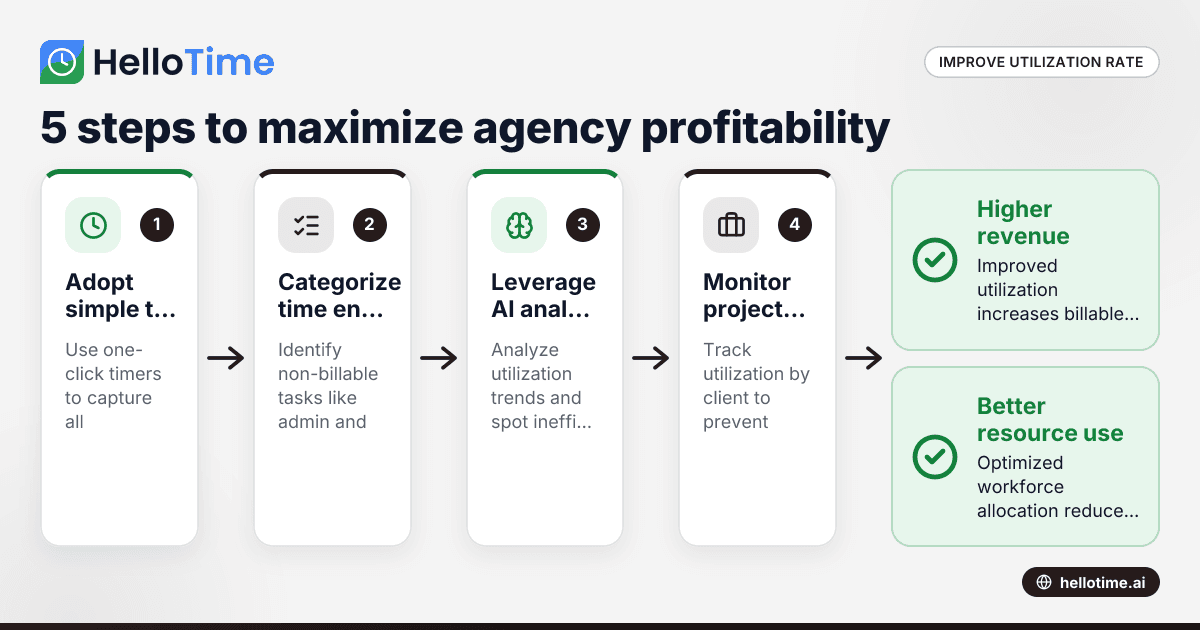
1. Adopt simple, one-click time tracking tools
Many agencies rely on spreadsheets or manual timesheets, which lead to incomplete or delayed data entry, reducing accuracy. Time tracking software with features like one-click timers or auto-tracked sessions frees employees from manual record-keeping, ensuring comprehensive data capture. With HelloTime’s effortless time tracking, your team can easily log billable and non-billable activities, supporting better utilization analysis.
2. Categorize time entries to analyze non-billable work
Knowing which tasks consume employee hours helps target improvements. Categorize time as billable client work, internal meetings, administrative tasks, training, or breaks. This enables agencies to reduce time spent on non-billable activities that do not generate revenue but are necessary. Managers can then streamline processes or delegate internal responsibilities more efficiently.
3. Use AI utilization rate tools for faster insights
AI-powered analytics in workforce management software can identify utilization trends, flag anomalies, and predict bottlenecks, saving managers hours of manual reporting. These tools analyze large data sets quickly and can highlight employees underutilized or projects burning excess hours, enabling timely interventions. AI utilization rate analytics help agencies make data-driven workforce planning decisions and improve profitability.
4. Monitor utilization per project and client
Tracking utilization by project and client helps agencies spot unprofitable accounts or scope creep. It gives insights into which types of work or clients consume excessive resources, guiding pricing adjustments or process improvements. This level of granularity ensures agencies are billing appropriately for the time and managing resources wisely across engagements.
5. Provide clear utilization expectations and feedback
Managers should set realistic utilization targets based on roles and workload, typically 70%-85% for billable staff in agencies. Transparent communication about goals and regular feedback encourages employees to focus on productive work. At the same time, allow some buffer for non-billable but essential activities to prevent burnout.
What are common barriers US agencies face in maximizing utilization rate and how to overcome them?
Common barriers include excessive administrative tasks, unclear project scope, client interruptions, and scope creep. These reduce available billable hours and distort utilization metrics. Overcoming them involves automating administrative work, setting clear project boundaries, and tracking all time spent diligently.
How can agencies reduce time lost to administrative tasks?
Administrative overhead—like manual timesheet entry, scheduling, and invoicing—can drag down utilization rates by absorbing employee hours, especially for small agencies without dedicated admin staff. Automating these processes with integrated workforce management software reduces burden, increases accuracy, and frees up time for billable work.
Example: Using HelloTime’s auto-built timesheets and invoicing from billable hours eliminates paperwork delays and errors, enabling faster client billing and fewer payroll headaches.
How to handle client interruptions and scope creep without harming utilization?
Client interruptions and scope creep can significantly reduce utilization rates if hours are not tracked and billed properly. Agencies should establish clear project scopes and change order processes upfront. Every additional request must be logged as billable work and communicated transparently to clients to avoid margin erosion.
Time tracking software that directly links hours to projects makes tracking extra work easier and billing more accurate. Teams should promptly update clients on changes and invoice accordingly to protect profitability and maintain strong client relationships.
How can smart scheduling improve utilization in shift-based teams?
For agencies with shift work or field operations, overscheduling or under-deploying staff leads to wasted capacity or overtime costs. Smart scheduling tools that consider employee availability, skills, and workload history optimize rosters to balance demand and utilization.
Managers avoid understaffing that stresses employees or overstaffing that reduces billable hour potential. Geofenced clock-in and attendance automation reduce time theft and improve accuracy, increasing the reliability of utilization data.
How does AI utilization rate tracking enhance profitability for agencies?
AI utilization rate tracking provides fast, data-driven insights by analyzing work patterns continuously. It identifies underutilization and inefficiencies, helping managers optimize workforce allocation and project budgets. This reduces manual reporting time and uncovers hidden revenue opportunities.
By automating time approvals and integrating with invoicing, AI tools speed up billing cycles and improve cash flow. US agencies benefit from better forecasting and operational agility with AI-powered utilization analytics.
What should US agencies look for when choosing time tracking software for utilization rate optimization?
Choosing the right tool affects how well agencies can monitor and improve utilization. Key features to look for include:
- Easy, one-click time capture with mobile and desktop options
- Auto-built, exportable timesheets with approval workflows
- Categorization of billable vs. non-billable tasks for better analysis
- Project and client-based reporting for granular insights
- Integration with payroll, invoicing, and scheduling systems
- AI-powered analytics to spot trends and optimize workforce use
- Compliance with US labor laws and privacy standards
HelloTime offers these capabilities in a streamlined platform that supports US agency needs across time tracking, roster scheduling, and reporting.
How do utilization rate improvements impact agency profitability?
Incremental improvements in utilization rate can significantly boost revenue without increasing headcount or overhead. For example, increasing an agency-wide utilization rate from 70% to 80% on a team of 10 employees working 160 hours monthly turns an extra 160 billable hours into additional revenue.
If the average billing rate is $100/hour, that’s an extra $16,000 per month, or $192,000 annually, directly improving profit margins. This demonstrates why utilization rate is a critical metric for agency owners and operations managers in the US.
If you manage a US agency aiming to increase profitability through better workforce utilization, explore the full set of features HelloTime offers. Ready to see what fits your team? Check out our pricing plans designed for agencies of all sizes.
Frequently asked questions
What is a good utilization rate for an agency in the US?
A typical good utilization rate ranges from 70% to 85%. This accounts for necessary non-billable activities like training and internal meetings while maximizing billable client work to maintain profitability.
How do I track utilization rate accurately?
Use dedicated time tracking software that simplifies logging billable and non-billable hours in real time. Ensure employees record time daily or weekly and categorize tasks clearly for precise calculation.
Can AI tools improve utilization rate management?
Yes. AI tools analyze time data continuously to identify productivity trends and potential inefficiencies faster than manual reporting, enabling proactive resource allocation and better decision-making.
How does utilization rate relate to employee burnout?
Setting utilization targets too high without adequate breaks may cause burnout. Balance utilization goals with employee wellbeing by including non-billable time for rest, training, and administrative duties.
Can utilization rate tracking help with billing disputes?
Accurate time tracking linked to client projects provides transparent billing records, reducing disputes. It also supports prompt invoicing and demonstrates your agency’s professionalism.
What are common mistakes US agencies make with utilization rates?
Common errors include tracking incomplete or inaccurate time, ignoring non-billable activities, and lacking regular utilization review meetings. Avoid these by using automated tools and instituting consistent reporting cycles.
Read next
This article covers one part of a bigger topic. For the complete picture, read our guide to utilization rate.
Keep reading
Related articles
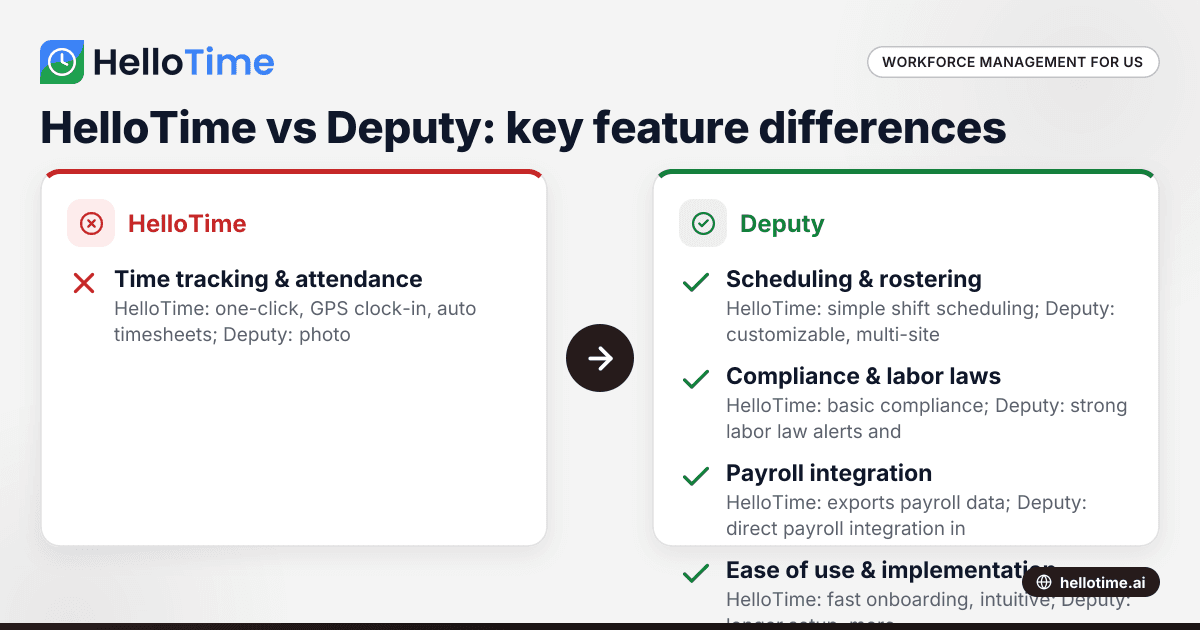
HelloTime vs Deputy: Which Workforce Management Software is Best for United States Small Businesses?
HelloTime and Deputy are popular workforce management tools offering employee scheduling, time tracking, and attendance solutions for US small.
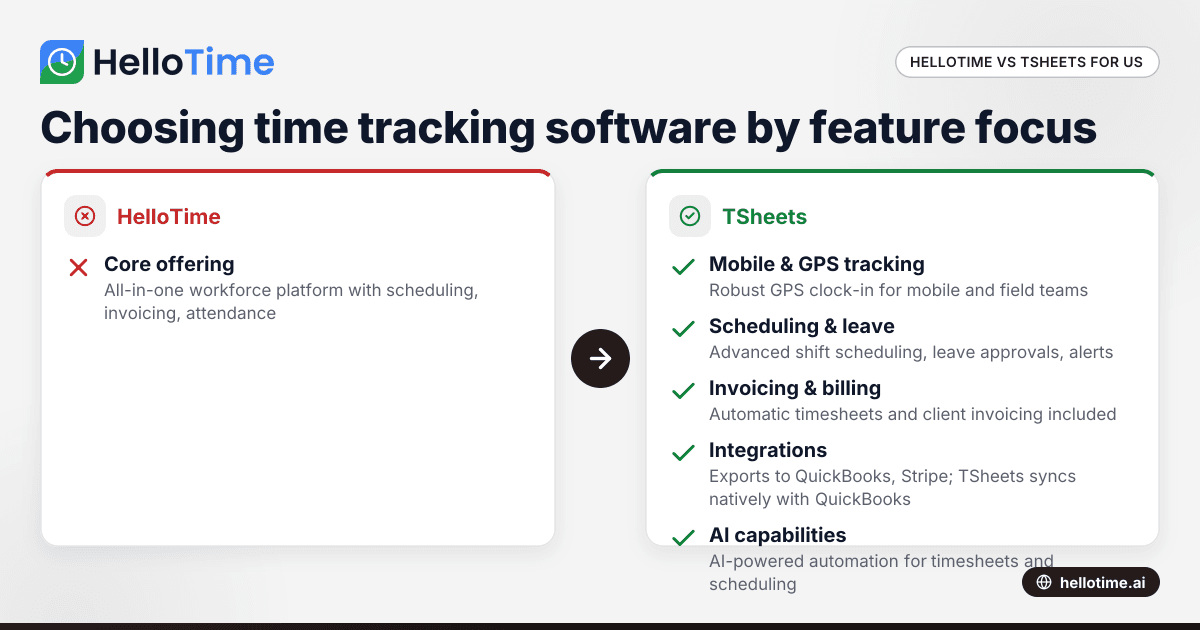
HelloTime vs TSheets: Choosing the Best Time Tracking Software for United States Agencies
HelloTime and TSheets are popular time tracking solutions for agencies and professional services in the United States. Comparing HelloTime vs TSheets.
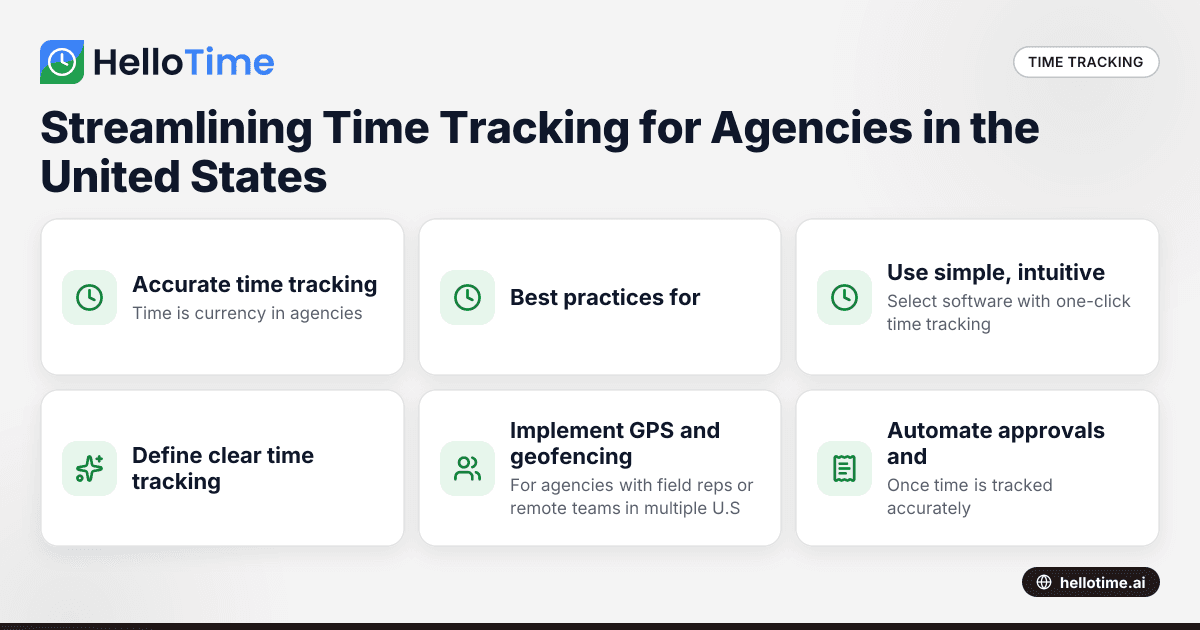
Streamlining Time Tracking for Agencies in the United States: Best Practices to Boost Client Billing Accuracy
Streamlining time tracking for agencies in the United States is essential for ensuring accurate client billing and maximizing profitability. By.