Small Business Leave Policy Template in Australia: How to Set Annual Leave, Personal Leave, Public Holiday and Approval Rules
A small business leave policy template in Australia sets out who can take leave, how requests are made, what notice is expected, who approves leave.
The HelloTime team
12 min read
On this page
A small business leave policy template in Australia sets out who can take leave, how requests are made, what notice is expected, who approves leave, and how public holidays are handled. A clear policy helps you stay fair, reduce roster gaps, and make leave records easier to manage across teams in Sydney, Melbourne, Brisbane and beyond.
Key takeaways
- A leave policy should explain annual leave, personal leave, public holidays, unpaid leave and approval rules in plain English.
- Your policy should match the National Employment Standards and any applicable modern award or enterprise agreement.
- Small businesses need clear notice, evidence and blackout-period rules to avoid confusion and staffing shortages.
- A simple template works best when paired with one system for requests, approvals, balances and records.
- Privacy matters if you collect medical or attendance information. Handle it carefully under the Privacy Act 1988 and the Australian Privacy Principles.
- This article is general information, not legal or tax advice. Check your award, agreement or adviser before issuing a final policy.
Why every small business needs a leave policy template in Australia
A leave policy is a written set of rules for how employees request and take time off. It matters because leave touches payroll, rostering, project deadlines, customer service and legal compliance.
Many small businesses still manage leave in email, text messages, paper forms or spreadsheets. That works for a while. Then someone says they told a manager last month, a public holiday falls inside annual leave, or two key staff ask for the same week off in December. Without a clear policy, the business ends up making case-by-case decisions that feel inconsistent.
A good small business leave policy template Australia businesses can use should do four things well:
- Explain leave types in simple terms.
- Set a consistent request and approval process.
- Protect staffing coverage during busy periods.
- Create records that are easy to review later.
This is especially important for businesses with mixed work patterns. A design agency in Melbourne may need to manage planned annual leave around client deadlines. A café group in Brisbane may need stricter rules for weekend and public holiday rosters. A field service business in Sydney may need notice periods that reflect booked jobs and travel time.
What should a small business leave policy include?
Your policy does not need legal jargon. It needs clarity. Most small businesses should include the sections below.
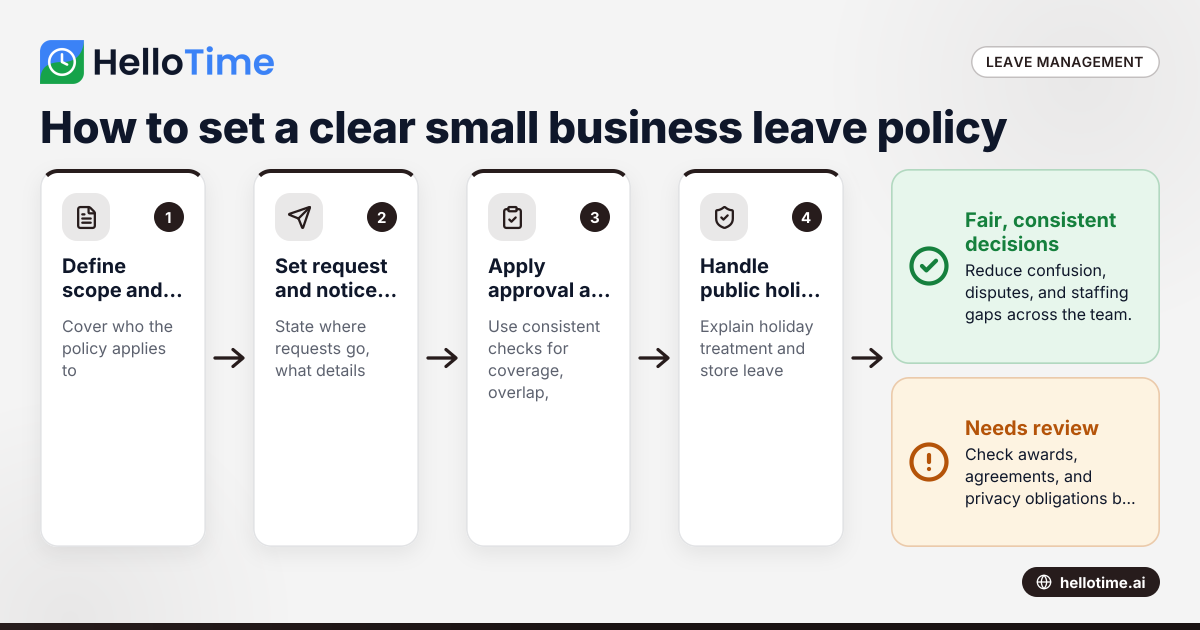
1. Purpose and scope
Start by stating who the policy applies to. For example, it may cover full-time and part-time employees, and explain that casual employees have different leave entitlements.
You can also note that the policy works alongside the employee’s contract, the National Employment Standards, and any modern award or enterprise agreement that applies.
2. Leave types covered
List the kinds of leave your business manages. For most small businesses, that includes:
- Annual leave
- Personal leave, including sick leave and carer’s leave
- Public holidays
- Unpaid leave
- Compassionate leave if you choose to mention it in your broader policy set
- Any business-specific category, such as study leave or time off in lieu, if applicable
Keep each definition short. Leave detailed accrual mechanics to your employment documents or payroll settings if needed.
3. Request process
Explain exactly how staff should apply. Include:
- Where requests are submitted
- How much notice is expected
- What details must be included
- Who approves leave
- When the employee can treat leave as approved
This section prevents many disputes. A request should never be treated as approved until the business confirms it.
4. Evidence requirements
Set out when evidence may be requested for personal leave. Keep this practical and respectful. State that the business may ask for reasonable evidence where permitted, and that personal information will be handled confidentially.
5. Approval rules
This is the heart of the policy. Explain how decisions are made when several people want the same dates. Your rules might refer to:
- Operational requirements
- Minimum staffing levels
- Existing approved leave
- Peak trading periods
- Fairness across the team
6. Public holiday treatment
Explain what happens when a public holiday falls during approved leave or on a rostered day. This is one of the most common sources of confusion in small teams.
7. Record-keeping and privacy
State how leave records are stored and who can access them. If you collect medical certificates or health information, note that access is limited to authorised staff and handled in line with privacy obligations.
What does a small business leave policy template Australia businesses use actually look like?
It should be short, clear and easy to apply. Aim for two to four pages. If it runs much longer, staff often stop reading.
Below is a practical template structure you can adapt.
Small business leave policy template
Policy title: Employee Leave Policy
Effective date: 04/10/2026
1. Purpose This policy sets out how employees request and take leave, how leave is approved, and how the business manages leave records and staffing coverage.
2. Scope This policy applies to all employees of the business. Casual employees may have different leave entitlements. This policy operates alongside applicable workplace laws, contracts, modern awards and enterprise agreements.
3. Types of leave covered The business manages annual leave, personal leave, carer’s leave, public holidays, unpaid leave and any other approved leave categories notified by the business.
4. Requesting leave
- Leave requests must be submitted through the business leave system or approved form.
- Annual leave should be requested as early as possible.
- Personal leave should be notified to the employee’s manager as soon as practicable.
- A leave request is not approved until the employee receives confirmation from an authorised manager.
5. Notice requirements Employees should provide reasonable notice for planned leave. The business may require longer notice during peak periods, for extended leave, or where rosters must be arranged in advance.
6. Evidence The business may request reasonable evidence for personal leave or other leave where permitted. Documents containing personal or health information will be handled confidentially.
7. Approval rules Leave approval will consider operational needs, staffing levels, customer commitments, safety, and previously approved leave. Where multiple requests are received for the same period, the business may consider the date of request, team coverage and fairness across the year.
8. Peak periods and blackout dates The business may limit annual leave during identified peak trading or operational periods. These periods will be communicated in advance where possible.
9. Public holidays Public holidays will be managed in line with workplace laws and any applicable award or agreement. Employees should speak with their manager if a public holiday falls during a period of approved leave.
10. Leave balances and records Employees may view their leave balances through the business system or by request. The business will maintain leave records in a secure manner.
11. Misuse or non-compliance Failure to follow this policy may affect leave approval and may be managed under the business’s usual conduct procedures.
12. Policy review The business may update this policy from time to time to reflect operational needs or legal changes.
That is the basic version. In practice, most businesses should add a little more detail under annual leave, personal leave and public holiday rules.
How do I set annual leave rules without making the policy too strict?
Keep annual leave rules simple: say how to request it, how much notice you expect, how approvals work, and when the business may refuse dates for genuine operational reasons. Staff want clarity, not pages of legal wording.
Under annual leave, your policy should cover the real issues that affect staffing.
Set a notice expectation
Avoid vague wording like “reasonable notice” on its own. Add examples that fit your business. For example:
- One day off: as much notice as possible
- One week off: request at least several weeks ahead
- Extended leave: request well in advance
You do not need to create rigid rules for every scenario. You do need enough guidance so managers apply the same standard.
Define peak periods
If your business has obvious busy periods, name them. A retailer may limit leave during major sales periods. A hospitality venue may limit leave during holiday trading peaks. A professional services firm may restrict leave during major project delivery windows or BAS preparation periods if finance support is stretched.
List blackout periods carefully. They should be genuine business needs, not a blanket ban all year.
Explain how competing requests are handled
This is where fairness matters. Your policy might say that where more than one employee requests the same dates, approval will depend on:
- Business coverage
- Skill mix on the roster
- Date the request was submitted
- Whether the employee had priority access to those dates in prior years
Managers should not rely on memory. A system that timestamps requests helps avoid arguments later.
Mention leave balances
Employees should be able to see their balances clearly. If they cannot, every conversation turns into a dispute about what is available.
How should personal leave and evidence rules work?
Personal leave rules should focus on prompt notice, respectful communication and reasonable evidence where needed. Keep the process private and practical so employees can report an illness or caring need without unnecessary stress.
Require notification as soon as practicable
Your policy should tell staff who to contact, by what time if possible, and what to include. For shift-based businesses, that could mean calling a roster manager before the shift starts. For office teams, it may mean notifying the direct manager and updating the leave system the same day.
Be careful with evidence requirements
You can state that reasonable evidence may be required. Avoid overly detailed medical demands in the policy itself. Most small businesses do not need to prescribe every document type in writing.
This section also touches privacy. Medical certificates and health details are sensitive. Keep access restricted to those who genuinely need it. If your business is covered by the Privacy Act 1988 and the Australian Privacy Principles, your handling of personal information should reflect those obligations.
Avoid over-sharing
A good policy does not force employees to disclose more health information than necessary. Managers should know whether leave is supported and how long the person may be away. They usually do not need detailed clinical information.
What should the policy say about public holidays?
Say that public holidays will be handled according to workplace law, the employee’s arrangements, and any applicable award or agreement. Keep the wording short and avoid guessing at entitlements in a generic policy.
Public holidays create confusion because they intersect with rosters, annual leave and part-time patterns.
Include practical scenarios
You do not need a legal textbook. Add a few plain-English reminders, such as:
- Employees should check rosters and approved leave before public holiday periods.
- If a public holiday occurs during approved annual leave, the business will apply the correct treatment under the relevant rules.
- Questions about rostered public holiday work should be raised with the manager in advance.
This helps staff ask the right questions early, instead of after timesheets are finalised.
Keep state and territory differences in mind
Public holidays vary by location. A business with staff in Sydney and Melbourne may not handle every date the same way. Your policy can say that recognised public holidays depend on the employee’s work location and applicable rules.
How do I write leave approval rules managers can actually follow?
Use a short approval checklist: business impact, coverage, notice, prior approvals and fairness. If a manager cannot apply the rule in one minute, the policy is too vague or too complicated.
Approval rules fail when they sound fair but give managers no method. Turn your policy into a simple process.
A practical approval process
- Check the employee’s leave balance or request type.
- Confirm the dates and total hours requested.
- Review team coverage for those dates.
- Check for overlapping approved leave.
- Consider peak periods, customer work and safety needs.
- Approve or decline promptly, with a short written reason if declined.
- Record the decision in the leave system.
This process works for both office and rostered teams.
Train managers to apply the same rule every time
Many leave disputes are not about entitlement. They are about inconsistent decisions. One manager says yes to short-notice leave. Another says no for the same situation. Your policy should reduce that gap.
This is also where an ai small business approach can help. Not by replacing manager judgement, but by making records, balances, overlapping requests and approval steps visible in one place.
Set response times
Employees should know when they can expect a decision. For example, personal leave notifications may be acknowledged the same day, while planned annual leave requests may be reviewed within a set business timeframe.
Common mistakes small businesses make with leave policies
A leave policy does not fail because it is too short. It fails because it is unclear, inconsistent or impossible to use day to day.
Mistake 1: Copying a generic policy and never tailoring it
A broad template is only a start. Your business needs rules that fit your staffing model, locations and busy periods.
Mistake 2: Ignoring awards and agreements
Your policy cannot override applicable workplace rules. If a modern award or enterprise agreement applies, your template must work with it.
Mistake 3: Using email as the approval system
Email chains get lost. Managers change. Staff forward half the conversation. A central record is much easier to trust.
Mistake 4: Not documenting why leave was declined
A short written reason improves transparency and helps if a similar request comes up later.
Mistake 5: Keeping health information too broadly accessible
Only authorised people should see personal or medical documents. This is basic good practice and supports privacy compliance.
Turning your template into a working leave process
A policy is only useful if staff and managers actually follow it. That means the process should be easy from request to approval to record-keeping.
Build one source of truth
Use one method for all leave requests. Do not mix spreadsheets, paper forms, messages and verbal approvals. A central workflow reduces mistakes and saves admin time.
For many small businesses, that means using workforce software rather than chasing forms. HelloTime can help by keeping leave requests, approvals, attendance and team visibility together with broader features for time tracking, scheduling and workforce management.
Keep reading
Related articles
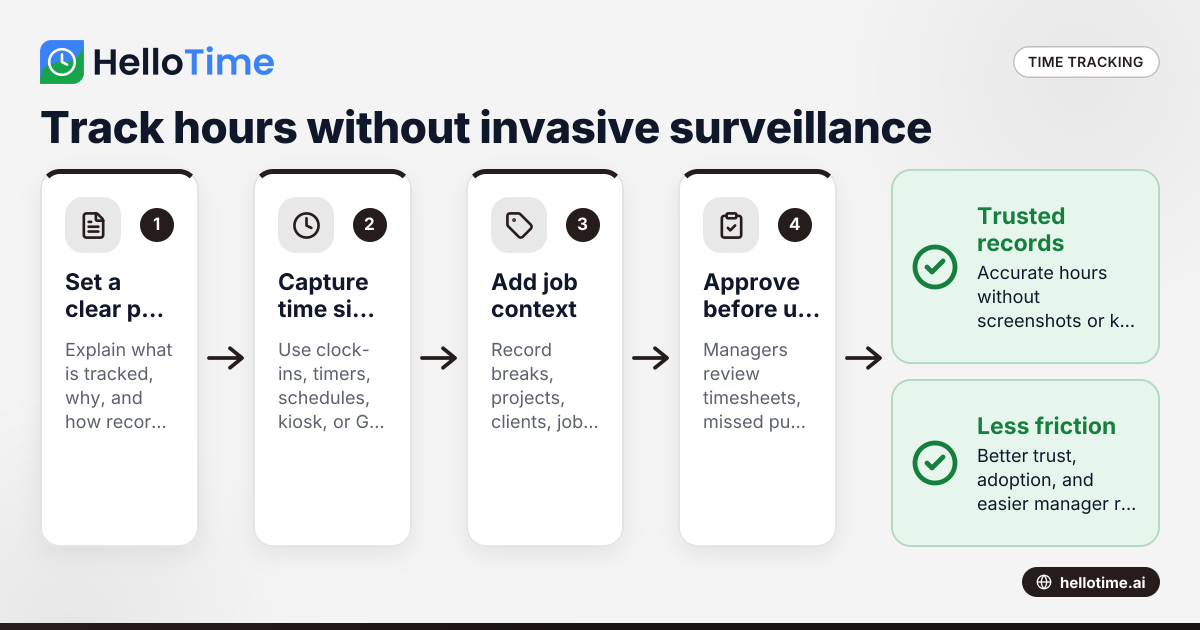
User Monitoring Alternatives in Time Tracking Software in the United States: How Small Businesses Can Track Hours Without Invasive Surveillance
If you are looking for user monitoring time tracking software in the United States , there is a better option than screenshots, keystroke logs, and.
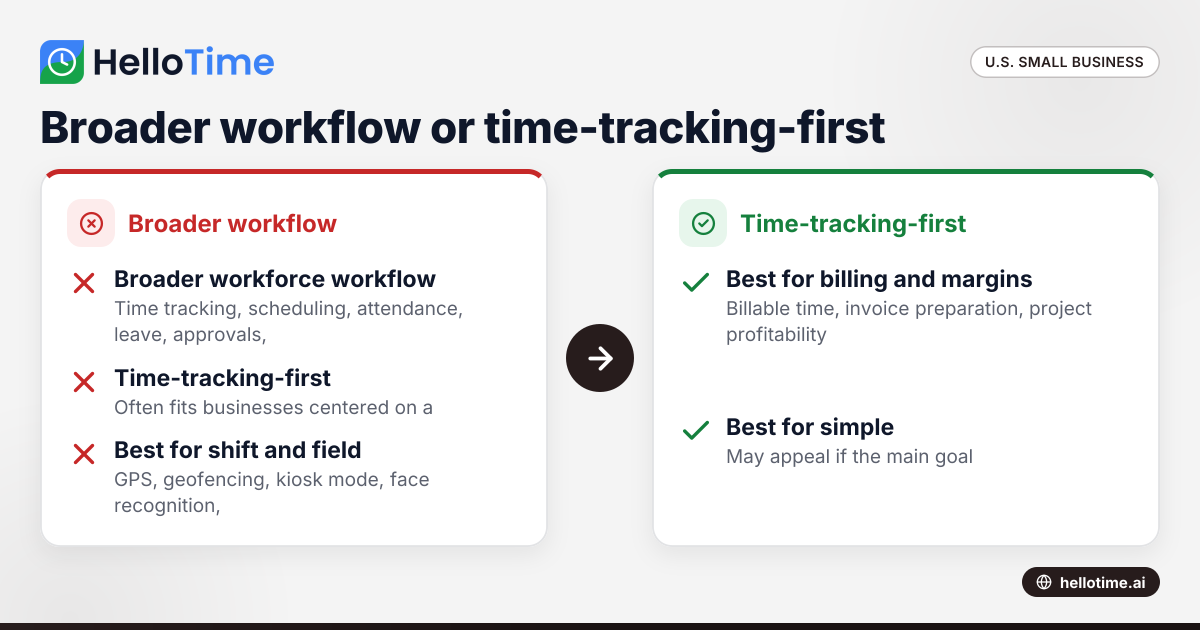
HelloTime vs QuickBooks Time in the United States: Which Is Better for Small Business Time Tracking, Scheduling, and Attendance?
If you are comparing HelloTime vs QuickBooks Time in the United States, the better fit depends on how your team works day to day. HelloTime is.
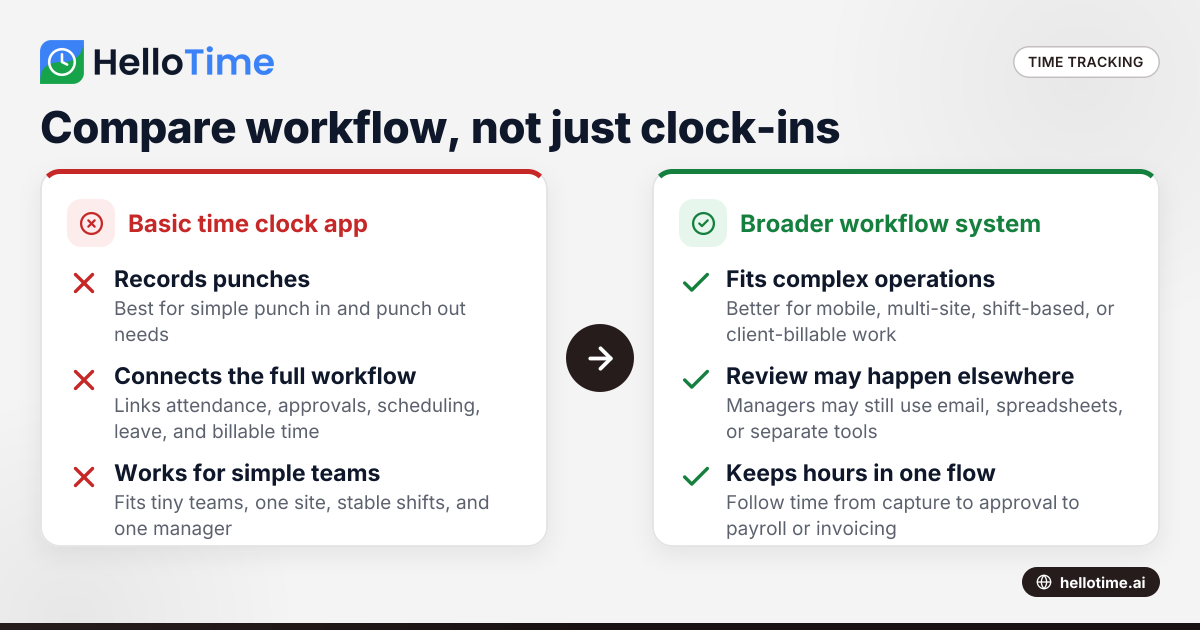
HelloTime vs Time Clock Apps in the United States: What Small Businesses Should Compare for Attendance, Approvals, and Scheduling
If you are comparing HelloTime vs time clock apps in the United States, the biggest difference is scope. Basic time clock apps record punches, while.