Small Business Payroll Deductions in United States: How to Calculate FICA, Federal Withholding, and Timesheet-Based Gross Pay
Small business payroll deductions in United States start with three basics: calculate gross pay from hours worked, subtract required employee taxes.
The HelloTime team
12 min read
On this page
Small business payroll deductions in United States start with three basics: calculate gross pay from hours worked, subtract required employee taxes and any authorized pre-tax or post-tax deductions, and then arrive at net pay. For most employers, the core pieces are timesheet-based gross pay, FICA taxes, and federal income tax withholding based on the employee’s Form W-4 and current IRS guidance.
Key takeaways
- Payroll deductions usually begin with accurate gross pay from timesheets, salary records, and overtime rules.
- FICA includes Social Security and Medicare taxes, and employers also pay a matching share.
- Federal income tax withholding depends on the employee’s Form W-4 and IRS withholding tables.
- Pre-tax deductions can lower taxable wages for some taxes, but the treatment depends on the benefit.
- Clean time tracking and approvals reduce payroll errors, re-runs, and employee disputes.
- This article is general information, not legal or tax advice, and rules can change.
What are small business payroll deductions in United States?
Small business payroll deductions in United States are the amounts taken out of an employee’s gross pay before the employee receives net pay. Some deductions are required by law. Others are voluntary and based on the employee’s benefit elections or written authorization.
The most common required deductions for many small employers are:
- Social Security tax
- Medicare tax
- Federal income tax withholding
Depending on the business and the employee, you may also see deductions for health insurance, retirement contributions, wage garnishments, or state and local taxes. This article focuses on the federal pieces most small businesses start with: FICA, federal withholding, and gross pay based on timesheets.
For hourly teams, payroll accuracy usually depends on the quality of your time records. If staff clock in on paper sheets, text managers their hours, or submit spreadsheets late, payroll deductions become harder to calculate correctly. A clean process for time capture, approvals, and leave tracking helps you get gross pay right before taxes are even considered.
How do you calculate payroll deductions for an hourly employee?
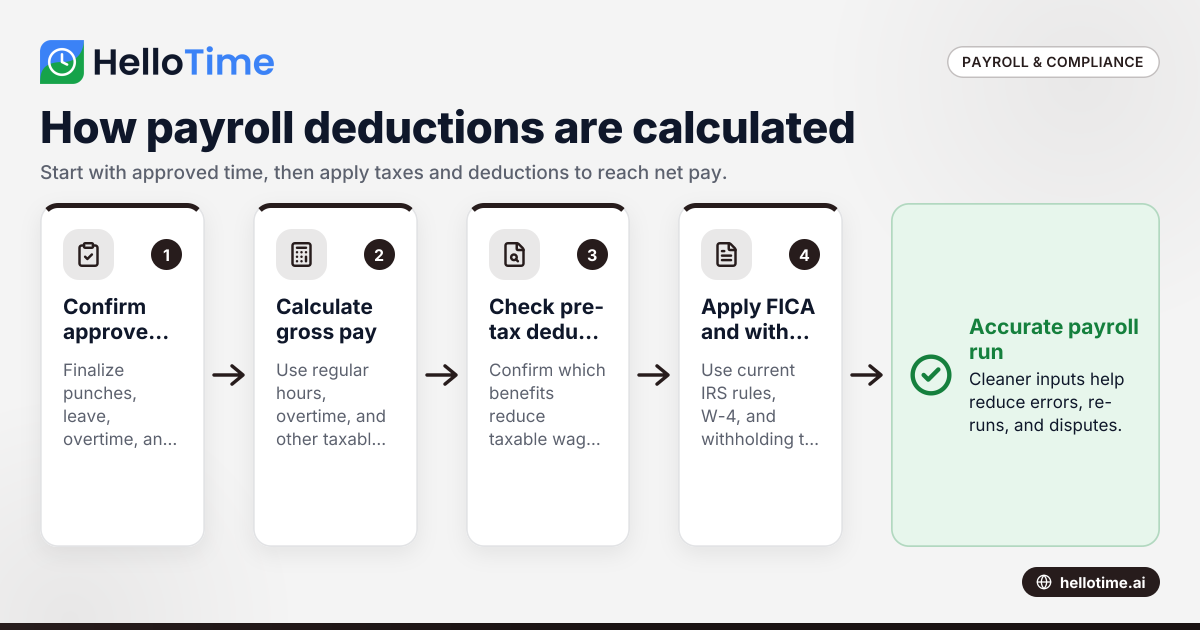
Start with gross pay from approved hours, apply overtime if required, then calculate employee tax withholding and any authorized deductions. FICA is usually a percentage of taxable wages, while federal income tax withholding comes from the employee’s Form W-4 and IRS tables.
That short version is accurate, but the real work is in the order of operations and the quality of your data.
Step 1: Calculate timesheet-based gross pay
Gross pay is the employee’s total earnings before deductions. For an hourly employee, the formula often looks like this:
Gross pay = regular hours pay + overtime pay + other taxable earnings
Example:
- Employee works 38 regular hours at $20 per hour
- Employee works 5 overtime hours at $30 per hour
- No bonus or commission this pay period
Gross pay:
- Regular pay: 38 × $20 = $760
- Overtime pay: 5 × $30 = $150
- Total gross pay = $910
If your business has shift differentials, nondiscretionary bonuses, or multiple pay rates, those earnings may also need to be included in gross wages. If you run a field service company in Houston or a restaurant group in Chicago, this is where missed punches and manual edits often create downstream payroll problems.
Step 2: Identify pre-tax deductions, if any
Some benefits are deducted before certain taxes. Common examples can include certain health plan premiums or retirement contributions. The tax treatment depends on the type of plan.
This matters because not every deduction reduces every tax. A pre-tax benefit may reduce federal income tax wages but not always Social Security or Medicare wages. You should confirm the tax treatment of each benefit before payroll runs.
Step 3: Calculate FICA taxes
FICA refers to Social Security and Medicare taxes. In general:
- Social Security tax is withheld from employee wages up to the annual wage base
- Medicare tax is withheld from employee wages, and higher earners may owe additional Medicare tax
- Employers also pay their own matching share of Social Security and Medicare taxes
Because rates, wage bases, and thresholds can change, use current IRS guidance for the year you are processing payroll.
For a small business, the practical point is simple: FICA is usually a percentage-based calculation on taxable wages, but you need the correct year’s limits and thresholds.
Step 4: Calculate federal income tax withholding
Federal withholding is based on:
- The employee’s Form W-4
- Payroll frequency
- Taxable wages for the pay period
- Current IRS withholding methods and tables
The Form W-4 no longer works like the old allowance-based system. Employees provide filing status and any other adjustments on the current form. Your payroll process should use that information exactly as entered.
Step 5: Subtract post-tax deductions
Some deductions happen after taxes. These can include certain benefit costs, garnishments, or other voluntary deductions, depending on the situation.
Step 6: Arrive at net pay
Net pay is what the employee receives after all taxes and authorized deductions are subtracted from gross pay.
Net pay = gross pay - taxes - other deductions
How do you calculate FICA and federal withholding step by step?
Calculate gross wages first, adjust for any pre-tax benefits, apply current-year FICA rules to taxable wages, then use the employee’s Form W-4 and IRS withholding tables for federal income tax. Finish by subtracting any post-tax deductions to get net pay.
Here is a simple workflow for a small business owner or payroll manager.
1. Confirm the pay period and approved hours
Before you touch taxes, make sure the timesheet is final. That means:
- All punches are in
- Missed entries are corrected
- Leave is reflected correctly
- Overtime is reviewed
- A manager has approved the record
This is where workforce tools matter. If hours come in from a mobile app, kiosk, or geofenced clock-in, you can spend less time chasing corrections. For teams exploring an ai small business workflow, the real value is often cleaner inputs, fewer manual calculations, and faster approvals rather than “AI payroll” as a magic button.
2. Determine taxable wages for the pay period
Start with gross pay. Then check whether any deductions should come out before federal income tax or before FICA taxes. Use the plan’s payroll tax rules, not assumptions.
A basic worksheet might include:
- Gross pay
- Less applicable pre-tax deductions
- Taxable wages for Social Security
- Taxable wages for Medicare
- Taxable wages for federal income tax
3. Apply Social Security and Medicare withholding
Use the current year’s IRS rules. Pay attention to:
- The Social Security wage base for the year
- Medicare withholding for all covered wages
- Additional Medicare tax rules for higher wages, when applicable
If an employee crosses the Social Security wage base during the year, withholding changes at that point. That is one reason year-to-date payroll records matter.
4. Use the employee’s W-4 for federal withholding
Federal income tax withholding is not a flat percentage for most employees. It depends on the W-4 and the IRS method you use for the pay frequency.
To avoid mistakes:
- Use the current W-4 on file
- Match the payroll schedule correctly
- Use current IRS worksheets or withholding tables
- Keep records of changes when employees submit a new W-4
5. Review employer taxes separately
The employee sees employee withholding on the pay stub. But your business also owes employer payroll taxes, including the employer share of Social Security and Medicare.
That cost does not reduce the employee’s net pay, but it does affect your labor cost and cash planning.
A simple payroll deductions example for a U.S. small business
Let’s walk through a practical example using rounded numbers for illustration only. Because tax rules and withholding methods change, do not use this as a filing calculation.
Assume:
- Biweekly payroll
- Hourly employee in Detroit
- 80 regular hours at $22 per hour
- 4 overtime hours at time-and-a-half
- No bonus
- Employee has a pre-tax health deduction of $60 for the pay period
Step 1: Gross pay
- Regular pay: 80 × $22 = $1,760
- Overtime rate: $22 × 1.5 = $33
- Overtime pay: 4 × $33 = $132
Gross pay = $1,892
Step 2: Apply the pre-tax deduction
If that health deduction is pre-tax for federal withholding and FICA under the applicable plan rules, taxable wages may be reduced. If it is only pre-tax for certain taxes, the wage base may differ by tax type.
For a simplified example, assume the $60 reduces taxable wages for both FICA and federal withholding.
Taxable wages = $1,892 - $60 = $1,832
Step 3: Calculate employee FICA withholding
You would then apply current-year Social Security and Medicare rates to the taxable wages, subject to the annual wage base and any threshold rules.
For illustration:
- Social Security withholding = taxable Social Security wages × current rate
- Medicare withholding = taxable Medicare wages × current rate
Step 4: Calculate federal withholding
Using the employee’s W-4 and the current IRS biweekly withholding method, calculate the federal income tax withholding amount for the pay period.
Step 5: Subtract deductions to get net pay
Net pay = gross pay - employee FICA - federal withholding - employee deductions
This is why payroll can feel simple at a glance but become messy in practice. The hardest part is rarely the subtraction. It is having the right wages, the right tax treatment, and the right source documents.
Why timesheet accuracy matters before payroll deductions
Payroll errors often start before payroll. They start when time entries are incomplete, shifts are edited without a trail, or leave sits in a manager’s inbox until payday.
Common timesheet problems that affect deductions
Here are the most common issues small businesses run into:
- Missing clock-ins or clock-outs
- Overtime not approved before payroll closes
- Breaks not recorded consistently
- Multiple job rates not applied correctly
- Paid leave and unpaid leave coded the wrong way
- Manual spreadsheet formulas changing from pay period to pay period
Each of these affects gross pay. And if gross pay is wrong, the tax calculations will also be wrong.
How to tighten payroll inputs
A better process usually includes:
- One system for clock-ins and timesheets
- Clear cutoff dates for approvals
- Leave balances connected to payroll inputs
- An audit trail for edits
- Reports that show exceptions before payroll runs
This is where software can help. HelloTime supports time tracking, approvals, scheduling, leave management, and attendance workflows that make payroll prep cleaner. You can review the full features if you want to see how those workflows fit together for U.S. teams.
What payroll records should a small business keep?
Keep time records, pay rates, W-4 forms, deduction authorizations, pay statements, and payroll tax filings. You should also keep audit trails for timesheet edits and approval history so you can explain how gross pay and deductions were calculated.
Good recordkeeping protects the business when an employee disputes pay, when a manager questions overtime, or when you need to recreate a prior pay run.
Core records to maintain
For each employee, keep:
- Legal name and address
- Hire date
- Pay rate or salary details
- Form W-4
- Benefit election records
- Written authorization for voluntary deductions
- Timesheets or time clock records
- Overtime approvals
- Leave records
- Pay stub details
- Year-to-date payroll registers
You should also keep employer-side records such as payroll tax deposits, returns, and any correction history.
Why does this matter for operations?
Payroll discipline reduces rework, protects employee trust, and gives managers cleaner labor data. As headcount grows, better records and approvals help you answer pay questions faster and support stronger internal controls.
If you are growing from 15 employees to 60 employees, payroll errors become more expensive. They cost admin time, manager time, and employee trust. Buyers and larger clients also expect mature internal processes. Even before a formal security review, many U.S. customers ask about controls, recordkeeping, and vendor reliability. In practical terms, payroll discipline supports cleaner operations across the business.
Common payroll deduction mistakes small businesses make
Small businesses do not usually make payroll mistakes because the math is impossible. They make mistakes because the process is fragmented.
1. Using unapproved hours
Running payroll from draft timesheets creates avoidable corrections.
2. Treating all deductions the same way
Not every benefit is pre-tax for every payroll tax. You need the right classification.
3. Using an outdated W-4 or tax method
Federal withholding depends on current IRS rules and the employee’s current form.
4. Forgetting year-to-date limits
FICA calculations can change when annual wage thresholds are reached.
5. Mixing employee withholding with employer tax cost
Employees care about net pay. Owners also need to budget for employer payroll tax expense.
6. Waiting until payday to fix attendance issues
By then, every correction is urgent. A weekly review process is usually easier.
A practical payroll workflow for small businesses
If you process payroll in-house, build a repeatable checklist. A simple process reduces mistakes whether you have 8 employees or 80.
Weekly or daily
- Capture hours in one system
- Review missed punches
- Approve leave requests
- Flag overtime early
Before payroll run
- Lock the pay period
- Approve final timesheets
- Confirm pay rate changes
- Review pre-tax and post-tax deductions
- Check year-to-date wages
- Calculate payroll
- Review exception report
- Finalize pay
After payroll run
- Share pay statements
- Store payroll reports
- Schedule tax deposits and filings
- Document corrections, if any
Many businesses start with spreadsheets and move later. That works for a while, but manual payroll prep gets harder when schedules, job sites, and headcount increase. If you want a U.S.-focused overview of where HelloTime fits, see HelloTime in the US.
Should small businesses calculate payroll manually or use software?
Manual payroll can work for a very small team with simple pay rules, but software is safer once you have overtime, multiple locations, leave tracking, or frequent timesheet edits. The bigger issue is not convenience. It is consistency, auditability, and fewer payroll corrections.
If you are deciding whether to stay manual, ask:
- How many payroll corrections did we make last quarter?
- How often do managers submit hours late?
- Do we have a single source of truth for attendance?
- Can we explain every change to a timesheet?
- How long does payroll prep take each pay period?
For many small businesses, the best first step is not changing everything at once. It is tightening time capture and approvals first. Once gross pay is more reliable, payroll deductions become much easier to calculate and review.
If your team is still using paper, shared spreadsheets, and text-message approvals, start there. Strong payroll begins with strong time records.
If you want to streamline the inputs behind payroll, explore the features at /features or compare plans at pricing.
Keep reading
Related articles
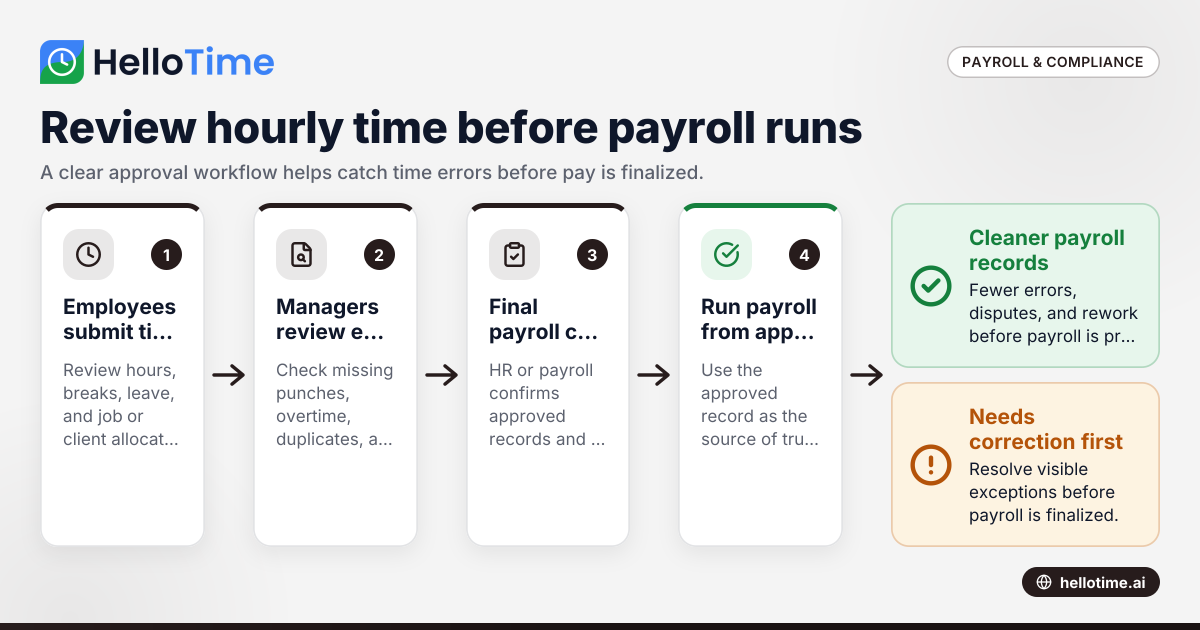
Payroll Timesheet Approval for Small Businesses in United States: How to Review Hourly Pay Before You Run Payroll
Payroll timesheet approval in United States small businesses is the process of reviewing employee hours before payroll is finalized. It helps you.
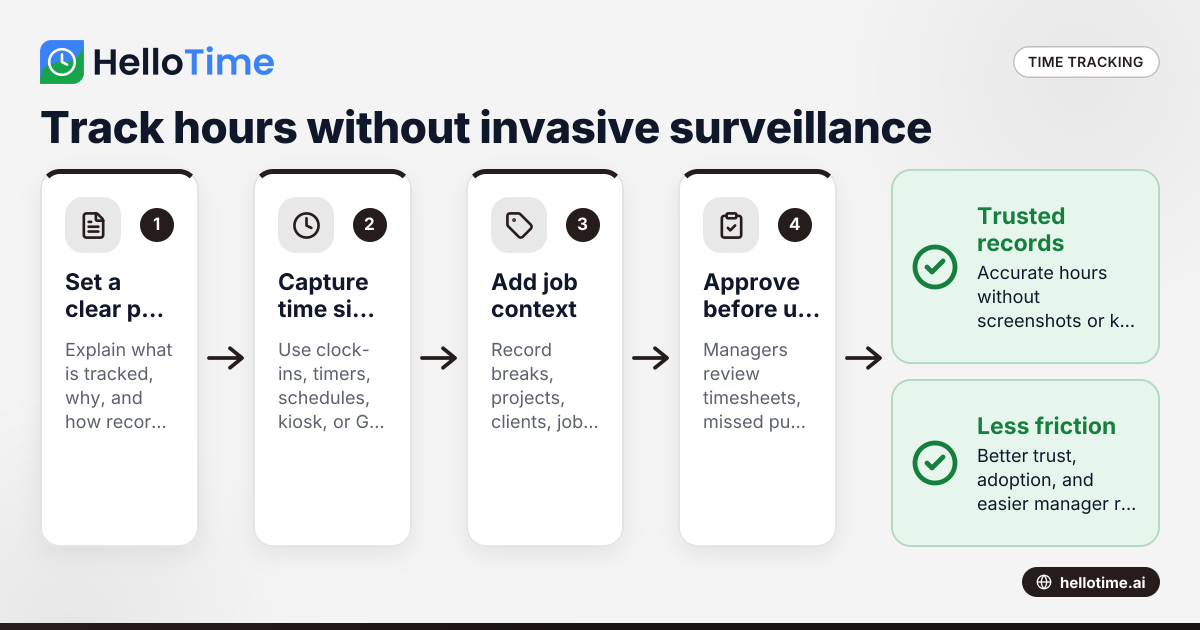
User Monitoring Alternatives in Time Tracking Software in the United States: How Small Businesses Can Track Hours Without Invasive Surveillance
If you are looking for user monitoring time tracking software in the United States , there is a better option than screenshots, keystroke logs, and.
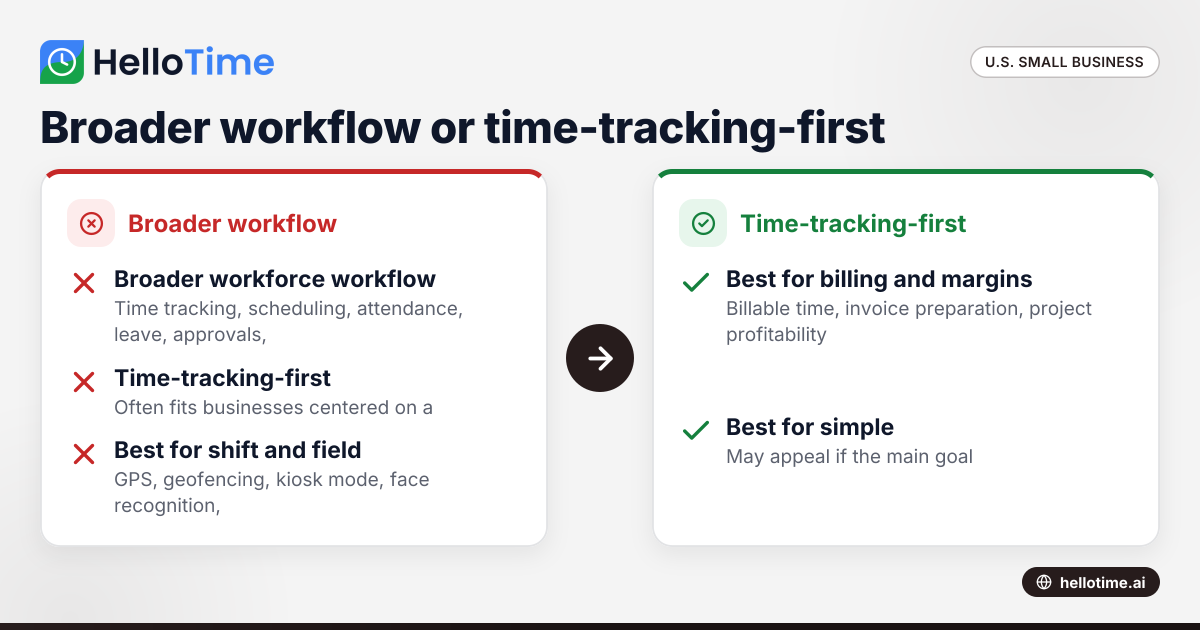
HelloTime vs QuickBooks Time in the United States: Which Is Better for Small Business Time Tracking, Scheduling, and Attendance?
If you are comparing HelloTime vs QuickBooks Time in the United States, the better fit depends on how your team works day to day. HelloTime is.