HelloTime vs Adapt in the United States for Overtime Calculation: Which Software Handles Complex OT Rules Best?
Overtime calculation rules can be complex and costly if managed incorrectly. Choosing the right software that handles these rules accurately is.
The HelloTime team
7 min read
On this page
Overtime calculation rules can be complex and costly if managed incorrectly. Choosing the right software that handles these rules accurately is crucial for U.S. businesses. HelloTime and Adapt both offer time tracking and workforce management solutions, but which one manages complex overtime calculations better? This article compares their features and capabilities to help you decide.
Key takeaways
- U.S. overtime calculation rules vary by federal and state laws, impacting software choice.
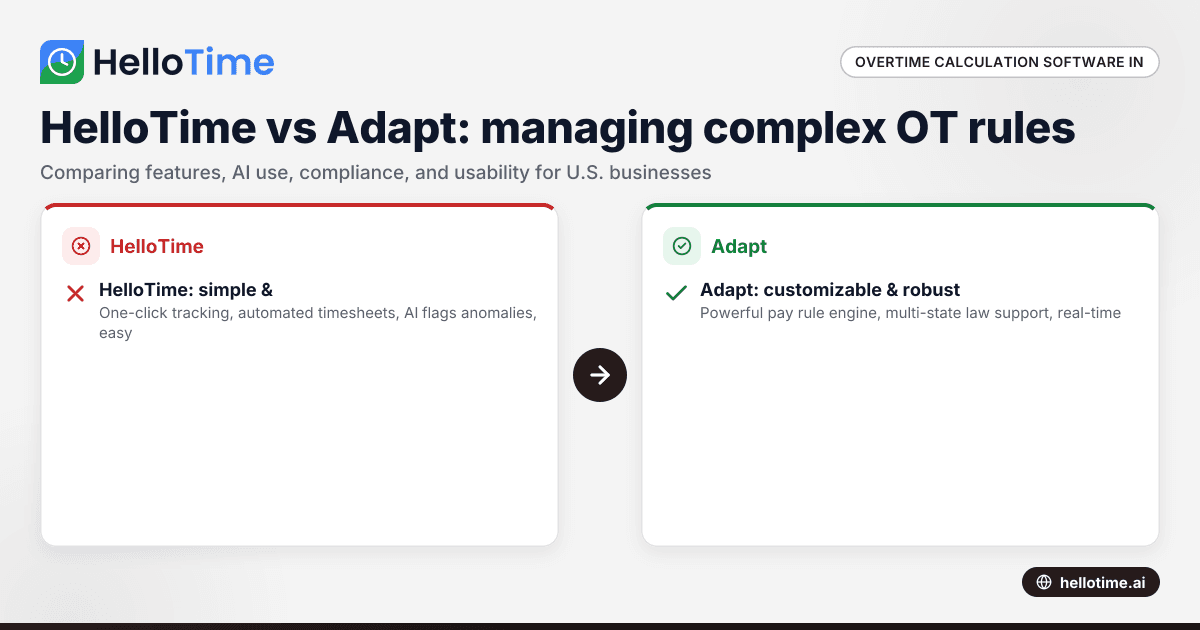
- HelloTime offers simple one-click time tracking with auto-built timesheets, easing overtime compliance.
- Adapt provides robust pay rule engines tailored to complex labor laws in multiple states.
- AI overtime calculation technologies can reduce errors, but vary in sophistication across platforms.
- For U.S. businesses, local compliance, user-friendliness, and integration with payroll are key selection factors.
- HelloTime currently does not offer full U.S. payroll but excels in tracking and compliance features.
Understanding overtime calculation rules in the United States
In the U.S., overtime rules originate mainly from the Fair Labor Standards Act (FLSA) but many states impose additional regulations. The federal standard mandates 1.5x pay for hours worked beyond 40 in a workweek. However, states like California have daily overtime rules (over 8 hours/day), and overtime exemptions vary by employee classification.
Businesses must comply with both federal and relevant state laws, or face penalties and lawsuits. Payroll and workforce management software must handle these rules automatically and accurately, especially for companies with multi-state operations. Otherwise, manual hours calculation and error-prone spreadsheets pose risks.
What features matter most in overtime calculation software?
The ideal overtime calculator should:
- Automate tracking of hours worked, including split shifts and breaks.
- Support complex rules: daily, weekly, double overtime, different pay rates.
- Adapt to changing and location-specific laws.
- Integrate seamlessly with payroll and invoicing.
- Provide clear reports for audits and compliance.
- Minimize manual errors with intelligent automation, including AI-driven calculations.
Below, we examine HelloTime and Adapt against these criteria.
How does HelloTime handle overtime calculation rules?
HelloTime offers one-click time tracking with automatic creation of timesheets and straightforward approvals. It’s designed with simplicity and compliance in mind for U.S. businesses.
- Automated timesheets: HelloTime builds detailed timesheets including regular and overtime hours according to your configured rules.
- State-specific compliance: While federal defaults apply, you can customize overtime thresholds per your state’s laws.
- AI overtime calculation: HelloTime uses AI to flag unusual work patterns or potential overtime violations early, reducing compliance risk.
- User-friendly: Managers and employees can view and manage hours through an intuitive dashboard.
- Integration: HelloTime connects with popular payroll systems used in the U.S., such as QuickBooks and Stripe.
However, HelloTime’s payroll module with statutory filings is currently not available for U.S. businesses. U.S. employers need to export data or connect it to existing payroll platforms.
What can Adapt offer for complex U.S. overtime rules?
Adapt is known for its powerful pay rule engine that allows businesses to configure detailed labor laws across different jurisdictions, including overtime.
- Flexible rule creation: Adapt supports multiple overtime calculations (daily, weekly, biweekly), with exceptions and overrides.
- Multi-state support: Its system can manage the varied labor laws of all 50 states, a benefit for growing companies.
- Real-time calculation: Overtime is calculated as shifts are entered, reducing surprise payroll issues.
- Comprehensive compliance: Adapt includes built-in updates reflecting legal changes, aiding ongoing compliance.
- Reporting and audit: Extensive reporting features provide transparency for HR and payroll audits.
Adapt’s interface may be more complex due to robust configurability, requiring some learning time.
Which software is better for AI-driven overtime calculation?
Both HelloTime and Adapt incorporate automation to assist with overtime calculations, but HelloTime stands out by using AI to proactively detect potential compliance issues. This AI overtime calculation approach helps reduce human errors, flags unusual working patterns, and supports managers with actionable alerts before payroll processing.
Adapt focuses more on enforced rule precision through configurable pay rules rather than AI insights. Businesses valuing predictive compliance might prefer HelloTime, while those needing advanced customization might lean toward Adapt.
How do HelloTime and Adapt compare for shift-based and hourly teams?
Shift-based industries such as retail, hospitality, and manufacturing often have complex overtime needs, including split shifts, shift differentials, and on-call time.
- HelloTime simplifies shift scheduling and integrates overtime with leave and attendance, making it easier to manage labor costs in one platform.
- Adapt excels in dealing with highly complex shift patterns with deep pay-rule customization but may require HR expertise to configure.
HelloTime’s user-friendly approach benefits small to mid-sized businesses new to overtime management, while Adapt suits larger enterprises with dedicated HR teams.
How straightforward is reporting and compliance management in each platform?
Accurate reporting is essential for audits, labor law compliance, and internal oversight.
- HelloTime’s reports provide clear breakdowns of regular and overtime hours. Its AI highlights anomalies, supporting quick compliance checks.
- Adapt offers customizable, detailed reports with export options that comply with state and federal regulations, suited for detailed payroll reconciliation.
Both platforms facilitate compliance but differ in complexity and depth of reports.
Can HelloTime or Adapt handle changing overtime laws effectively?
U.S. overtime laws can change at any time, especially at the state level.
- HelloTime offers timely system updates and AI-assisted monitoring to adapt overtime rules automatically.
- Adapt provides built-in legislative rule updates and offers professional support to configure changes.
Both reduce the burden on HR teams, but Adapt’s pay rule engine is often preferred by businesses needing granular control for regulatory shifts.
HelloTime vs Adapt: which is easier to set up for U.S. businesses?
HelloTime, with its straightforward onboarding and emphasis on simplicity, is easier and faster to deploy, especially for small businesses and agencies.
Adapt’s powerful customization requires more initial setup and training but offers scalability for complex organizational requirements.
Summary: Which software handles complex overtime rules best?
- For U.S. businesses seeking user-friendly, AI-enhanced overtime management integrated with time tracking, HelloTime is a strong choice.
- For companies with complex, multi-state labor law demands needing deep customization and robust pay rules, Adapt is more suitable.
- Consider your team’s size, overtime complexity, and existing payroll integrations before deciding.
Explore HelloTime features or compare plans at HelloTime pricing to see if it fits your U.S. business needs.
Frequently asked questions
Can HelloTime manage overtime rules for all U.S. states?
HelloTime supports federal overtime rules and allows customization for common state law variations. However, specifics like California's daily overtime can require manual configuration. Always confirm settings match your local laws.
Does HelloTime support AI overtime calculation?
Yes, HelloTime includes AI overtime calculation features that detect anomalies and flag potential compliance issues ahead of payroll, reducing errors and saving HR time.
Can Adapt’s pay rules handle California’s complex overtime regulations?
Adapt’s pay rule engine is designed for intricate labor laws, including California's daily and double overtime rules, making it suitable for companies operating there.
Is payroll processing available for U.S. businesses in HelloTime?
HelloTime’s payroll with statutory deductions is currently not available for U.S. businesses. Employers must export tracked hours to their payroll provider or accounting software for payment processing.
How do both platforms integrate with U.S. payroll systems?
HelloTime integrates with popular U.S. payroll and accounting platforms like QuickBooks and Stripe for seamless data transfer. Adapt also offers similar integrations but may require additional configuration.
Which is better for small businesses managing overtime in one state?
HelloTime’s simple interface and AI-powered alerts suit small U.S. businesses with straightforward overtime needs in a single state, offering a faster path to compliance.
Find out more about how HelloTime can help optimize your workforce management by checking features or see which plan matches your business at pricing.
Read next
This article covers one part of a bigger topic. For the complete picture, read our guide to hellotime vs.
Keep reading
Related articles
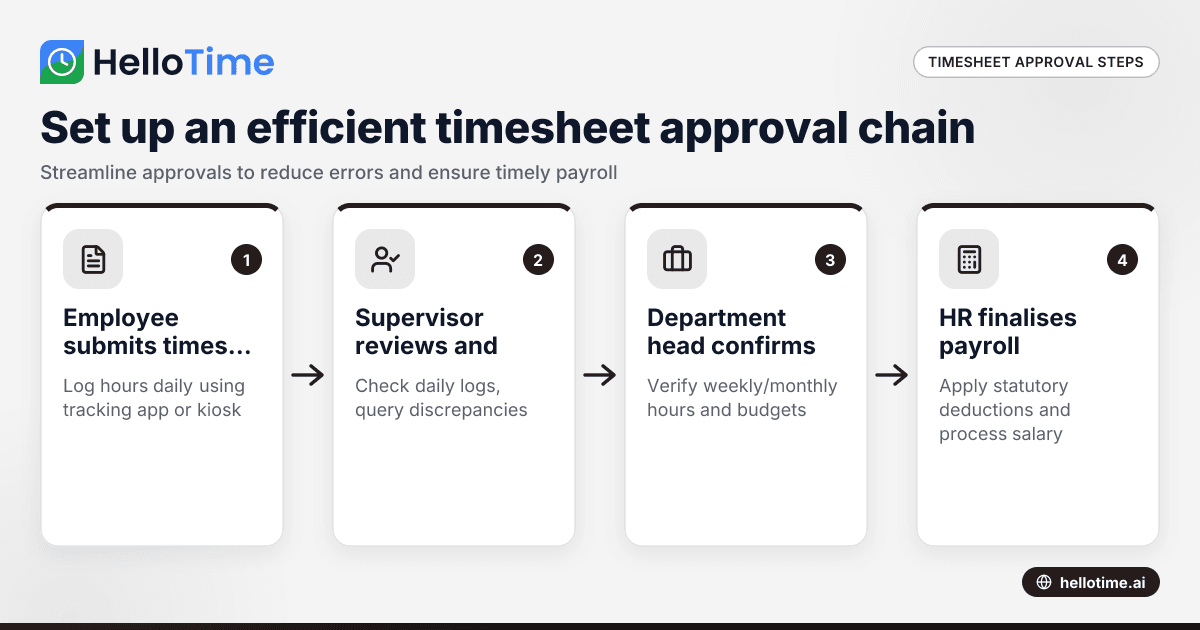
How to Set Up an Efficient Timesheet Approval Chain for Indian SMEs
How to Set Up an Efficient Timesheet Approval Chain for Indian SMEs This guide is for owners, HR, and operations managers at Indian small and.
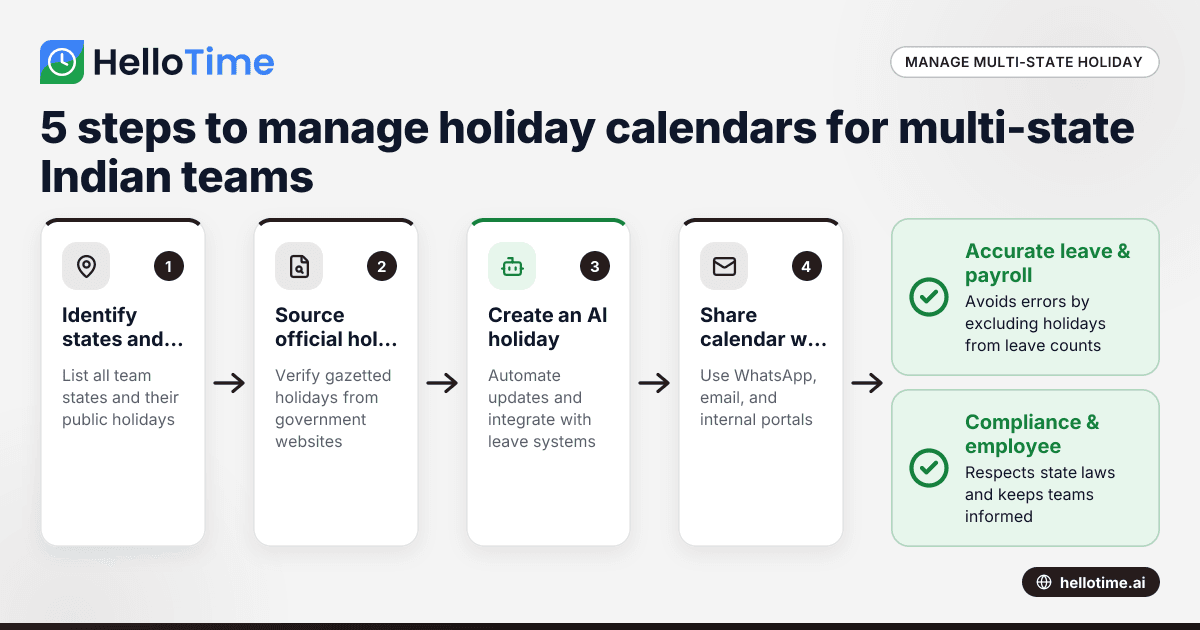
How to Manage Holiday Calendars for Multi-State Teams in India
Managing holiday calendars for multi-state teams in India can be complex due to different state-specific holidays and observances. By the end of this.
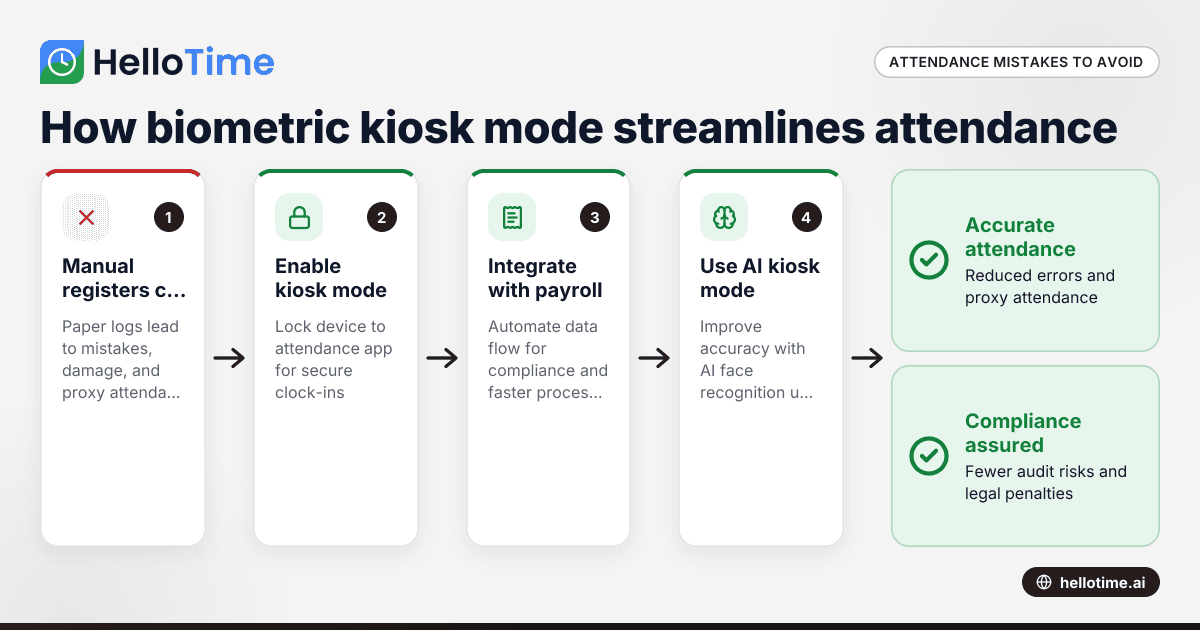
How Biometric Attendance Kiosk Mode Can Streamline Workforce Management for Indian Manufacturing Units
Manufacturing units in India often struggle with managing workforce attendance accurately and efficiently. Errors in attendance tracking lead to.