HelloTime vs When I Work: Choosing the Best Shift Scheduling Software for Retail Stores in the United States
HelloTime vs When I Work: Choosing the Best Shift Scheduling Software for Retail Stores in the United States Shift scheduling is crucial for retail.
The HelloTime team
6 min read
On this page
HelloTime vs When I Work: Choosing the Best Shift Scheduling Software for Retail Stores in the United States
Shift scheduling is crucial for retail stores in the United States to improve employee satisfaction, reduce absenteeism, and control labor costs. HelloTime and When I Work are popular options, each with distinct features suited for different retail business needs. This article compares them focusing on usability, AI capabilities, and US retail requirements.
Key takeaways
- HelloTime excels in attendance verification with GPS clock-in and face recognition, tailored for US retail stores.
- When I Work offers straightforward shift scheduling and communication, ideal for small teams.
- HelloTime’s AI-driven automation enhances accuracy and operational efficiency compared to When I Work’s basic reminders.
- Integration with US finance tools like QuickBooks and Stripe is stronger in HelloTime.
- Trialing both platforms helps determine the best fit for your retail business size and complexity.
- Consider US labor law compliance, data privacy, and communication regulations when choosing software.
What are the main differences between HelloTime and When I Work for retail shift scheduling?
HelloTime and When I Work each offer shift scheduling, but their focus diverges for US retail stores.
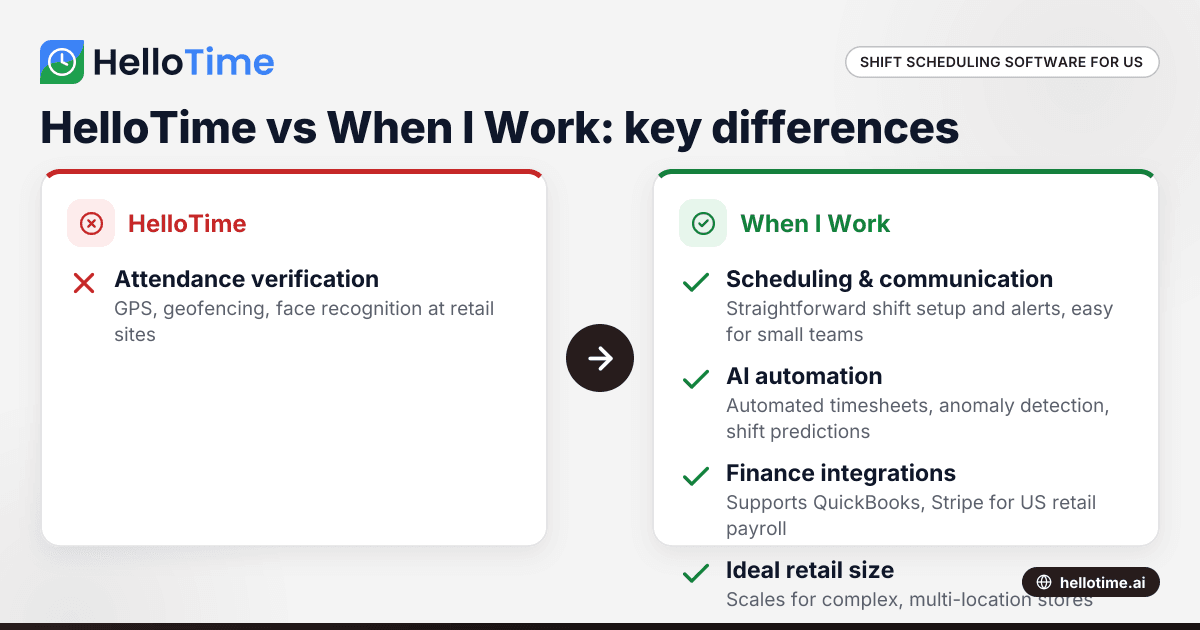
HelloTime combines shift scheduling with advanced attendance tracking, using GPS and geofencing to confirm employees are onsite at the correct retail location. Its tablet kiosk attendance with face recognition prevents buddy punching and errors. These features reduce labor costs by ensuring accurate hours for payroll and billing.
When I Work prioritizes ease of use and employee communication. It helps small retail teams create shifts, swap shifts, and send alerts quickly through its app. However, it lacks deeper attendance verification and financial reporting integrations that HelloTime offers.
HelloTime automates time tracking with AI, building timesheets and flagging anomalies. While full payroll automation isn’t available yet for US customers, HelloTime exports accurate data compatible with common accounting stacks like QuickBooks and Stripe.
How does AI impact HelloTime compared to When I Work?
HelloTime uses AI to streamline scheduling and attendance tracking, reducing manual errors and improving labor cost control.
HelloTime’s AI automates timesheet creation, detects unusual attendance patterns, and predicts shift adherence. This proactive approach helps retail managers prevent late clock-ins or unapproved overtime. It is especially valuable for retailers in cities like Chicago or Houston facing variable customer traffic.
In contrast, When I Work employs simpler automation such as shift reminders and notifications without advanced AI workforce analytics. While helpful, it does not offer predictive or anomaly detection capabilities.
The AI HelloTime vs When I Work difference positions HelloTime as a more dynamic option for US retail businesses managing complex shift patterns and onsite attendance verification.
How do you decide between HelloTime and When I Work for your retail shift scheduling?
HelloTime offers comprehensive attendance and AI-driven automation suited for larger or multi-location retailers wanting secure onsite verification and detailed reporting. When I Work suits smaller US retailers focused on rapid scheduling and team communication.
Evaluate your store’s size, attendance needs, accounting integrations, and employee tech comfort. Use free trials of both platforms to understand usability and support responsiveness. Ultimately, pick the software that balances features with ease of use for your retail operation’s priorities.
What factors should US retail businesses consider when choosing between HelloTime and When I Work?
Selecting scheduling software depends on your retail store’s specifics:
Workforce Size and Complexity: Larger chains benefit from HelloTime’s layered attendance and scheduling tools; smaller stores may prefer When I Work’s simplicity.
Onsite Attendance Verification: HelloTime’s GPS and face recognition features secure clock-in processes.
Integration with Payroll and Invoicing: HelloTime supports popular US finance tools making payroll preparation easier.
Mobile Experience: Both apps are mobile-friendly, with When I Work recognized for ease among less tech-savvy teams.
Compliance: HelloTime includes leave management in line with US labor laws, supporting time-off tracking.
Pricing and Support: Review tiered plans for growth and test customer service response during evaluations.
How easy is it to implement HelloTime or When I Work in retail stores?
Both software solutions offer online onboarding and mobile apps for staff.
HelloTime requires configuring GPS and kiosk attendance setups that might take longer initially but improve accuracy and reduce payroll errors over time.
When I Work deploys quickly with simple scheduling and communication features, favored by smaller retailers needing immediate results.
Training resources and support exist on both sides; HelloTime’s richer feature set may mean a slightly longer learning curve.
Are there any US-specific considerations for using HelloTime or When I Work in retail?
US retailers should consider these points:
Data Privacy: Both platforms comply with common US data security standards. Confirm each tool meets your store’s requirements.
Sales Tax and Payroll Processing: HelloTime’s invoicing from billable hours aligns well with US tax and payroll workflows.
Labor Law Compliance: Tracking breaks, overtime, and leave per federal and state regulations is facilitated by HelloTime’s leave modules.
Communication Compliance: When I Work ensures employee messaging adheres to TCPA rules for text outreach.
Explore HelloTime’s features or compare pricing to find the best solution for your retail store.
Frequently asked questions
Is HelloTime suitable for small retail stores with few employees?
Yes, HelloTime scales from small shops to larger retailers but is especially beneficial for stores with complex shifts or multiple locations. Smaller retailers seeking basic scheduling might find When I Work more user-friendly initially.
Does When I Work support GPS clock-in for attendance verification?
Yes, When I Work offers GPS clock-in, but HelloTime enhances security with geofencing and face recognition, providing stronger onsite attendance confirmation.
Can HelloTime integrate with QuickBooks or Stripe relevant to US retailers?
HelloTime supports invoicing from billable hours and project profitability reports that integrate well with QuickBooks and Stripe, popular in US retail finance stacks.
What kind of AI features differentiate HelloTime from When I Work?
HelloTime uses AI to automate timesheets, detect attendance anomalies, and improve shift adherence predictions, while When I Work mostly offers basic shift reminders and alerts.
Do both platforms provide US labor law compliance support?
Neither provides legal advice, but HelloTime includes leave management aligned with typical US labor regulations, assisting retailers in managing employee time off correctly.
How quickly can I implement shift scheduling software in my retail store?
When I Work allows fast deployment focused on scheduling and communication. HelloTime’s setup may take longer due to attendance and AI features but offers tools to improve accuracy and efficiency. Both provide support for smooth onboarding.
Read next
This article covers one part of a bigger topic. For the complete picture, read our guide to hellotime vs.
Keep reading
Related articles
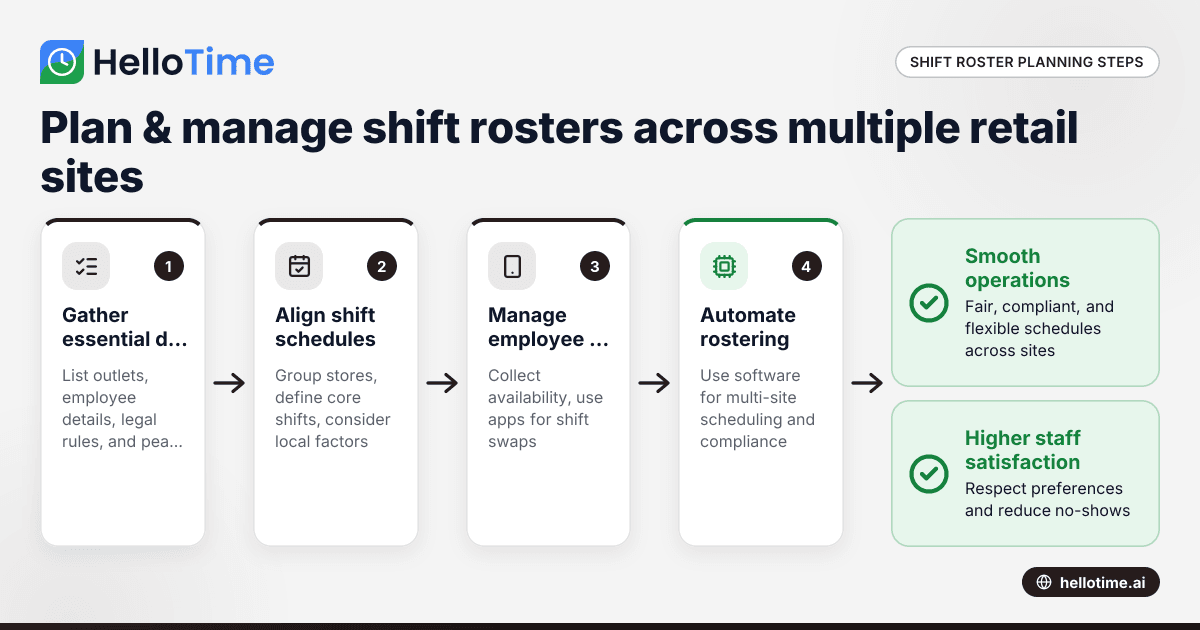
How to Plan and Manage Shift Rosters for Multi-Site Retail Chains in Mumbai and Bengaluru
How to Plan and Manage Shift Rosters for Multi-Site Retail Chains in Mumbai and Bengaluru This guide is for owners, HR and operations managers of.
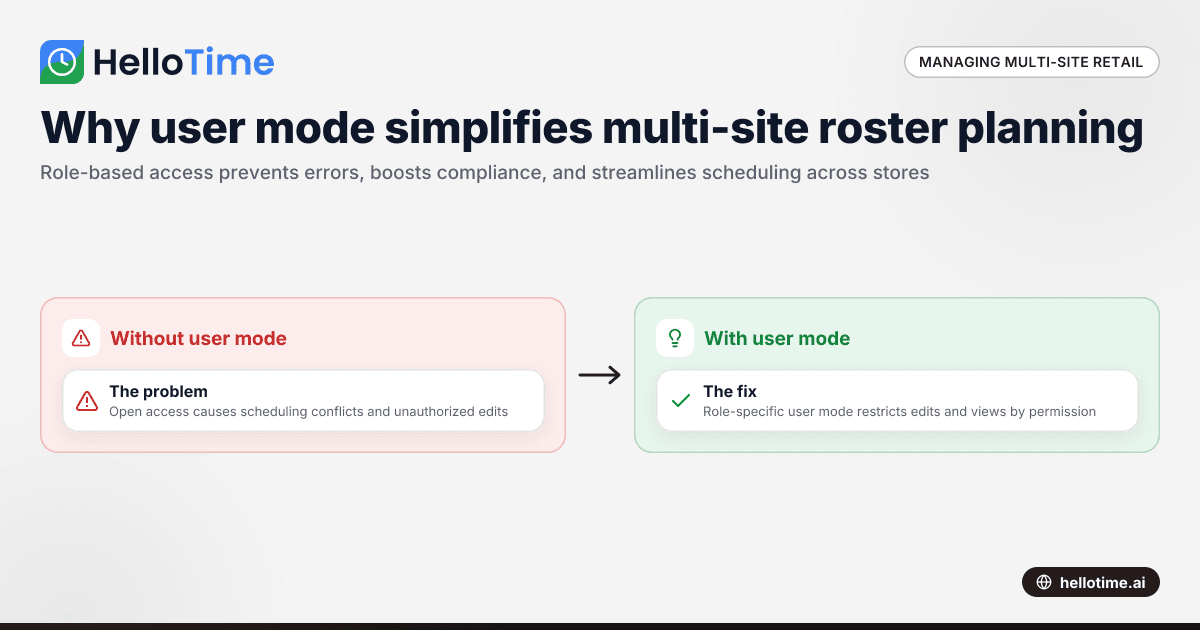
How User Mode Simplifies Managing Multi-Site Retail Roster Planning in the United States
User mode in multi-site retail roster planning customizes access and control for each user, matching their role. It prevents unauthorized schedule.
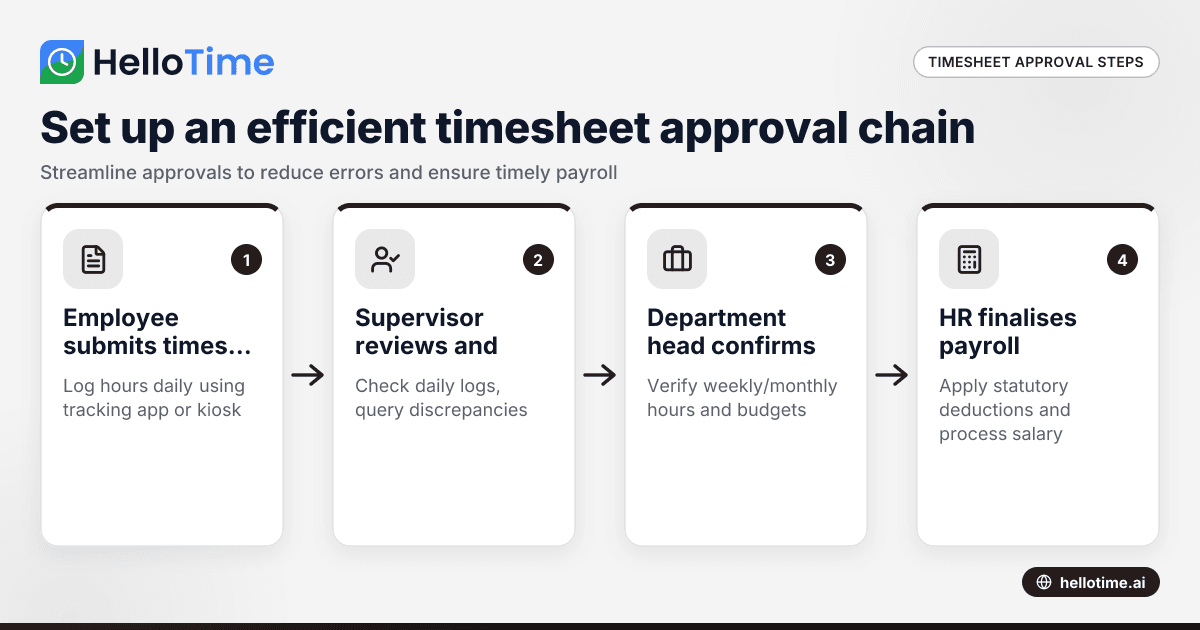
How to Set Up an Efficient Timesheet Approval Chain for Indian SMEs
How to Set Up an Efficient Timesheet Approval Chain for Indian SMEs This guide is for owners, HR, and operations managers at Indian small and.