Hourly vs Salaried Employees in the United States: How to Track Time and Calculate Pay Correctly
Hourly vs Salaried Employees in the United States: How to Track Time and Calculate Pay Correctly In the United States, hourly employees are paid for.
The HelloTime team
6 min read
On this page
Hourly vs Salaried Employees in the United States: How to Track Time and Calculate Pay Correctly
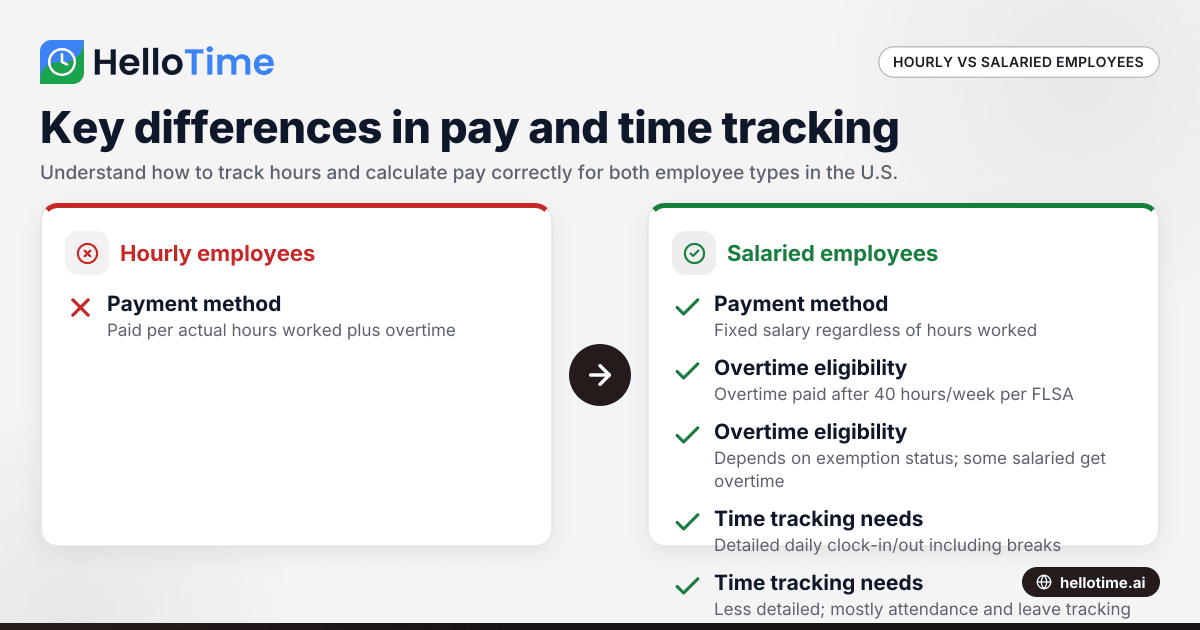
In the United States, hourly employees are paid for the actual hours they work with overtime pay for extra hours, while salaried employees receive a fixed regular pay regardless of hours worked. Knowing these distinctions helps ensure accurate payroll and compliance with labor laws.
Key takeaways
- Hourly employees must be paid for hours worked including overtime according to the Fair Labor Standards Act (FLSA).
- Salaried employees often receive a fixed salary and may be exempt or non-exempt from overtime rules.
- Time tracking for hourly workers needs detailed hour logging; salaried employees require less detailed tracking except for leave.
- Proper classification affects payroll accuracy, tax reporting, and legal compliance.
- AI hourly or salaried employee time tracking tools improve accuracy and simplify approvals.
- Misclassification risks audits, penalties, and wage disputes.
What is the difference between hourly and salaried employees in the United States?
Hourly employees earn wages based on each hour worked and get paid overtime for working more than 40 hours in a week per the FLSA. Salaried employees receive a fixed pay each pay period regardless of hours, but some salaried workers are non-exempt, meaning they still qualify for overtime. This distinction affects how you track hours and calculate pay.
The core difference is payment variability. Hourly workers’ pay depends directly on hours recorded, requiring precise time tracking. Salaried workers receive a set salary, but non-exempt salaried employees need hourly tracking to calculate any overtime.
How do I correctly track time for hourly and salaried employees?
For hourly employees, track actual clock-in and clock-out times daily, including breaks, so total hours and overtime can be accurately calculated. Salaried employees classified as exempt may only need attendance or leave logging rather than detailed hour-by-hour tracking.
Many U.S. businesses use automated digital systems with features like GPS clock-ins or facial recognition kiosks to improve accuracy and prevent time fraud. These methods fit industries like retail, hospitality, and field services with shift-based workers. For salaried workers, time tracking helps with project hours, leave requests, and payroll accountability.
How does AI hourly or salaried employee time tracking improve payroll accuracy?
AI-powered hourly or salaried employee tracking tools automate timesheets and catch errors like missed punches or unauthorized overtime. They speed up approvals and consolidate data for payroll, reducing manual mistakes and improving compliance.
Integrations with popular U.S. finance stacks such as QuickBooks and Stripe streamline invoicing and payroll preparation. With workforce complexity growing in cities like Chicago and Houston, AI-driven solutions ensure your business meets labor standards while saving HR valuable time.
Can hourly employees receive a salary, or can salaried employees be paid hourly?
Yes, employees’ pay structure can change from hourly to salaried or vice versa depending on their role and company policy, but correct classification per FLSA guidelines is essential. Some salaried non-exempt employees have overtime calculated via an hourly rate equivalent.
Misclassifying an employee’s pay type can lead to wage disputes and expensive audits. Review each role carefully to decide if the employee qualifies for exemption, which impacts overtime eligibility and payroll taxes.
What federal and state laws govern hourly and salaried employees' pay and time tracking?
The Fair Labor Standards Act (FLSA) is the main federal law governing minimum wage, recordkeeping, and overtime pay rules. However, many states have their own laws that may provide stronger employee protections.
Employers must keep accurate records of hours worked for at least three years. States like California and New York enforce strict time-tracking requirements and wage payment standards. Always check local and federal law to avoid penalties.
How to calculate pay for hourly employees including overtime
- Identify the employee’s hourly rate.
- Track total hours worked each week.
- Separate overtime hours (beyond 40 hours/week).
- Multiply regular hours by hourly rate.
- Multiply overtime hours by hourly rate × 1.5.
- Add both amounts for total gross pay.
Example: A Detroit worker earns $20/hour and works 50 hours in a week: regular pay is 40 × $20 = $800; overtime pay is 10 × $20 × 1.5 = $300. Total pay = $1,100.
How to calculate pay for salaried employees
Exempt salaried employees get a fixed pay with no overtime. For non-exempt salaried employees, calculate an hourly equivalent to determine overtime:
- Divide salary by 52 weeks.
- Divide weekly salary by 40 hours.
- Use hourly rate × 1.5 for overtime hours.
Example: Annual salary of $52,000 means weekly pay of $1,000. Hourly rate is $25. For 45 hours worked, 5 hours overtime pay equals 5 × 25 × 1.5 = $187.50 extra.
What tools can simplify time tracking and payroll compliance for hourly and salaried workers?
Digital time tracking software helps automate tracking, approvals, and payroll integration. Look for features like one-click tracking, GPS or geofence clock-ins, kiosk attendance with facial recognition, and integration with systems like QuickBooks and Stripe.
Such software reduces tracking errors and aligns with FLSA and state law requirements, saving HR teams hours weekly. AI hourly or salaried employee tracking automates timesheets and enforces compliance. Explore HelloTime’s features and pricing to find the right fit.
Frequently asked questions
What is the main difference between hourly and salaried employees?
Hourly employees are paid for actual hours worked and get overtime pay for excess hours, while salaried employees receive fixed pay regardless of hours worked, with overtime eligibility depending on exemption status under federal law.
Can salaried employees get overtime pay in the U.S.?
Yes, non-exempt salaried employees must receive overtime pay per the FLSA. Eligibility depends on salary thresholds and specific job duties as outlined by the Department of Labor.
How often should hourly employees’ work hours be tracked?
Hourly employees’ hours should be recorded daily or by shift to ensure accurate pay and overtime. Employers must retain these records for at least three years to comply with federal law.
What risks exist if I misclassify employees as hourly or salaried?
Misclassification can lead to wage violations, back pay claims, fines, and labor audits. It may damage your business reputation and cause costly legal challenges.
How can AI help manage time tracking between hourly or salaried employees?
AI tools automate time tracking, detect errors like missed punch-ins, streamline approvals, and ensure payroll accuracy. This saves administrative effort and enhances compliance with labor laws.
Explore how HelloTime can simplify your workforce management with powerful time tracking and scheduling tools designed for U.S. businesses on our features and pricing pages.
Read next
This article covers one part of a bigger topic. For the complete picture, read our guide to hourly or salaried.
Keep reading
Related articles
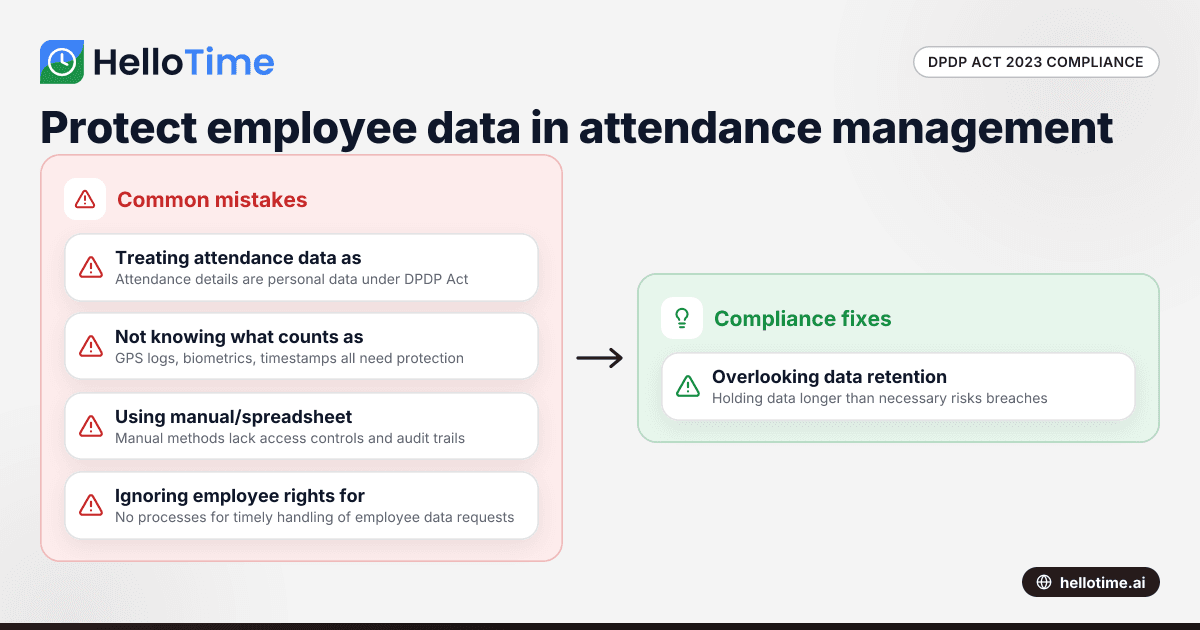
What Indian Businesses Need to Know About Data Protection Under the DPDP Act 2023 When Managing Attendance and Timesheets
Businesses tracking employee attendance and timesheets in India face growing risks if they overlook the DPDP Act 2023’s mandate for protecting.
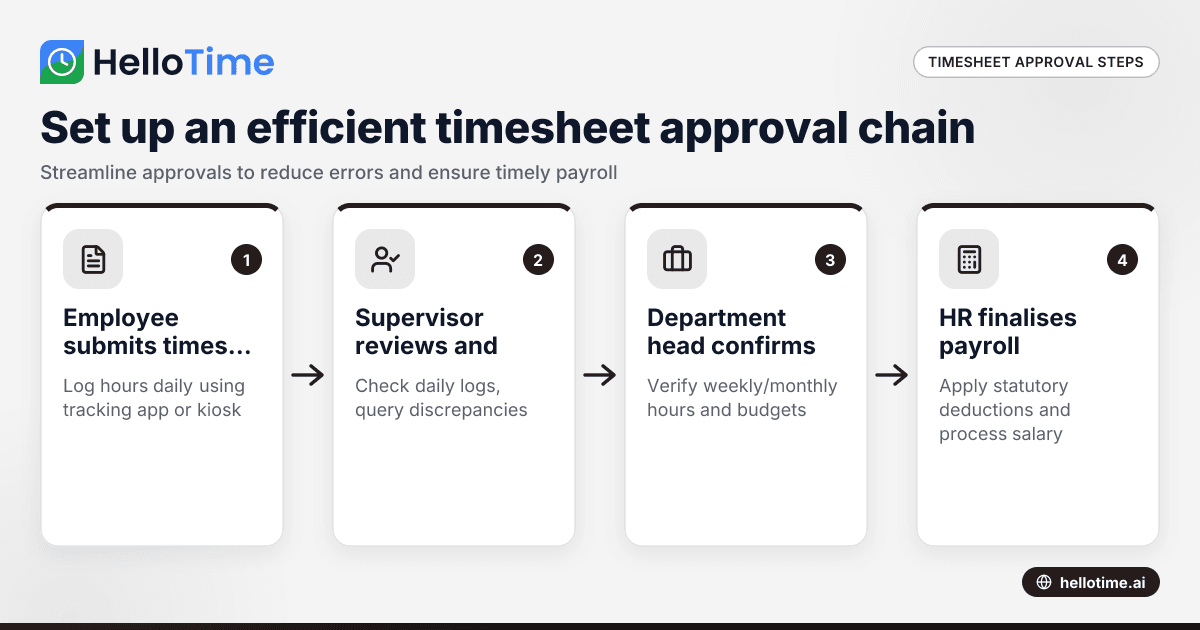
How to Set Up an Efficient Timesheet Approval Chain for Indian SMEs
How to Set Up an Efficient Timesheet Approval Chain for Indian SMEs This guide is for owners, HR, and operations managers at Indian small and.
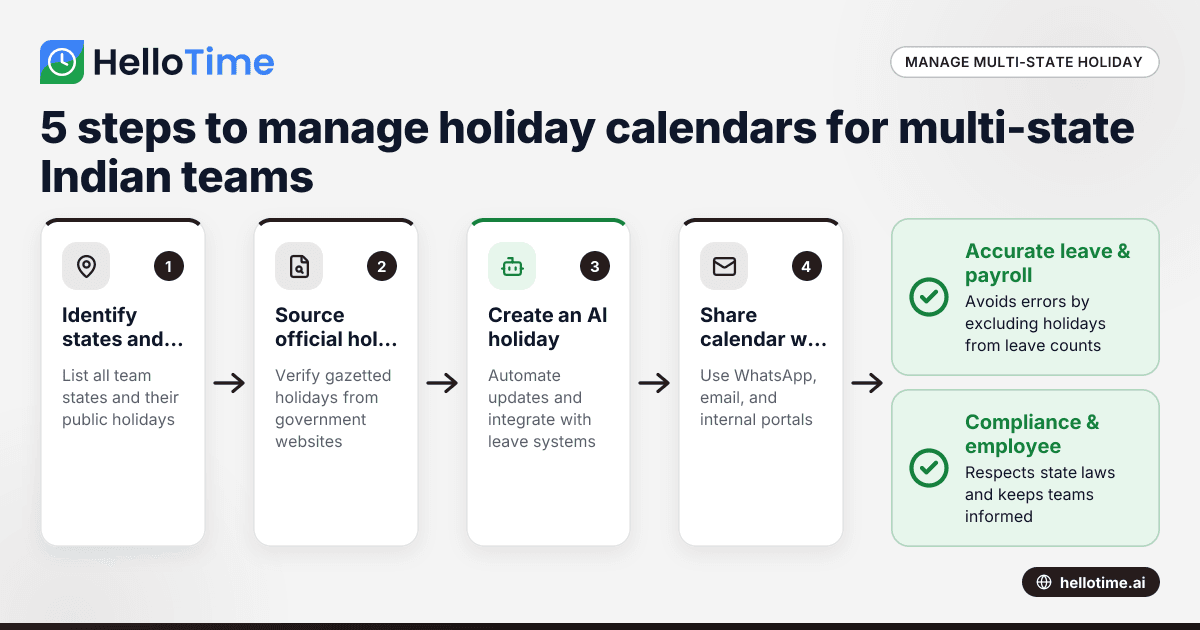
How to Manage Holiday Calendars for Multi-State Teams in India
Managing holiday calendars for multi-state teams in India can be complex due to different state-specific holidays and observances. By the end of this.