How Indian Agencies Can Calculate Utilization Rate from Timesheets for Better Profitability
Calculating utilization rate from timesheets allows Indian agencies to understand employee productivity by measuring the percentage of billable hours.
The HelloTime team
9 min read
On this page
Calculating utilization rate from timesheets allows Indian agencies to understand employee productivity by measuring the percentage of billable hours against total working hours. This insight helps optimise resource allocation, improve project pricing, and ultimately increase profitability in competitive markets like Mumbai, Bengaluru, and Pune. Accurate utilization tracking also supports compliance with Indian labour laws and facilitates smoother payroll management.
Key takeaways
- Utilization rate measures billable hours as a proportion of total hours worked.
- Accurate timesheets are essential for reliable utilization calculations.
- Agencies can increase profitability by tracking and improving utilization rates.
- Indian labour laws impact working hours and must be considered.
- AI utilization rate tools help automate and improve the accuracy of time tracking.
- Integration with payroll and invoicing ensures compliance with Indian tax laws like TDS, PF, and GST.
What is utilization rate and why does it matter for Indian agencies?
Utilization rate is the percentage of an employee’s total working hours that are spent on billable client work. For agencies operating in India, this metric is vital because it directly impacts revenue and profitability.
For example, if an account manager works 160 hours a month but only 100 hours are billable client work, their utilization rate is 62.5%. Higher utilization means more revenue generation without increasing headcount. It also helps agencies avoid underpricing projects, optimise staffing, and identify training needs to improve efficiency.
However, utilization should not be mistaken for overworking employees. A balanced utilization rate reflects optimal use of employee time while maintaining job satisfaction and quality of work.
How is utilization rate calculated from timesheets?
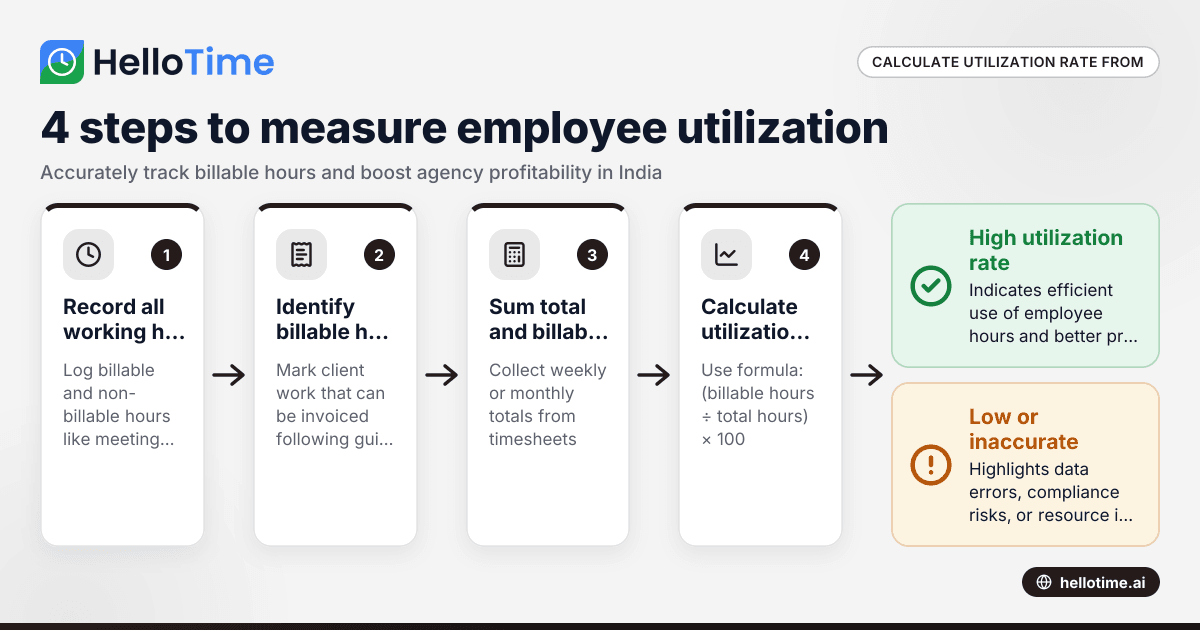
The basic utilization rate formula is:
Utilization Rate (%) = (Billable Hours / Total Hours Worked) × 100 Timesheets must capture both billable and non-billable time accurately. Non-billable work includes internal meetings, training, administrative tasks, and leave.
Steps to calculate utilization rate from timesheets
Record all hours worked daily Encourage employees or teams to record every hour worked with clear descriptions of activities such as client projects, internal tasks, or leave. Daily logging helps avoid forgotten hours and inaccurate data.
Identify billable hours Mark hours that can be invoiced to clients, such as client meetings, project execution, and deliverable preparations. Define guidelines so employees know which hours to classify as billable.
Sum total hours and billable hours for the period Collect timesheet data weekly or monthly and total the billable and overall hours.
Calculate the utilization rate using the formula Divide billable hours by total hours worked, then multiply by 100 to express as a percentage.
Example for a digital marketing agency in Pune
An employee logs these hours in a month:
- Billable project work: 120 hours
- Internal meetings and admin: 20 hours
- Leave: 8 hours (paid leave, excluded from working hours)
- Training: 12 hours (non-billable working hours)
Total working hours (excluding leave) = 120 + 20 + 12 = 152 hours
Utilization rate = (120 / 152) × 100 ≈ 78.9%
Note: Paid leave is excluded from the denominator since the employee was not working during those days.
This example shows a good utilization rate indicating efficient use of an employee’s working hours.
Pitfalls to watch out for in utilization calculation
- Inconsistent timesheet formats: Some employees may log activities ambiguously, mixing billable and non-billable tasks. Enforce standard categories and provide training.
- Including unpaid or leave hours: Paid leave should be excluded as it is not working time. However, unpaid leaves might count differently depending on company policy.
- Ignoring overtime: Overtime (approved extra hours) should be included in total working hours to measure real utilization.
- Underreporting non-billable hours: Employees may underreport meetings or admin tasks to inflate utilization; cross-check with manager approvals or project allocations.
How can AI utilization rate monitoring improve accuracy?
AI-powered utilization rate tools analyse timesheet data and classify billable versus non-billable time using pattern recognition and natural language processing. These tools learn from historical data, project descriptions, and task categories to automate classification.
Benefits of AI utilization rate tools
- Reduce manual errors: Automatically detect missing or misclassified hours, prompting employees to correct entries.
- Real-time monitoring: Managers get up-to-date dashboards showing utilization trends and workload distribution.
- Forecasting and planning: AI predicts resource needs and highlights potential under or over-utilization.
- Prevent burnout: Balances workloads by alerting managers when employees approach maximum working hours defined by Indian labour laws.
- Facilitate approvals: By suggesting proper task classifications, AI helps speed up timesheet approvals and payroll processing.
In India’s fast-paced markets like Mumbai and Bengaluru, AI utilization monitoring helps agencies maintain competitive edge by improving cost control and employee productivity.
Are there Indian labour law considerations when calculating utilization?
Yes. Indian labour laws like the Shops and Establishments Act (state-specific) and the Factories Act regulate working hours, overtime, and leave entitlements.
Key points to consider:
- Standard working hours: Usually 9 hours per day and 48 hours per week, but can vary by state and industry. For example, Maharashtra restricts weekly hours to 48 and daily hours to 9.
- Overtime: Should be paid at prescribed overtime rates. Overtime hours must be included when calculating utilization.
- Paid leave and holidays: Paid leave days and national/state holidays are excluded from working hours in utilization calculations.
- Rest intervals: Certain states require fixed break times during shifts; these should not be counted as working hours.
Ensuring timesheets comply with these rules is essential to avoid legal penalties and wage disputes. Organizations should align utilization tracking with labour law compliance to gain accurate insights.
What challenges do Indian agencies face in utilization rate calculation?
Many Indian agencies still rely on manual spreadsheets or paper timesheets causing:
- Incomplete or inaccurate data: Manual entry increases errors and data loss risks.
- Delayed approvals: Without automated workflows, timesheets wait longer for manager review.
- Difficulty in separating billable/non-billable time: Employees may misclassify tasks or mix categories.
- Lack of real-time visibility: Managers cannot promptly adjust resource allocations.
- Compliance risks: Labour law and tax deductions may be overlooked without integrated solutions.
- Multi-location challenges: Agencies operating in tier-2 and tier-3 cities struggle with clock-in accuracy and varying timesheet standards.
These factors reduce the reliability of utilization data, affecting budgeting, project pricing, and profitability.
How can you improve utilization rate calculation with software?
Software designed for time tracking and workforce management can overcome these challenges.
Features to look for:
- One-click or automated time tracking: Simplifies recording client and internal hours.
- Auto-built timesheets: Converts raw time logs into formatted reports minimizing manual work.
- Shift scheduling and leave management: Maps employee availability, approved leave, and absence to utilization calculation.
- GPS and geofenced clock-in/out: Enhances attendance authenticity for field and remote staff.
- AI-driven task classification: Automatically tags billable vs non-billable hours improving accuracy.
- Integrated payroll with Indian statutory compliance: Calculates payroll deductions automatically, including TDS, PF, ESI, Professional Tax (PT), and Labour Welfare Fund (LWF).
- Role-based access: Ensures privacy and data security compliant with India’s DPDP Act 2023.
Worked example: Using software for utilization in a Pune agency
- Employees clock in using a tablet kiosk with face recognition.
- Time tracking software automatically categorises client work vs internal meetings.
- Managers receive weekly reports showing utilization and can approve timesheets with one click.
- Payroll processes use same data for salary calculation including PF, ESI deductions.
- Agency avoids disputes over unpaid overtime or misclassified hours.
This reduces administrative overhead and empowers agencies to focus on project delivery and growth.
HelloTime offers many of these features tailored to Indian businesses. You can explore how it supports your team’s time tracking, scheduling, and payroll on our features page.
How do utilization rates impact agency profitability in India?
Higher utilization generally leads to increased billable hours without raising overhead costs, directly boosting revenue. However, it must be balanced against employee well-being to avoid burnout, absenteeism, and reduced quality.
Agencies in Mumbai, Bengaluru, Pune and other hubs use utilization data to:
- Price projects accurately: Understand hourly resource cost vs billable output to set profitable rates.
- Identify inefficiencies: Low utilization may expose idle staff or under-scoped projects.
- Adjust staffing: Hire or reallocate based on workload trends.
- Target training: Address skill gaps to enhance billable outcomes.
Example financial impact
An agency with a ₹10 lakh monthly salary bill and average utilization of 70% generates ₹7 lakh in billable hours. Increasing utilization to 80% raises billable hours to ₹8 lakh, improving profit margins without extra salaries.
Sustained utilization improvement therefore strengthens the business’s competitive position in price-sensitive Indian markets.
Which metrics complement utilization rate for a fuller picture?
Utilization rate alone doesn’t tell the whole story. Complement it with:
- Realization rate: Actual billed hours as a proportion of billable hours. Reveals billing efficiency.
- Project profitability: Revenue minus costs including salaries and expenses per project.
- Employee turnover rate: High turnover disrupts utilization continuity and increases hiring costs.
- Overtime hours: Excessive overtime may signal unsustainable workloads.
- Absenteeism and leave patterns: Affect resource availability and utilization accuracy.
Together, these KPIs enable Indian agencies to make informed workforce and business decisions.
Frequently asked questions
What is considered a good utilization rate for Indian agencies?
Industry norms vary, but a utilization rate between 70-85% is typical. A 75% rate balances billable work with time for internal tasks like training, meetings and administrative duties. Agencies should track trends and adjust goals based on business context.
Can utilization rates be too high?
Yes. Consistently exceeding 90% indicates potential employee overload, increasing the risk of burnout, errors, and attrition. Sustainable agencies set limits to protect work-life balance while driving profitability.
How does utilization rate differ from productivity?
Utilization focuses on the ratio of billable time to total hours worked. Productivity, on the other hand, measures the quality, output volume, or value produced during working hours regardless of billing. Both are important but serve different management purposes.
How do payroll deductions affect utilization calculation?
Deductions like PF, ESI and TDS do not change utilization percentages, since these measure time, not pay. However, they impact the effective cost of each employee hour, which is essential when calculating profitability per project or client.
Can AI utilization rate tools ensure compliance with Indian data protection laws?
Yes. Compliance with the Digital Personal Data Protection (DPDP) Act 2023 requires time tracking tools to securely store personal data, limit access, and inform employees on usage. Reputable AI-powered software solutions adhere to these norms to protect privacy and business integrity.
Calculating and understanding utilization rate from timesheets is key to improving agency profitability and workforce management in India. To explore how modern features like AI-driven time tracking, automatic timesheets, and payroll compliance can benefit your business, visit HelloTime and view our features or compare plans on our pricing page.
Read next
This article covers one part of a bigger topic. For the complete picture, read our guide to utilization rate.
Keep reading
Related articles
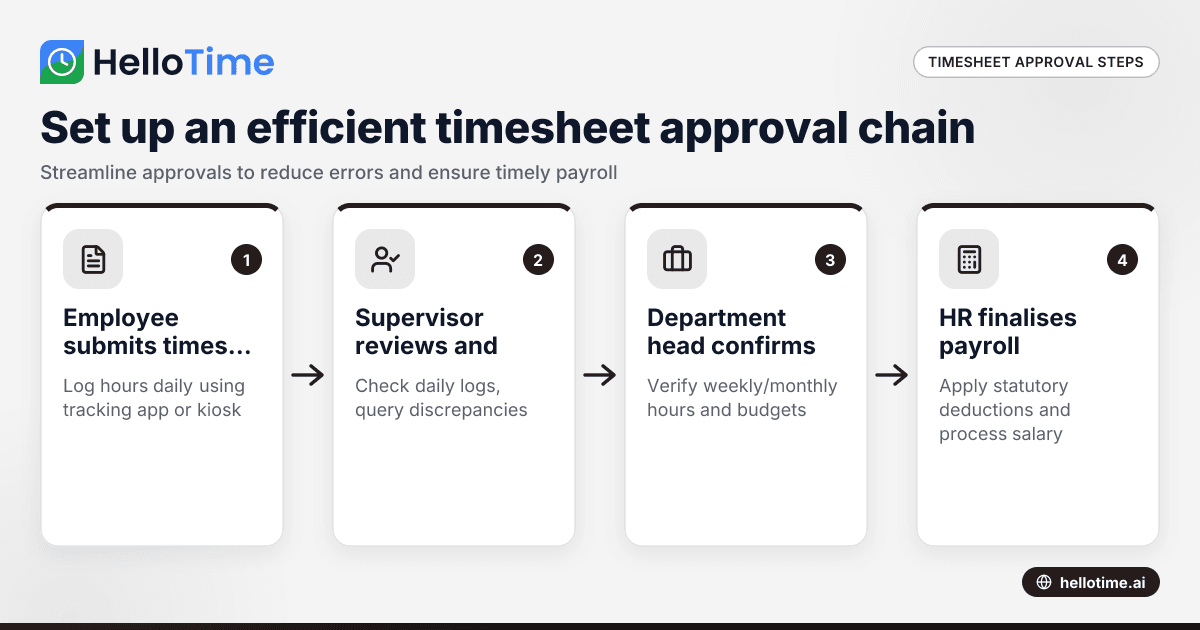
How to Set Up an Efficient Timesheet Approval Chain for Indian SMEs
How to Set Up an Efficient Timesheet Approval Chain for Indian SMEs This guide is for owners, HR, and operations managers at Indian small and.
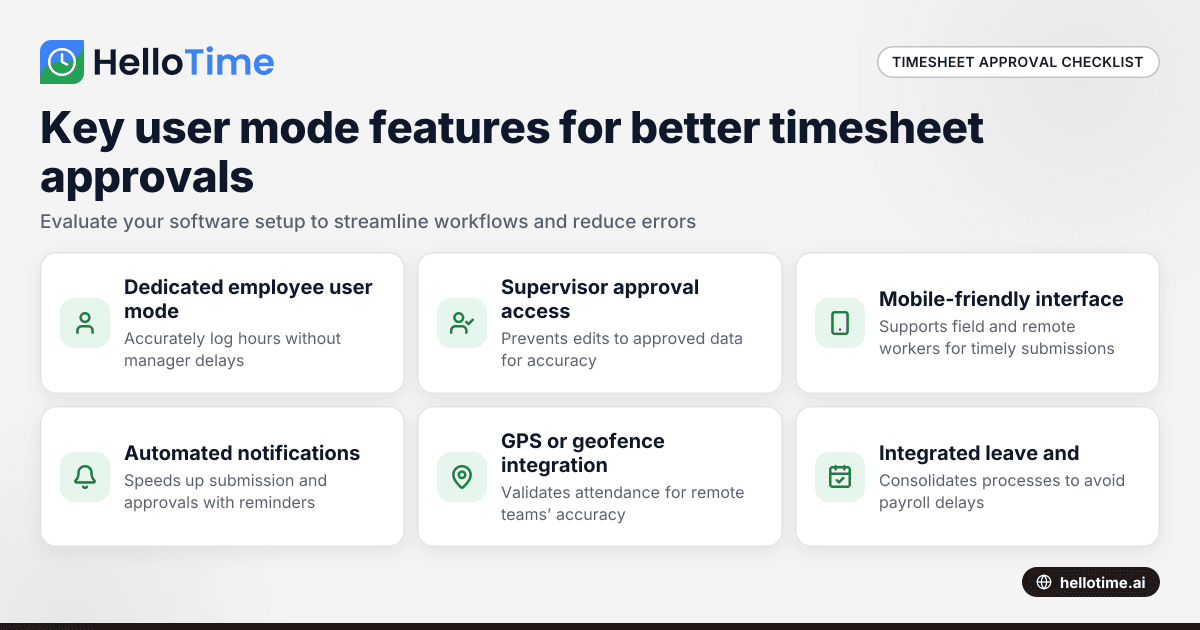
How User Mode Enhances Timesheet Approval Workflow for Indian Small Businesses
How User Mode Enhances Timesheet Approval Workflow for Indian Small Businesses.
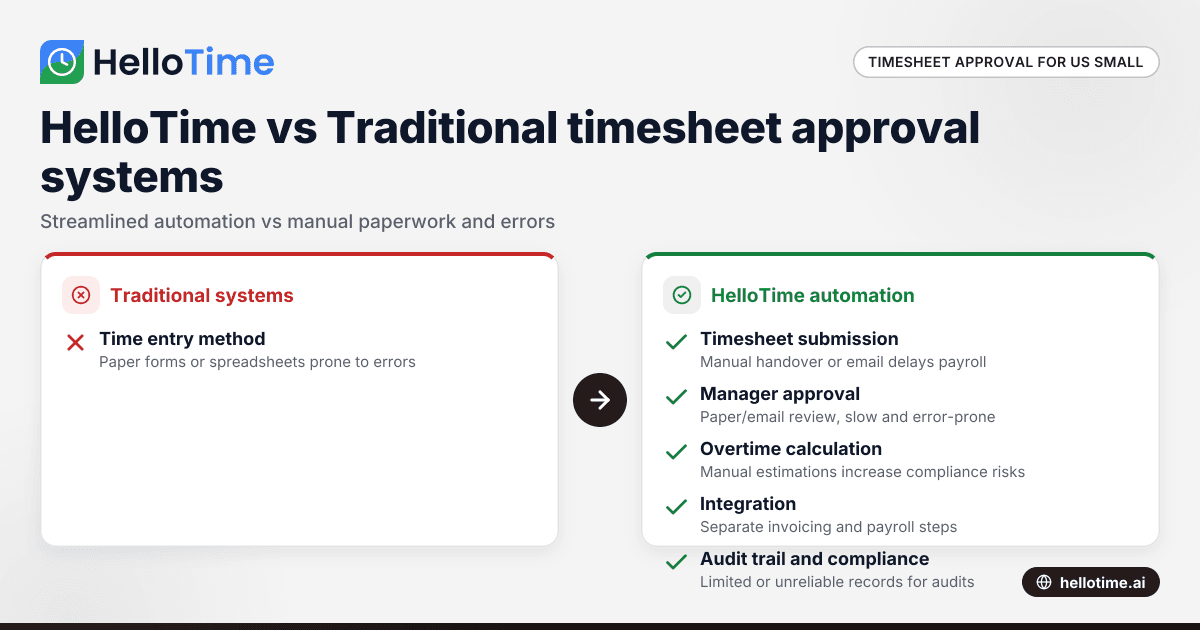
HelloTime vs Traditional Timesheet Approval Systems: Advantages for United States Small Businesses
HelloTime vs Traditional Timesheet Approval Systems: Advantages for United States Small Businesses When comparing HelloTime vs traditional timesheet.