How Security Guarding Agencies in the United States Can Use Timesheet Approval Workflows to Prevent Payroll Errors
Security guarding agencies in the United States can reduce costly payroll errors by implementing timesheet approval workflows. These workflows ensure.
The HelloTime team
7 min read
On this page
Security guarding agencies in the United States can reduce costly payroll errors by implementing timesheet approval workflows. These workflows ensure that employee hours are verified and approved before payroll is processed, improving accuracy, compliance, and operational efficiency.
Key takeaways
- Payroll errors in security agencies often stem from inaccurate or incomplete timesheets.
- Timesheet approval workflows add a verification layer to prevent mistakes and fraud.
- Automation and digital tools, including AI security guarding systems, simplify approvals.
- Agencies can customize workflows to suit various shifts, overtime, and client billing needs.
- Accurate timesheets help with regulatory compliance and improve employee trust.
- Integrating time tracking and payroll processes reduces manual entry and human error.
Why are payroll errors common in security guarding agencies?
The security industry relies heavily on accurate tracking of shifts and hours worked because guards are often paid hourly or via shift rates. Payroll can get complicated due to multiple shifts, overtime, holiday pay, or split shifts. Manual recording on paper or spreadsheets is prone to errors, leading to underpayment or overpayment.
In many security agencies, guards work variable schedules, sometimes across multiple client sites. Without a reliable timesheet approval workflow, inaccurate or fraudulent hours can slip through, causing budget headaches and compliance risks with laws such as the Fair Labor Standards Act (FLSA).
How can timesheet approval workflows prevent payroll errors?
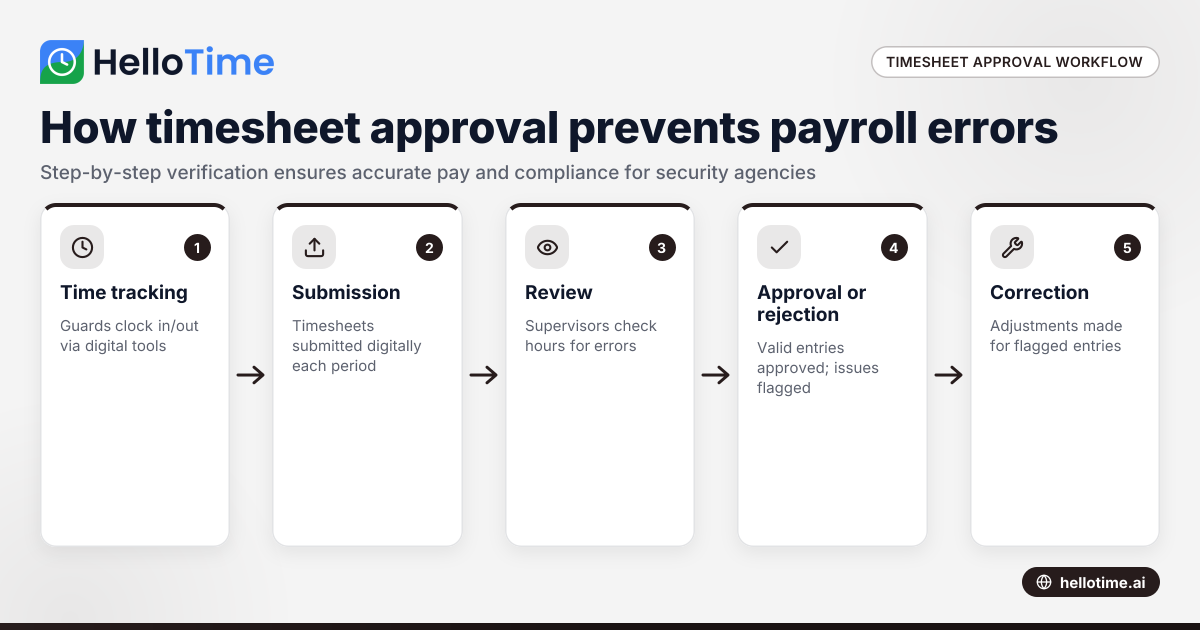
A timesheet approval workflow ensures every recorded time entry goes through at least one level of review before payroll processing. Here’s how it works:
- Time tracking: Guards clock in and out using software or kiosks.
- Submission: Timesheets are submitted digitally at the end of each pay period.
- Review: Supervisors or managers review hours, checking for inconsistencies.
- Approval or rejection: Valid entries are approved; errors or questionable records are flagged.
- Correction: Guards or managers make necessary adjustments.
- Final payroll processing: Only approved timesheets feed into payroll systems.
This multi-step process catches errors early, reduces manual corrections, and ensures payroll is based on verified data.
What role does "AI security guarding" play in timesheet approval?
AI security guarding technology enhances time tracking by automating attendance verification and anomaly detection in recorded hours. It can flag unusual clock-in patterns or overtime claims that deviate from typical behavior, supporting managers in quickly spotting timesheet discrepancies and approving accurate records.
AI analytics can also optimize scheduling and staffing by predicting when guard shortages may cause overtime, allowing preemptive adjustments that reduce payroll surprises.
What are the best timesheet approval practices for security guarding agencies?
Follow these practical steps to optimize your workflow:
- Use digital time tracking tools: Replace paper or Excel timesheets with software that supports easy clock-ins via mobile apps, tablets, or biometric kiosks.
- Set clear approval policies: Define who approves timesheets and the timeline to do so for each client site or team.
- Train supervisors and staff: Educate managers on common payroll mistakes and how to review timesheets effectively.
- Implement multi-level approvals when needed: For agencies with complex shifts or subcontractors, use tiered reviews.
- Automate alerts and reminders: Ensure approvers get timely notifications before payroll deadlines.
- Integrate timesheets with payroll systems: This reduces manual entry and syncing errors, especially if you use prevalent finance stacks like QuickBooks or Stripe.
With these measures, agencies protect their finances and build trust with guards who rely on timely, accurate pay.
How do timesheet approval workflows support compliance in the US?
Accurate employee time records are critical for complying with federal and state labor laws, such as the FLSA and varying state overtime rules. They also help demonstrate adherence during audits by the Department of Labor or state agencies.
By using structured approval workflows, agencies can document who verified hours and what adjustments were made. This traceability reduces risk of penalties related to misclassification, wage disputes, or unpaid overtime. It also supports proper reporting of contracted labor where 1099 filing might apply, ensuring the agency meets tax obligations.
How do security guarding agencies customize timesheet workflows for different shifts?
Many agencies manage several shift types — day, night, split shifts — and need workflows flexible enough to handle this complexity. Options include:
- Allowing different approvers for certain teams or shifts.
- Setting rules to automatically flag overtime or hours exceeding client contracts.
- Enabling guards to submit notes for exceptions or missed clock-ins.
- Using geo-fenced clock-in tools to confirm the guard was onsite.
Custom workflow configurations ensure approvals meet operational realities and reduce errors caused by unusual shifts.
What is the impact of integrating timesheet approvals with payroll software?
Integration between approved timesheets and payroll software streamlines the payment process. Payroll managers no longer need to manually enter hours, lowering human error risk and processing time. With seamless syncing, agencies can:
- Launch payroll runs faster and with confidence.
- Generate accurate client invoices for billable hours.
- Track employee costs and project profitability in real time.
This integration is especially useful for shift-based agencies billing clients by hours worked.
How can a security guarding agency get started with timesheet approval workflows?
Security guarding agencies can begin by selecting time tracking software that supports approval workflows and integrates well with existing payroll or accounting platforms. Start small with one team or client site, setting up basic approval steps and training supervisors. Gradually expand as processes become familiar.
Many solutions offer mobile tools, geo-fencing, and automated alarms for missed approvals — features that boost compliance and convenience. Evaluate options based on your agency’s size, client demands, and complexity of shifts.
For agencies wanting to utilize automation fully, consider exploring features that support streamlined approvals and clock-in accuracy.
Conclusion
Timesheet approval workflows provide a vital control for security guarding agencies in the United States to prevent payroll errors. They enhance financial accuracy, legal compliance, and operational efficiency. By combining digital time tracking, intelligent review steps, and integration with payroll, agencies protect their business and employees. Explore how these workflows can simplify your timesheet management and payroll process by checking out our pricing and features.
Frequently asked questions
What are the main causes of payroll errors in security guarding agencies?
Payroll errors often come from manual timesheet errors, missed clock-ins, inconsistent shift records, or fraudulent time reporting. Poor communication between guards and supervisors and lack of verification processes are common contributors.
How does AI improve timesheet accuracy for security guards?
AI systems can automatically detect unusual punch-in/out times, highlight overtime spikes, and cross-check attendance against schedules. This helps managers spot and correct inconsistencies before payroll runs.
Can timesheet approval workflows help with client billing?
Yes. Approved timesheets provide verified hours that can directly feed into client invoices, reducing billing disputes and improving revenue recognition for hourly or shift-based contracts.
What should a security agency do if a timesheet error is found after payroll?
Most payroll systems allow adjustments in the next pay cycle. Agencies should document the correction, communicate with the affected employee, and update internal controls to prevent repeat errors.
How often should supervisors review and approve timesheets?
Ideally, approvals should happen at the end of each pay period, before payroll processing. Some agencies review daily or weekly to catch errors sooner, especially for complex schedules.
Are there legal requirements for timesheet approval in the United States?
While federal law requires accurate time records, there is no mandated approval process. However, maintaining documented approval workflows supports compliance and defends against wage disputes. This overview is general information and not legal advice.
Read next
This article covers one part of a bigger topic. For the complete picture, read our guide to security guarding agencies.
Keep reading
Related articles
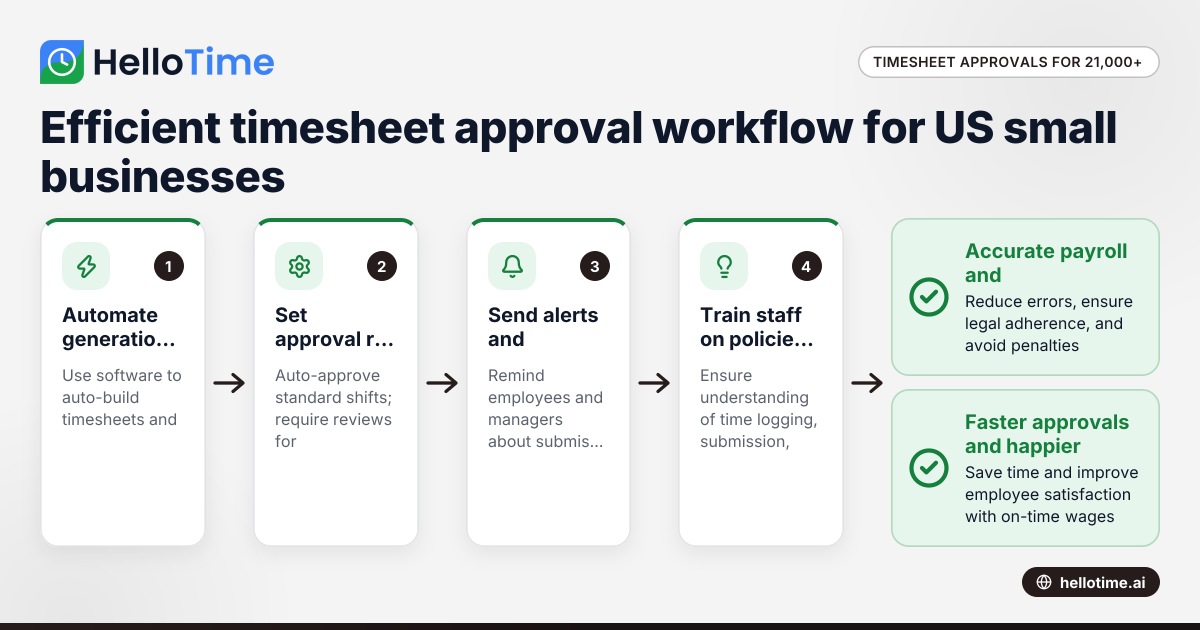
How United States Small Businesses Can Handle Timesheet Approval Workflows with Over 21,000 Minutes Logged
Managing timesheet approvals efficiently becomes critical for US small businesses logging large volumes of employee hours, such as over 21,000 minutes
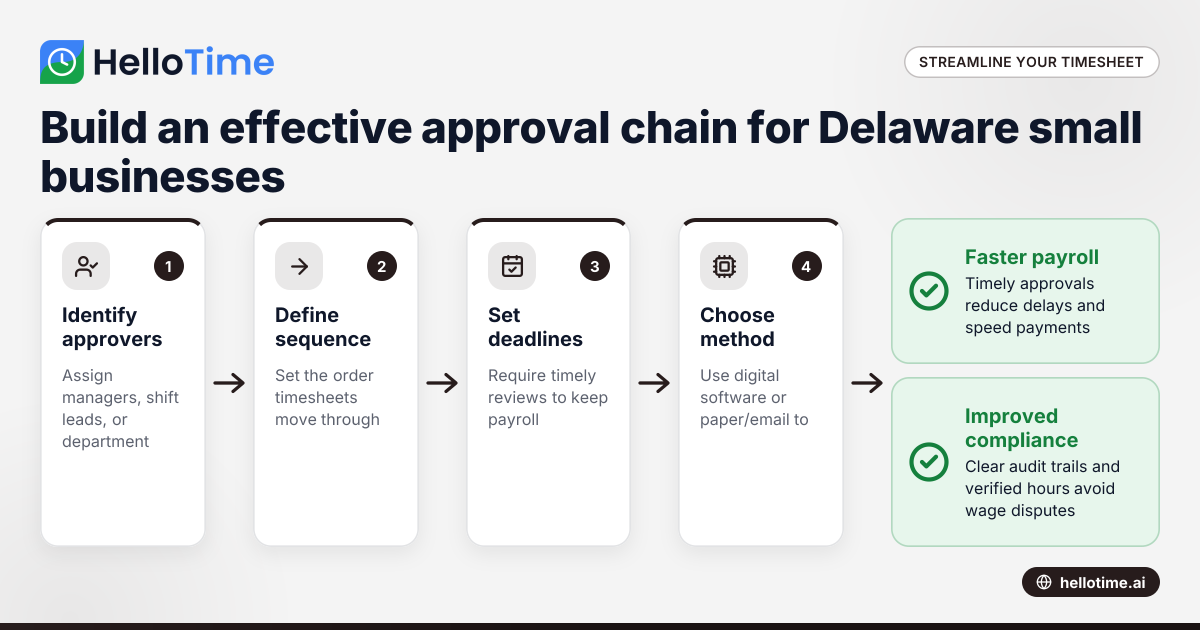
How Delaware Small Businesses Can Streamline Timesheet Approval with Effective Approval Chains in the United States
How Delaware Small Businesses Can Streamline Timesheet Approval with Effective Approval Chains in the United States Delaware small businesses can.
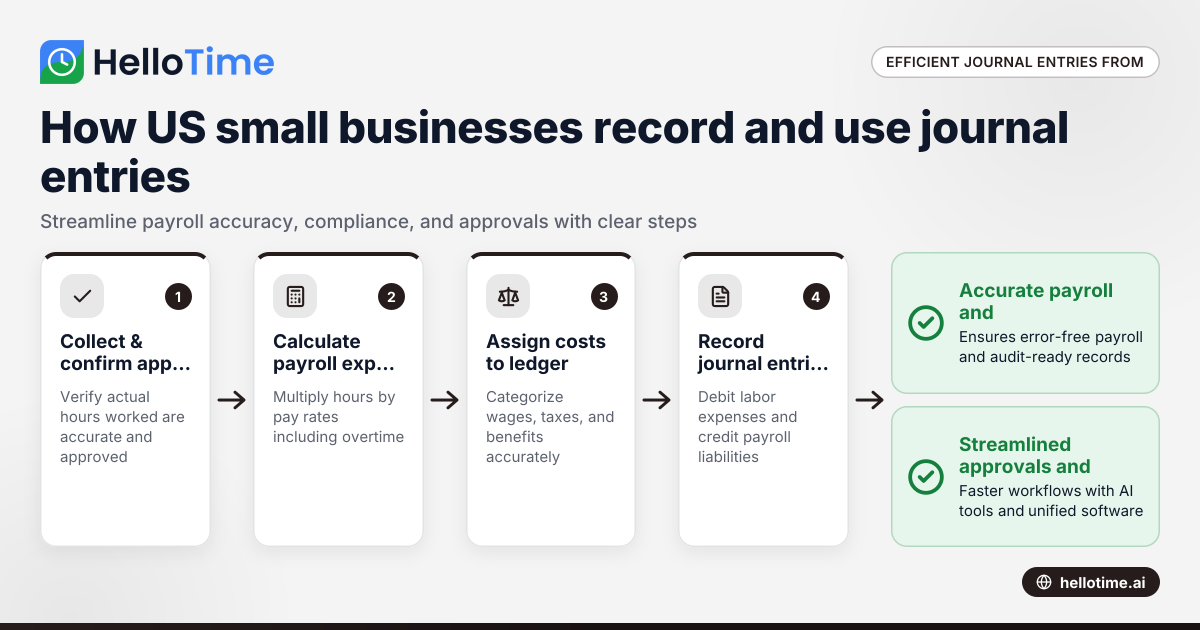
How United States Small Businesses Can Record and Use Journal Entries for Accurate Timesheet Approvals
Accurate timesheet approvals and linked journal entries are vital for US small businesses to ensure payroll accuracy, compliance with labor laws, and.