How Small Businesses in India Can Use Face Recognition Biometric Attendance Kiosks for Efficient Shift Tracking
Face recognition biometric attendance kiosks use AI face recognition technology to automate employee attendance tracking. These devices offer.
The HelloTime team
6 min read
On this page
Face recognition biometric attendance kiosks use AI face recognition technology to automate employee attendance tracking. These devices offer contactless, fast, and accurate shift management, helping Indian SMEs prevent attendance fraud and integrate attendance data smoothly with payroll and compliance systems.
Key takeaways
- Face recognition biometric attendance kiosks accurately record employee attendance without contact.
- AI face recognition improves speed and security in shift tracking for businesses in India.
- Such kiosks prevent attendance fraud like buddy punching and ghost employees.
- They integrate with payroll and compliance tools to ease PF, ESI, TDS, and other statutory processes.
- Small businesses benefit from automated timesheets, leave management, and shift scheduling.
- Implementing kiosks requires secure data handling compliant with the DPDP Act 2023 and local labour laws.
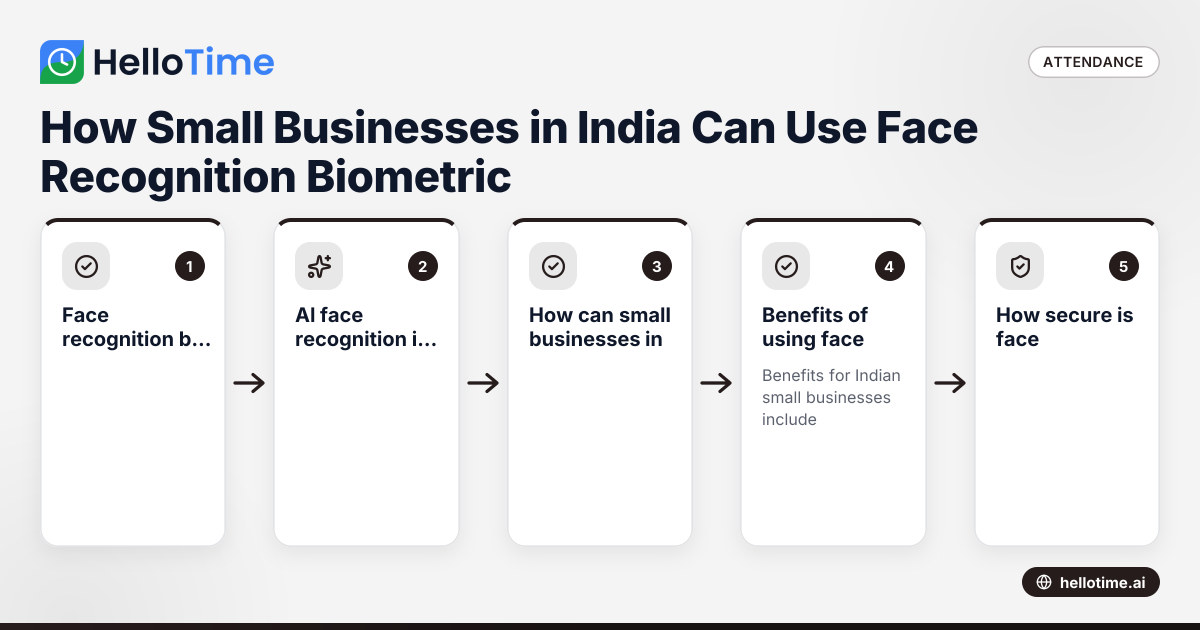
What is a face recognition biometric attendance kiosk?
A face recognition biometric attendance kiosk is a workplace device that uses AI face recognition algorithms to identify employees from their facial features and record attendance instantly. Unlike fingerprint scanners or manual registers, it requires no physical contact, making it faster and hygienic.
In Indian businesses such as retail stores in Mumbai or manufacturing firms in Pune, these kiosks streamline shift attendance by automatically generating accurate timesheets. This replaces error-prone spreadsheets and manual registers and saves time for HR teams.
How does AI face recognition improve shift tracking for Indian SMEs?
AI face recognition automates attendance by instantly verifying employees’ faces at clock-in points, reducing manual errors and preventing buddy punching where one person clocks in for another.
Its speed is especially valuable in busy settings, such as retail outlets and warehouses in tier-2 and tier-3 cities, where long queues can disrupt operations. Because attendance data links directly to shift schedules and payroll, it lowers administrative burdens and decreases wage calculation errors.
How can small businesses in India install and use face recognition biometric attendance kiosks?
Installing and using face recognition biometric attendance kiosks involves these steps:
- Assess requirements: Determine employee count, shift patterns, and attendance challenges.
- Choose compliant hardware: Select a kiosk that meets DPDP Act 2023 data privacy norms and suits your environment (indoor or outdoor).
- Integrate with software: Connect the kiosk with workforce management tools like HelloTime for auto timesheets, leave management, and payroll.
- Train employees: Explain kiosk use, attendance policies, and data privacy safeguards to staff.
- Pilot and monitor: Test on select shifts, ensuring smooth recognition and data capture.
- Enforce policies: Use captured data to enforce punctuality, leave approvals, and shift compliance.
This integrated system speeds approvals, reduces errors, and provides live attendance reports to management.
What are the benefits of using face recognition biometric attendance kiosks in India?
Benefits for Indian small businesses include:
- Precision attendance: AI-powered recognition ensures accurate employee identification.
- Contactless and hygienic: Essential for post-pandemic workplace safety.
- Eliminates attendance fraud: No proxy or ghost attendance possible.
- Payroll accuracy: Accurate timesheets support correct PF, ESI, TDS, and professional tax calculations.
- Compliance assistance: Facilitates reporting to labour authorities under Indian laws.
- Faster approvals: Auto-generated attendance records speed leave and shift approvals.
- Boosts productivity: Saves HR teams time spent on manual data entry and reconciliation.
- Versatility: Works well across sectors—retail, hospitality, manufacturing, construction, and field operations.
How secure is face recognition biometric attendance for employee data privacy?
Face recognition kiosks that comply with the DPDP Act 2023 use encryption and access controls to safeguard employee biometric data. Data collection is consent-based, used strictly for attendance and workforce management.
Employers should select devices from Indian vendors transparent about data usage and privacy. This reduces legal risk and builds employee trust by aligning with local regulations.
What challenges should SMEs in India consider with face recognition attendance kiosks?
While beneficial, SMEs should note:
- Upfront costs and setup: Hardware purchase and integration require initial investment.
- Power and connectivity needs: Dependable electricity and network access ensure real-time data flow.
- Environment suitability: Proper lighting and kiosks placement matter for accurate recognition.
- Employee acceptance: Staff may have concerns about biometric and privacy issues.
- Technical faults: Occasional misrecognition needs prompt HR resolution.
- Data compliance vigilance: Systems must strictly abide by biometric privacy laws.
Planning and vendor support can address these concerns effectively.
How can face recognition facial attendance kiosks integrate with payroll and statutory compliance?
Attendance data from face recognition kiosks feeds directly into workforce management and payroll software to:
- Automate hours and overtime calculations.
- Accurately compute PF, ESI, PT, LWF, and TDS statutory contributions.
- Generate reports like Form 24Q for tax compliance.
- Minimise payroll errors.
Integrating with platforms like HelloTime creates a unified system for attendance, leave, shifts, and payroll, increasing transparency and reducing manual workload.
How do I choose the right face recognition biometric attendance kiosk for my small business?
Consider these factors:
- Accuracy and responsiveness of AI face recognition technology.
- Compliance with India’s biometric and personal data laws.
- Suitability for your workforce size and shift schedules.
- Integration with your current HR and payroll tools.
- User-friendliness and support from vendors.
- Operating conditions prevalent in your workplace (indoor/outdoor).
- Total cost including installation, training, and upkeep.
Request demos or pilot trials to ensure the solution fits your specific needs.
How does face recognition biometric attendance kiosk India pricing work?
Pricing depends on device specifications, number of kiosks, software subscriptions, and added features like leave management or payroll.
Many vendors offer scalable plans tailored to SME workforce sizes. For transparent pricing suited to Indian SMEs, consider solutions like HelloTime, with more details at their pricing page.
Conclusion
Face recognition biometric attendance kiosks powered by AI face recognition are transforming shift management for small businesses in India. These kiosks provide fast, fraud-proof attendance data integrated with payroll and compliance systems. Indian SMEs in Mumbai, Bengaluru, Pune, and beyond benefit from improved accuracy, efficiency, and labour law adherence.
Explore the potential of face recognition kiosks with HelloTime’s features or view detailed options on pricing.
Frequently asked questions
What is AI face recognition and how reliable is it for attendance?
AI face recognition uses artificial intelligence to map facial features quickly and accurately, even with changes in lighting or face accessories. It is highly reliable for real-time attendance in Indian workplaces.
Are face recognition attendance kiosks compliant with Indian law?
Yes, if they adhere to data privacy under the DPDP Act 2023 and labour regulations concerning biometric data. Choose vendors transparent about consent and security.
Can face recognition kiosks work in locations with poor internet connectivity?
Yes, many kiosks operate offline by storing attendance locally and syncing data when connectivity resumes, though regular power and internet access are advisable.
How do biometric attendance kiosks prevent buddy punching?
Attendance is verified uniquely by facial biometrics, so one employee cannot clock in or out for another, eliminating buddy punching.
Will implementing face recognition attendance increase payroll accuracy?
Yes, automated and accurate attendance reduces payroll errors and ensures correct statutory deductions for PF, ESI, PT, and TDS.
Is employee consent mandatory for collecting biometric data in India?
Yes, under the DPDP Act 2023, explicit employee consent is required for biometric data collection, and data must be used solely for attendance and workforce management.
Read next
This article covers one part of a bigger topic. For the complete picture, read our guide to face recognition.
Keep reading
Related articles
Best Attendance Apps for Small Businesses in the United States: Features, Compliance, and Ease of Use
An attendance app is a digital tool that helps small businesses track employee hours, attendance, and leave efficiently. It replaces manual.
How United States Small Businesses Can Handle Timesheet Approval Workflows with Over 21,000 Minutes Logged
Managing timesheet approvals efficiently becomes critical for US small businesses logging large volumes of employee hours, such as over 21,000 minutes
Open Source Time Tracking Tools for Indian Agencies: Benefits and Considerations
Open source time tracking tools are software with publicly accessible code, letting Indian agencies use and customise them without licence fees. They.