How the DPDP Act 2023 Impacts Employee Attendance and Timesheet Data Management in Indian SMEs
The Digital Personal Data Protection (DPDP) Act 2023 is India’s law regulating how personal data, including employee attendance information, must be.
The HelloTime team
6 min read
On this page
The Digital Personal Data Protection (DPDP) Act 2023 is India’s law regulating how personal data, including employee attendance information, must be collected, stored, and processed. It ensures employee privacy and sets clear rules for SMEs around attendance data management to avoid breaches and legal issues.
Key takeaways
- DPDP Act 2023 requires responsible handling of employee attendance and timesheet data to protect privacy.
- SMEs must get clear, explicit consent from employees before collecting personal data like biometric or GPS attendance.
- Attendance data must be used only for defined purposes such as payroll, leave, or shift scheduling.
- Strong data security measures are essential to prevent breaches or unauthorised access.
- Employees have rights under DPDP to access, correct, or delete their attendance data.
- Workforce management software like HelloTime can help automate consent, secure data storage, and maintain audit trails for compliance.
What is the DPDP Act 2023 and why does it matter for employee attendance data?
The DPDP Act 2023 sets standards for handling personal data, including employee attendance records, to protect privacy rights in India. Attendance data such as biometric scans, GPS locations, and shift timings are considered personal data under the Act. SMEs must carefully handle this information to comply with DPDP and maintain trust.
Attendance records reveal sensitive details about employee presence and movements, so mishandling can lead to legal penalties and reputational harm. The Act enforces transparent data practices, explicit consent, and strong security for employee attendance data.
How does DPDP affect SME processes around timesheets and attendance?
DPDP impacts daily attendance workflows by requiring:
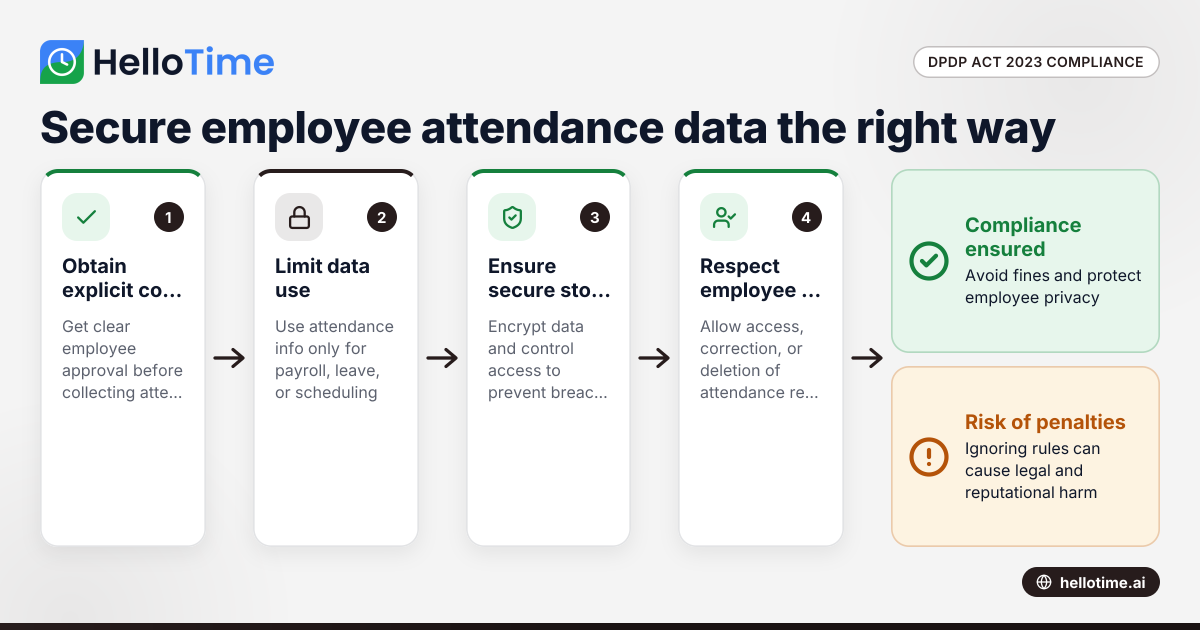
- Informed consent from employees before collecting biometric or location data.
- Strict purpose limitation — use attendance data only for payroll, leave management, or shift scheduling.
- Data minimisation — collect only the necessary information.
- Secure storage with controlled access and retention based on legal or operational needs.
- Respect for employee rights to access, correct or delete attendance records.
- Strong cybersecurity measures like encryption and audit trails to prevent breaches.
These steps help SMEs comply with legal standards and protect employee privacy.
What practical steps can Indian SMEs take to comply with DPDP in attendance tracking?
Indian SMEs should:
- Conduct a thorough data audit of attendance information collected and current security practices.
- Update consent forms and digital prompts to obtain explicit employee consent.
- Limit data collection to essentials, e.g. timestamps instead of exact GPS coordinates where possible.
- Use secure software platforms with encryption and controlled access.
- Train managers and staff on DPDP principles and data protection.
- Set up quick-response processes for employee data requests.
- Regularly review and remove outdated attendance data per retention policies.
Digital workforce tools like HelloTime simplify these steps by integrating consent management, secure GPS clock-in, audit trails, and auto data retention workflows.
How does AI DPDP integration improve attendance data privacy and compliance?
AI DPDP refers to using artificial intelligence technologies that comply with DPDP rules while managing attendance data.
AI helps by automatically detecting unusual attendance patterns or data risks without compromising accuracy. It can blur exact GPS locations for privacy yet validate attendance. AI also automates consent workflows and compliance reporting, increasing operational efficiency.
For instance, AI-enabled facial recognition on tablet kiosks processes data locally, limiting exposure. This helps Indian SMEs in cities like Jaipur or Pune protect sensitive attendance data effectively without manual oversight.
Why is sensitive employee data under DPDP important for SMEs with shift-based teams?
Sensitive employee data includes biometric identifiers used for attendance, such as fingerprints or facial images. DPDP designates this as critical personal data, requiring extra protection.
Shift-based businesses like retail outlets, hotels, or manufacturing units collect extensive biometric info daily. Mishandling this data risks costly fines and reputational damage. SMEs must ensure biometric devices encrypt templates, restrict access, and collect employee consent beforehand.
Compliance is especially important in metropolitan centres like Mumbai and Bengaluru, where labour inspectors increasingly check DPDP adherence. Workforce software that embeds biometric privacy safeguards makes compliance easier.
What challenges do Indian SMEs face when aligning attendance tracking with DPDP?
Key challenges include:
- Limited resources or expertise on data privacy.
- Legacy attendance systems using paper or spreadsheets that lack digital consent and security.
- Educating employees to understand their data rights and consent importance.
- Initial costs or complexities adopting compliant attendance software.
- Balancing robust privacy controls with user-friendly attendance processes.
Despite these hurdles, gradually adopting tools designed for Indian SMEs and explaining benefits like enhanced privacy help ease DPDP implementation.
How can HelloTime help Indian SMEs manage attendance data under DPDP?
HelloTime’s workforce management software supports DPDP compliance with features like:
- Digital capture and storage of employee consent for attendance and biometrics.
- Secure GPS geofenced clock-in, tablet kiosks with local face recognition, and encrypted data storage.
- Automated timesheets with approval workflows and audit logs.
- Data minimisation and configurable retention settings.
- Easy employee access to view, correct, or request deletion of their attendance data.
- Payroll integrated with Indian statutory deductions (TDS, PF, ESI) using attendance data.
By automating privacy and data governance, HelloTime helps Indian SMEs reduce compliance risks and administrative burden.
Explore features or compare plans on pricing to find the right HelloTime solution for your business.
Frequently asked questions
What type of employee data falls under the DPDP Act 2023 in attendance management?
Personal data includes clock-in/out times, biometric scans, GPS locations during attendance, shift schedules, and leave details. All such data must be handled following DPDP’s privacy and security rules.
How do I get valid employee consent for attendance tracking under DPDP?
Provide clear, simple explanations about what data is collected, why, how long it will be stored, and employees’ rights. Obtain explicit documented consent through signed forms or in-app checkboxes before collecting attendance data.
Can SMEs share attendance data with third parties under DPDP?
Sharing requires additional consent unless legally mandated (e.g., PF audits). Always verify third-party recipients comply with DPDP to maintain privacy safeguards.
What happens if an employee requests deletion of their attendance data?
Employees can request deletion, but exceptions apply if data must be retained for statutory or legal reasons. In such cases, inform the employee why data retention is necessary.
How does HelloTime simplify DPDP compliance for Indian SMEs?
HelloTime automates consent collection, secures attendance data, manages employee data rights, and maintains audit trails, reducing manual effort and compliance risks.
Are there penalties for non-compliance with DPDP in employee attendance data?
Yes. Improper handling can lead to significant fines based on turnover and other corrective actions. Early compliance avoids legal and reputational damage.
To protect your employees and business, adopting compliant attendance and timesheet management systems is crucial under DPDP 2023. Smart, secure tools like HelloTime help you manage data responsibly while focusing on growth. Learn more about features or check pricing.
Read next
This article covers one part of a bigger topic. For the complete picture, read our guide to gdpr dpdp dpa.
Keep reading
Related articles
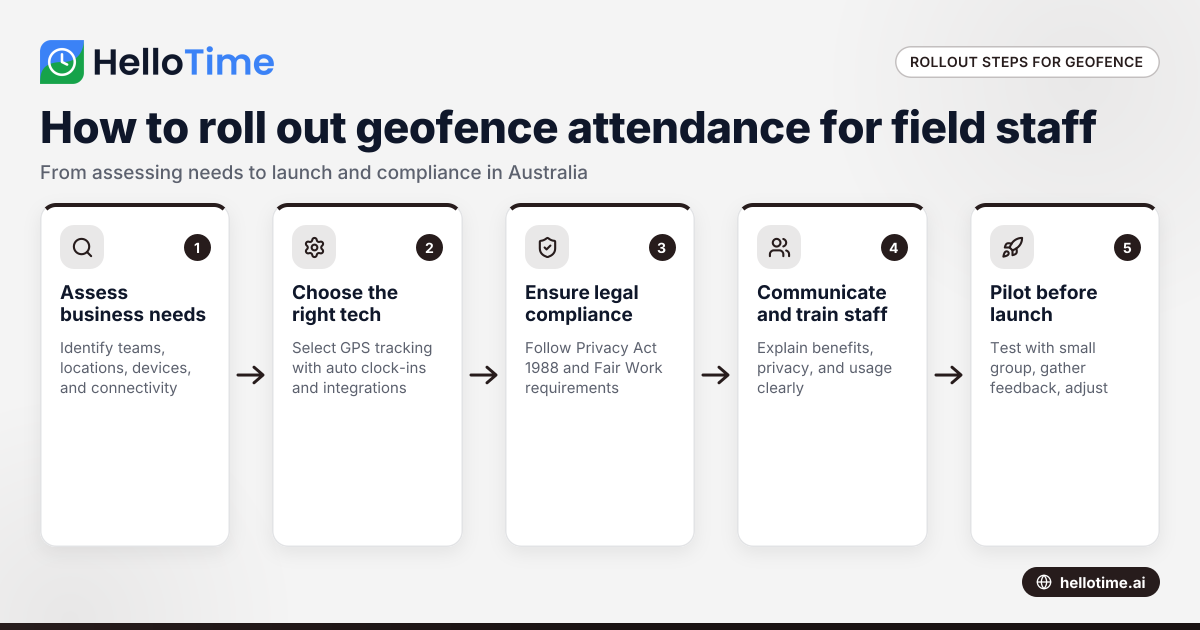
How to Successfully Roll Out Geofence Attendance for Field Staff in Australia
Rolling out geofence attendance in Australia means using GPS-defined zones to track when field staff clock in and out within designated work.
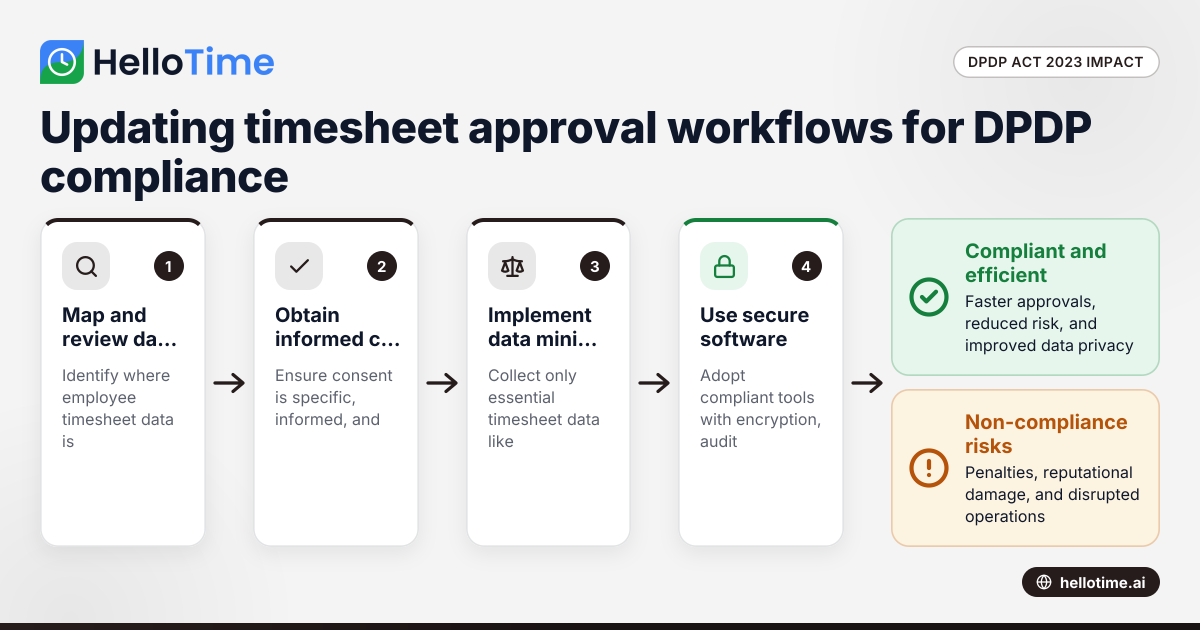
How the DPDP Act 2023 Affects Timesheet Approval Workflow for Manufacturers in Maharashtra, India
How the DPDP Act 2023 Affects Timesheet Approval Workflow for Manufacturers in Maharashtra, India The Digital Personal Data Protection (DPDP) Act 2023
How Delaware Small Businesses Can Bulk Import Employee Data for Faster Shift Scheduling and Timesheet Setups
Managing employee data efficiently is essential for Delaware small businesses, especially when handling shift scheduling and timesheets. AI bulk.