How to Convert Salary to Hourly Wage for Manufacturing Workers in Maharashtra, India
Converting salary to hourly wage for manufacturing workers in Maharashtra involves dividing the monthly salary by the total hours worked in that.
The HelloTime team
7 min read
On this page
Converting salary to hourly wage for manufacturing workers in Maharashtra involves dividing the monthly salary by the total hours worked in that month. This calculation helps manufacturers understand labour costs accurately, enables precise shift scheduling, and ensures compliance with Indian labour laws and Maharashtra state regulations.
Key takeaways
- Converting salary to hourly wage requires understanding monthly working hours, including statutory working days and overtime rules in Maharashtra.
- Maharashtra manufacturers must comply with the Factories Act and Payment of Wages Act while calculating hourly wages.
- Handling leave, holidays, and shift differentials affects the final wage calculation.
- Using payroll software with built-in calculations simplifies salary to hourly conversion and statutory compliance.
- Knowing the hourly wage aids in budgeting, cost control, and fair payment for manufacturing workers.
- AI salary tools can automate these calculations, saving time and reducing errors.
Why convert salary to hourly wage in Maharashtra manufacturing?
Manufacturing units in Maharashtra, from Mumbai to Pune and Nashik, often pay workers a fixed monthly salary or wages. But shift work, overtime, and variable attendance require breaking down this salary into an hourly rate. This helps factory owners and HR managers:
- Plan shifts and rosters efficiently, knowing the exact labour cost per hour.
- Calculate overtime pay as mandated by the Indian Factories Act, ensuring legal compliance.
- Manage payroll accurately with deductions like PF, ESI, and professional tax (PT) specific to Maharashtra.
- Generate precise costing reports to improve profitability and pricing negotiations.
Using hourly wages also helps when manufacturers hire temporary workers or assign contractors paid for hours worked rather than fixed monthly sums.
What basic components do I need to convert salary to hourly wage?
To convert salary to hourly wage correctly, follow these steps:
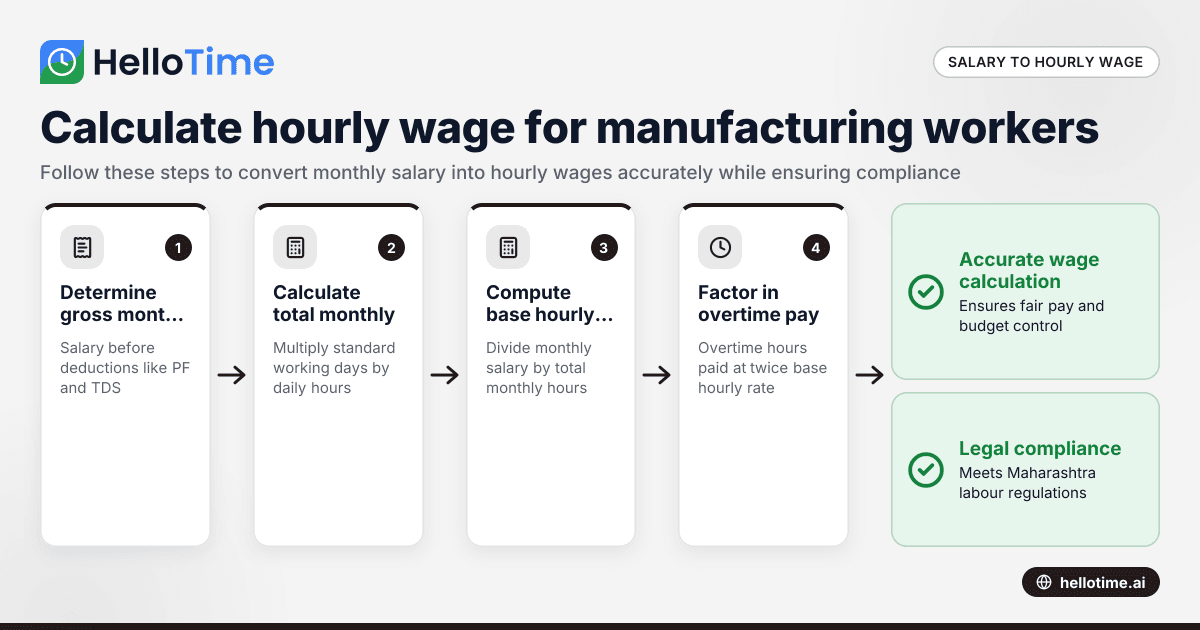
- Determine gross monthly salary: This is the salary before deductions such as TDS, PF, or ESI.
- Define standard monthly working days: Maharashtra typically follows the Factories Act limit — 26 working days a month is common, excluding weekly offs.
- Calculate daily working hours: Usually, 8 to 9 hours per day in manufacturing setups.
- Calculate total monthly working hours: Multiply working days by daily working hours.
- Calculate hourly wage: Divide gross monthly salary by total monthly working hours.
For example, if a worker’s monthly salary is ₹20,000, with 26 working days and 8 hours daily, total hours = 208 hours. Hourly wage = ₹20,000 ÷ 208 = approximately ₹96 per hour.
How do overtime and statutory compliances affect hourly wage calculation?
Overtime payment rules under Indian law and Maharashtra State legislation make salary to hourly conversions more complex. Here is how:
- Overtime compensation must be at least twice the normal hourly rate.
- Overtime is payable for work exceeding 9 hours per day or 48 hours per week under the Factories Act, 1948.
- Calculation must separate normal hours and overtime hours for payroll.
- Statutory deductions (Provident Fund at 12%, ESI for eligible employees, Professional Tax applicable in Maharashtra) affect net take-home but not hourly wage.
For example, if a worker does 10 hours instead of 8, the 2 extra hours are paid at double the calculated hourly wage. So for an hourly wage of ₹96, overtime is ₹192 per hour.
How to calculate hourly wage with overtime?
- Calculate hourly wage from monthly salary (as shown above).
- Define normal working hours and overtime hours per day/week.
- Multiply overtime hours by twice the hourly wage.
- Add normal hours pay plus overtime pay for total salary verification.
How to factor leaves, holidays, and absent days in hourly wage?
Paid leave, statutory holidays, and leaves taken without pay impact effective hourly wage:
- Paid leaves are treated as paid working days; salary remains the same.
- Holidays declared under the Maharashtra Shops and Establishments Act or Factories Act are generally paid.
- Leave without pay requires adjusting salary, reducing it proportionally.
- Absenteeism affects total payable hours and must be excluded when calculating effective hourly wage.
What happens if a worker is absent for a day?
Deduct salary proportionally from monthly salary based on absent days. If there are 26 working days and 2 absent days, pay for 24 days only. Hourly wage remains same but total monthly salary paid reduces.
Does AI salary software help with these calculations?
AI salary tools automate salary to hourly wage conversion by integrating statutory rules:
- Automatically calculate monthly, daily, and hourly wages based on attendance data.
- Factor in Maharashtra-specific laws for overtime, leave, and deductions.
- Generate reports aligning with GST invoices and accounting software like Tally.
- Support payroll automations with Indian statutory compliance (TDS, PF, ESI, PT, LWF).
- Provide real-time dashboards to manage shift costs in manufacturing plants in Bengaluru, Pune, and other centres.
Using AI salary tools built into workforce management software like HelloTime improves accuracy and saves time, reducing manual errors in complex shift and wage calculations.
I have a monthly salary, how to calculate an hourly rate from it?
Converting salary to hourly for a monthly-paid worker involves dividing the monthly salary by total monthly hours worked.
- Confirm monthly gross salary — for example, ₹25,000.
- Calculate total working days in the month (usually 26).
- Multiply daily working hours (usually 8) by total days = 208 hours.
- Hourly wage = ₹25,000 ÷ 208 = ₹120.19.
- Verify if overtime payment rates differ and calculate separately.
- Adjust for leaves, statutory holidays, and absent days if applicable.
This method applies widely in manufacturing and complies with Maharashtra labour laws, providing clear hourly rates for payroll and scheduling.
How can manufacturers in Maharashtra comply with labour laws when converting salary to hourly wage?
Manufacturers must ensure compliance with:
- The Maharashtra Shops and Establishments Act (regulates working hours, wages, holidays).
- The Factories Act, 1948 (overtime, rest intervals, health and safety).
- Payment of Wages Act, 1936 (timely salary payments).
- Employees’ Provident Fund & Miscellaneous Provisions Act (PF contributions).
- Employee State Insurance Act (for eligible employees).
- Professional Tax Act (state-level deductions).
- Maharashtra Labour Welfare Fund (LWF) contributions.
Properly converting salary to hourly wage helps meet these compliance requirements by making wages transparent and aligned with hours worked. Maintaining attendance records and shift rosters digitally or physically is necessary. Payroll software tailored to Indian statutory deductions simplifies this.
What challenges do Maharashtra-based manufacturers face when shifting from salary to hourly wages?
- Complex shift patterns with variable hours per worker.
- Calculating overtime consistently per Maharashtra and Indian law.
- Managing partial attendance and leaves manually.
- Keeping accurate data to avoid disputes with labour inspectors.
- Integrating payroll with Tally and GST invoicing.
- Handling payments timely via UPI or Razorpay as per agreements.
Overcoming these is easier with workforce management solutions that track GPS-enabled clock-ins, auto-build timesheets, and generate compliance reports.
Final thoughts
Manufacturers in Maharashtra looking to convert salary to hourly wages must understand local labour laws and consider shift patterns, overtime, and leaves to calculate accurate hourly rates. Automating these calculations with solutions like HelloTime reduces errors, improves compliance, and saves time. Explore features to see how HelloTime can transform workforce and payroll management for your manufacturing unit. Review plans at pricing.
Frequently asked questions
What is the simplest formula to convert salary to hourly wage?
Divide the gross monthly salary by the total working hours in the month. Total hours = working days × daily working hours. This gives a base hourly wage before considering overtime or leaves.
How is overtime paid for manufacturing workers in Maharashtra?
Overtime is paid at twice the normal hourly rate for any hours worked beyond 9 hours a day or over 48 hours a week, as per the Factories Act. This amount is added to the basic salary in payroll.
Are statutory deductions like PF and ESI included in hourly wage calculations?
No, statutory deductions reduce net take-home pay but do not affect the gross hourly wage, which is based on gross salary before deductions.
How do leaves affect hourly wage?
Paid leaves count as working days and don’t reduce salary. Unpaid leaves lower total payable salary proportionally. Adjust hours worked and salary accordingly.
Can AI salary software handle Maharashtra labour compliance?
Yes. AI salary tools integrated in workforce software handle working hours, leaves, overtime, and statutory deductions specific to Maharashtra, ensuring compliance and accuracy.
How does digital time tracking improve salary to hourly conversions?
Digital clock-ins and auto-built timesheets eliminate errors in attendance, capture overtime accurately, and feed clean data into payroll for precise hourly wage calculations. This is ideal for shift-based manufacturing workers.
Read next
This article covers one part of a bigger topic. For the complete picture, read our guide to salary to hourly.
Keep reading
Related articles
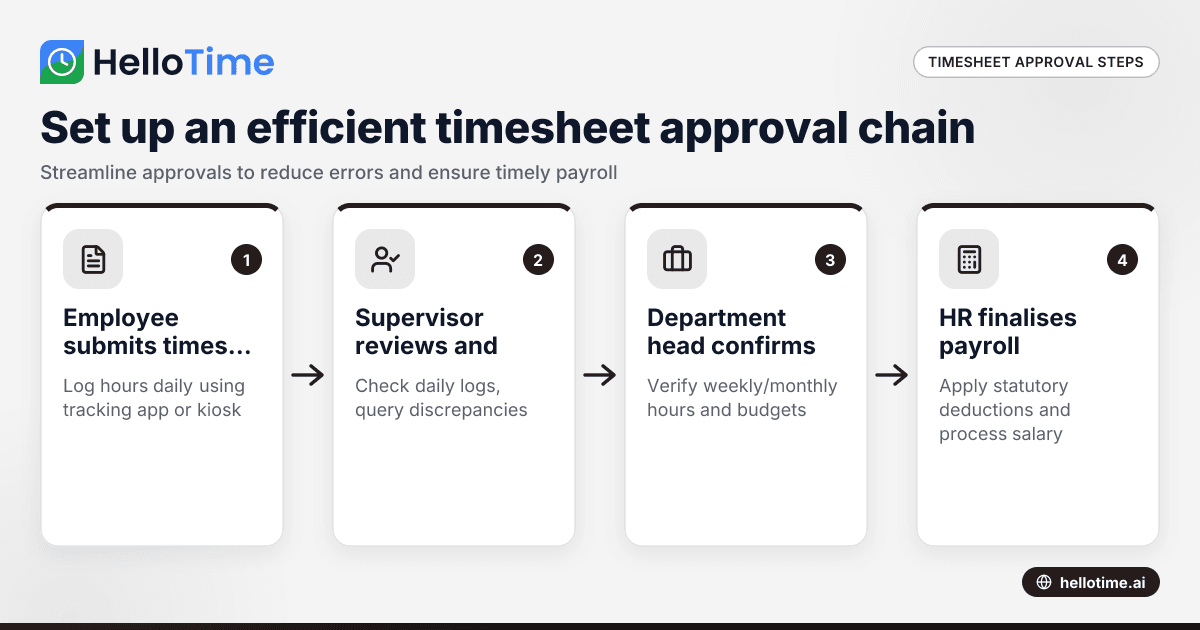
How to Set Up an Efficient Timesheet Approval Chain for Indian SMEs
How to Set Up an Efficient Timesheet Approval Chain for Indian SMEs This guide is for owners, HR, and operations managers at Indian small and.
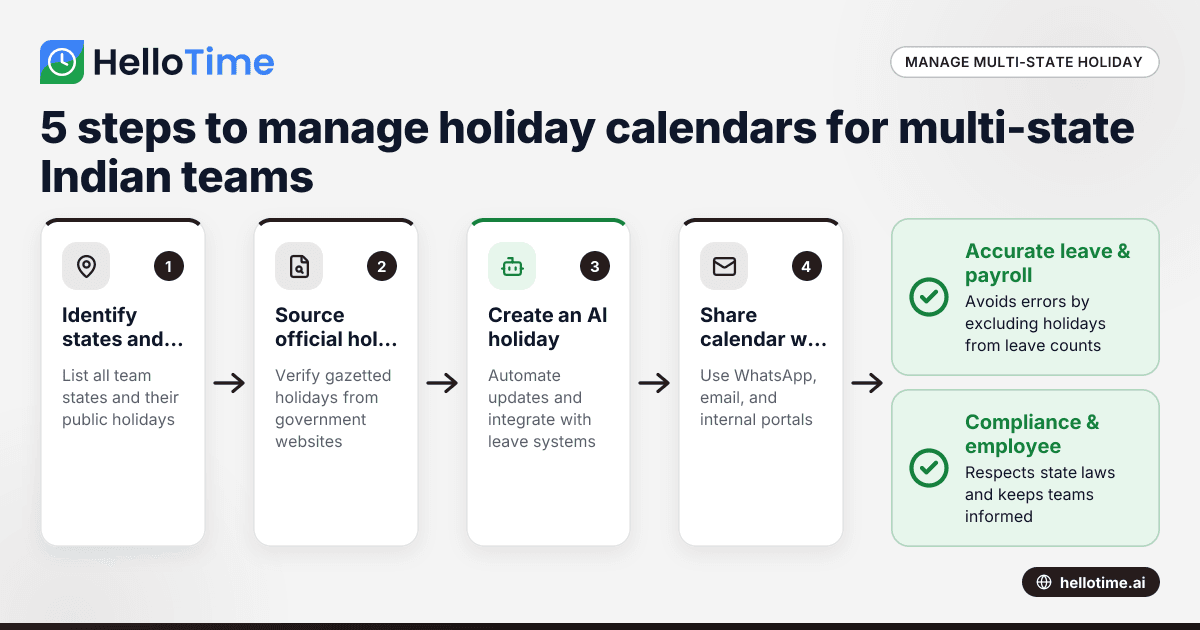
How to Manage Holiday Calendars for Multi-State Teams in India
Managing holiday calendars for multi-state teams in India can be complex due to different state-specific holidays and observances. By the end of this.
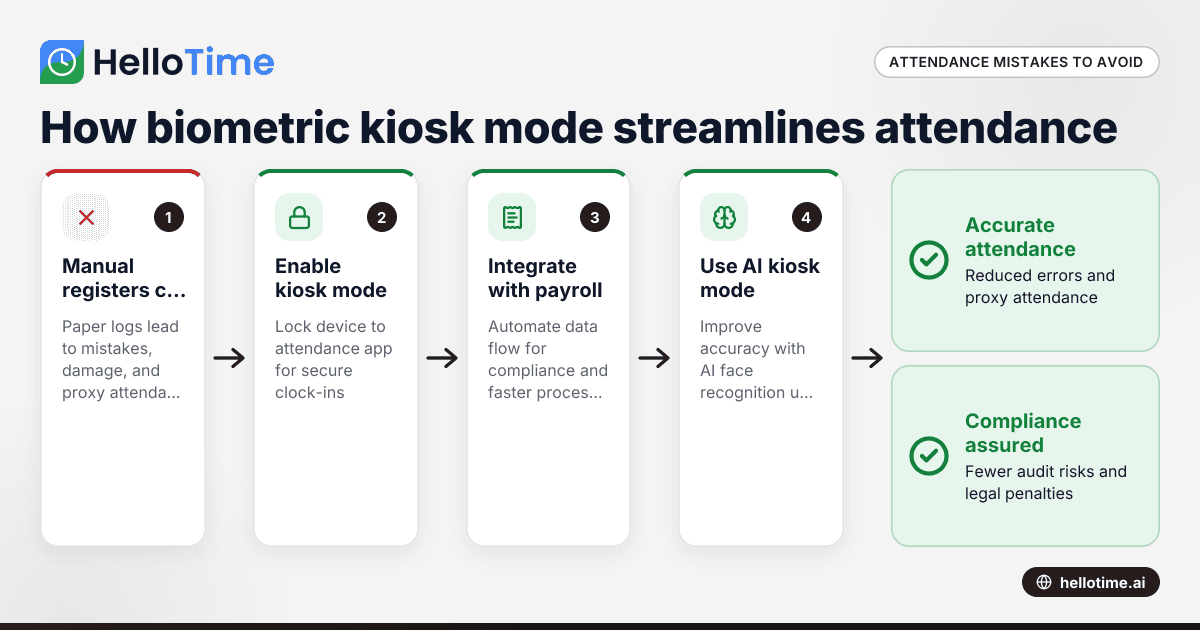
How Biometric Attendance Kiosk Mode Can Streamline Workforce Management for Indian Manufacturing Units
Manufacturing units in India often struggle with managing workforce attendance accurately and efficiently. Errors in attendance tracking lead to.