How to Manage Payroll in Maharashtra Manufacturing Businesses Using Xero Payroll Alternatives in India
Maharashtra manufacturers face unique challenges in managing payroll due to complex statutory compliance, diverse workforce shifts, and multiple.
The HelloTime team
10 min read
On this page
Maharashtra manufacturers face unique challenges in managing payroll due to complex statutory compliance, diverse workforce shifts, and multiple deductions like PF, ESI, and professional tax. Using Xero payroll alternatives in India that cater specifically to these local requirements can simplify workforce management and enhance accuracy in salary processing.
Key takeaways
- Managing payroll in Maharashtra manufacturing units involves adherence to PF, ESI, TDS, Professional Tax, and local labour laws.
- Xero payroll India options often lack full support for Indian statutory requirements.
- AI-powered payroll software can automate timesheets, attendance, and statutory deductions, saving time and reducing errors.
- Shift-based rosters and attendance tracking with biometric or geofenced clock-ins help manage hourly wage workers efficiently.
- Integration with invoicing and project profitability tools streamlines cash flow management for manufacturers.
- Maharashtra-specific payroll software ensures compliance with local Professional Tax and Labour Welfare Fund contributions.
Why do Maharashtra manufacturers need specialized payroll software, not just Xero payroll India?
While Xero payroll enjoys a strong international reputation for small business payroll management, its India edition currently lacks full automation for Indian statutory requirements critical to manufacturing units in Maharashtra. Manufacturers here deal with specific labour laws and wage structures that general software cannot effectively manage.
For example, Maharashtra mandates Professional Tax (PT) deducted based on salary slabs that differ from other states. Factories with 20 or more employees must also comply with Employees’ Provident Fund (EPF) and Employees’ State Insurance (ESI), which need precise calculation and remittance. Additionally, contributions to the Maharashtra Labour Welfare Fund (LWF) apply to factories meeting certain criteria.
Xero payroll India does not yet cover the full spectrum of these deductions automatically or handle complex shift-based wages common in manufacturing. This forces HR teams to manually calculate deductions in spreadsheets or Tally, increasing error risks and audit hassles.
In contrast, payroll software tailored for Maharashtra manufacturing units automatically applies correct statutory rates, supports varying shift hours, and integrates attendance data, reducing manual work and compliance risk.
Understanding statutory compliance in Maharashtra manufacturing payroll
Maharashtra’s factories must comply with the following key statutory deductions:
Employees’ Provident Fund (EPF): Applicable if more than 20 employees are on the rolls, EPF requires 12% contribution each from employer and employee on basic wages, plus specific allowances. Calculations must exclude overtime and certain bonuses.
Employees’ State Insurance (ESI): Factories with 10+ employees earning less than ₹21,000/month must enroll. Employer contributes 3.25% of wages and employee contributes 0.75%. ESI covers health insurance and sickness benefits.
Professional Tax (PT): Maharashtra levies PT up to ₹2,500 per year on salaried employees, deducted monthly based on salary slabs. For example, employees earning below ₹7,500/month are exempted, while those earning ₹25,000 and above pay ₹200/month.
Labour Welfare Fund (LWF): Maharashtra state requires eligible factories to contribute a fixed amount per employee monthly, which might vary by district. This fund benefits workers through welfare schemes.
Failure to correctly deduct and remit these contributions can result in penalties, interest, and legal notices from government departments like the EPFO or the Maharashtra Professional Tax Department.
How does AI-powered payroll software help Maharashtra manufacturers manage payroll better?
AI-driven payroll enhances accuracy and efficiency in managing manufacturing payroll.
Modern payroll software utilising AI automates attendance processing, detects errors, predicts payroll costs, and streamlines approvals. This reduces manual workload and compliance risks for Maharashtra factories handling complex shifts and statutory deductions.
AI converts biometric or geofenced attendance data into accurate wage calculations automatically. It flags anomalies such as missing clock-ins or incorrect statutory slabs promptly, allowing HR teams to correct issues before payroll finalisation. Machine learning can also forecast payroll liabilities, aiding smoother cash flow management. AI-enabled workflows facilitate timely supervisor approvals through mobile devices, making shift worker management more efficient. This technology is particularly beneficial for manufacturers in Mumbai, Pune, and Aurangabad aiming to reduce payroll errors and administrative overhead.
What is ai xero payroll and why does it matter for Maharashtra manufacturers?
"AI Xero payroll" refers to incorporating artificial intelligence capabilities into Xero’s payroll processes, automating data handling to improve accuracy. However, for Maharashtra manufacturers, Xero's current payroll system lacks comprehensive AI features tailored to Indian statutory needs.
While AI-powered enhancements promise error reduction and smoother workflows, Xero payroll India does not fully support Maharashtra-specific taxes and shift wage complexities. Therefore, manufacturers seeking AI-enabled payroll benefits should consider alternatives designed for local compliance. Such systems harness AI to seamlessly process attendance and statutory deductions aligned with Maharashtra labour laws, which Xero payroll currently cannot provide out-of-the-box.
How can Maharashtra manufacturers manage hourly shift workers and attendance efficiently?
Manufacturers typically operate on multiple shifts with many workers paid hourly or daily wages. Payroll accuracy depends on precise attendance logging and shift management.
Traditional methods like paper registers or Excel sheets have drawbacks such as buddy punching, falsified hours, and late data capture, leading to wage disputes.
Best practices include:
Tablet kiosk attendance with face recognition: Installing biometric or facial recognition kiosks at entry points checks employees in real-time. This prevents proxy attendance and reduces false reporting.
GPS and geofencing-enabled clock-ins: Employees clock in/out only within factory premises, ensuring time worked is location-verified especially for field or off-site assignments.
Integrated shift scheduling: Software aligns clock-in/out times with pre-set rosters, identifying shift overruns or early exits. This makes overtime and shift differentials easy to calculate.
Mobile supervisor approvals: Shift leads can approve or query timesheets instantly via mobile apps, reducing bottlenecks in payroll preparation.
Example: In a Pune-based automobile parts manufacturer, switching from manual registers to biometric kiosks and AI software reduced payroll processing time by 50% and eliminated wage disputes related to shift hours.
What are the challenges of using Xero payroll India for Maharashtra manufacturers?
While Xero suits service-sector SMEs in India, manufacturing units face several issues:
Lack of automated Maharashtra Professional Tax calculation: Xero payroll India does not automatically apply PT slabs specific to Maharashtra. This forces manual calculations and quarterly submission outside the system.
No Labour Welfare Fund deduction support: LWF is a mandatory deduction in Maharashtra manufacturing but must be tracked and filed separately in Xero.
Limited shift rostering capabilities: Manufacturing requires managing multiple shifts daily with hourly varying wages or piece rates, which Xero payroll does not handle well.
Absence of project profitability and labour cost tracking: Manufacturing units often require detailed cost reports by project or production batch, unavailable in Xero.
No inbuilt biometric or geofencing attendance integration: Data must be manually imported, increasing error chances.
These gaps lead to workarounds using spreadsheets or legacy payroll tools, increasing administrative overhead and compliance risks.
Which Xero payroll India alternatives fit Maharashtra manufacturers best?
Look for payroll software with features tailored to Maharashtra factories:
Built-in Indian statutory compliance: Auto-calculate PF, ESI, TDS, Maharashtra PT slabs, and LWF contributions with up-to-date rates.
Auto-generation of Form 24Q and PF/ESI returns: Simplify government reporting and avoid penalties.
Shift scheduling and wage calculations: Support multiple shifts, hourly rates, piece-based wages, and overtime rules.
Attendance hardware integration: Biometric/face recognition kiosks, GPS and geofencing support.
Invoicing and GST-compliant billing integration in INR: Link labour costs to client billing directly.
AI assistance: Catch errors before payroll is processed and help forecast payroll liabilities.
HelloTime incorporates these functionalities, making it a strong choice for Maharashtra manufacturing companies wanting to modernise payroll management.
Why is integrating payroll with invoicing and project time tracking important?
Manufacturers often undertake project-based jobs or contract manufacturing where billing depends on labour hours spent on projects. Without integration, payroll and invoicing are disconnected, leading to mismatched costs and revenues.
Consider a Pune contract manufacturer supplying customised equipment parts on tight margins. Tracking billable labour hours linked to client projects enables:
- Accurate calculation of labour costs per project.
- Timely generation of invoices with embedded labour costs.
- Better project profitability analysis and tender price decisions.
- Optimised cash flow forecasting based on confirmed labour expenses.
Payroll software integrated with project time tracking and invoicing tools consolidates all this data, giving management real-time insights. It reduces manual reconciliation and improves working capital management.
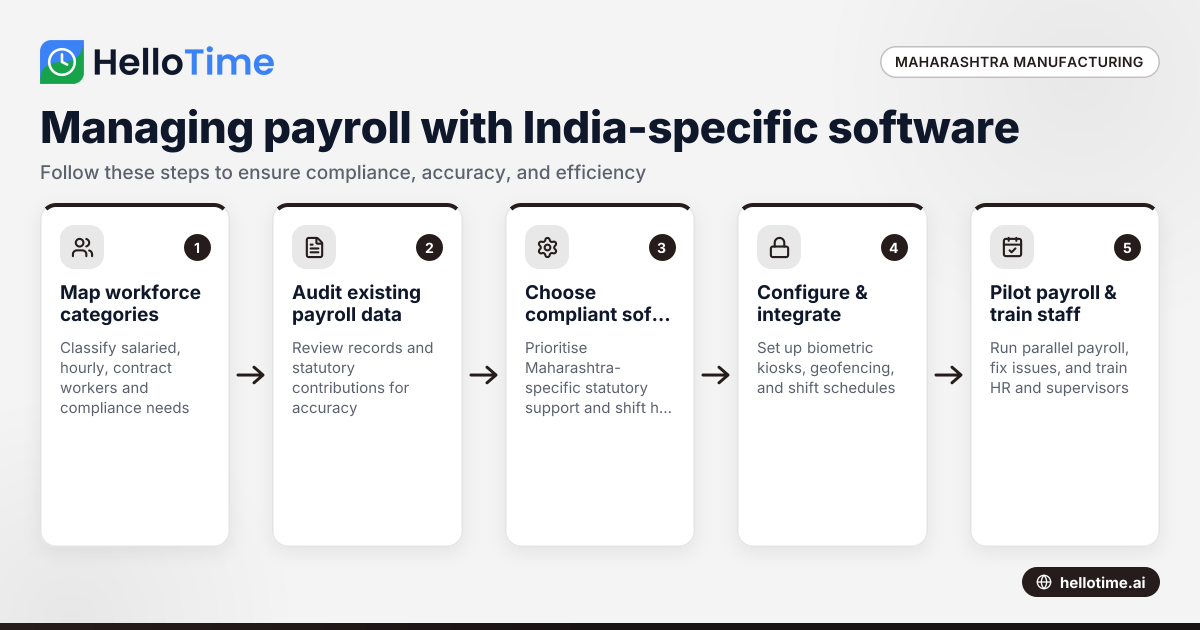
What steps should Maharashtra manufacturers follow to implement a new payroll system?
Migrating to a specialised payroll system requires careful planning:
Map Your Workforce: Categorise employees by type—salaried, hourly, contract workers—and applicable compliance rules (PF, ESI, PT, LWF).
Audit Current Data: Review existing payroll records, attendance registers, wage structures, and statutory contributions to ensure correctness before migration.
Evaluate Software Options: Prioritise Indian statutory compliance, shift management, attendance integration, and invoice linkage.
Select and Configure: Choose the payroll system (e.g., HelloTime), set up employee data, statutory parameters, schedules, and attendance devices.
Data Migration: Import historic payroll and employee info carefully, validating for errors.
Train Staff: HR and supervisors should learn kiosk operation, approval workflows, and dashboard monitoring.
Pilot and Go-live: Run parallel payroll for one cycle to confirm correctness and fix issues.
Ongoing Updates: Keep up with PT rate changes, PF and ESI notifications, and labour law amendments, updating the system accordingly.
Failing to follow these steps risks payroll errors, delayed payments, and penalties for non-compliance.
How to ensure data privacy compliance with payroll software in Maharashtra?
Payroll data is highly sensitive personal and financial information. Under India’s Digital Personal Data Protection Act (DPDP) 2023, businesses must safeguard employee data privacy.
Best practices include:
Choose software that stores data securely within India and encrypts sensitive fields.
Maintain role-based access control: Restrict payroll data to authorised HR and management only.
Avoid exporting data to third parties without employee consent or without legally mandated safeguards.
Regular audit trails: Software should log access and changes to payroll for transparency.
Adhere to data retention and deletion policies as prescribed by law.
Complying with DPDP not only avoids legal risks but also builds employee trust.
How can HelloTime help Maharashtra manufacturers with payroll management?
HelloTime is designed to handle the complexity of Indian payroll, including Maharashtra-specific requirements. It offers:
One-click time tracking with automatic timesheet generation linked to shifts and attendance.
Integrated leave management and biometric (face recognition) clock-ins for accurate attendance.
Automated statutory deduction calculations: PF, ESI, Professional Tax, TDS, and Labour Welfare Fund.
Compliance reports and instant Form 24Q generation.
Project profitability analysis linked to labour hours.
By digitising and automating payroll, HelloTime reduces errors and frees HR teams to focus on workforce management. Explore its features to see how it can fit your manufacturing business needs.
Frequently asked questions
Is Xero payroll India suitable for manufacturing businesses in Maharashtra?
Xero payroll India currently lacks the full statutory deduction automation and shift-based wage handling that Maharashtra manufacturing units require. Using payroll software customised for Indian factories reduces manual effort and chances of compliance errors.
Can payroll software manage Professional Tax and Labour Welfare Fund automatically?
Yes, specialised payroll systems include auto-calculation of Maharashtra’s Professional Tax based on employee salary slabs, timely deductions, and filing. They also handle Labour Welfare Fund contributions and statutory return submissions, ensuring smooth compliance.
How does AI improve payroll accuracy in manufacturing?
AI automatically scans attendance logs to flag missing entries or anomalies, predicts payroll liabilities based on historical data, and automates timesheet approvals. This saves administrative time and minimises costly payroll disputes.
What is the best way to track attendance for shift workers?
Using biometric facial recognition kiosks combined with GPS and geofenced clock-ins ensures employees can only record attendance within work premises. This prevents proxy attendance and improves the reliability of payroll data.
Is it necessary to integrate payroll with invoicing for manufacturers?
Integration aligns labour costs directly with client billing and project accounting. This helps manufacturers in cities like Mumbai and Pune accurately price contracts, evaluate project profitability, and maintain healthier cash flows.
To streamline your manufacturing payroll and compliance in Maharashtra, consider exploring payroll software built for Indian enterprises like HelloTime. Discover its pricing and features tailored for your business needs.
Read next
This article covers one part of a bigger topic. For the complete picture, read our guide to xero payroll.
Keep reading
Related articles
How Device Policy Controllers Enhance Security and Compliance for United States Small Businesses Using Time Tracking Software
Device Policy Controllers (DPCs) are software tools that enforce security policies on mobile devices and computers used for business. For small.
How United States Small Businesses Can Handle Timesheet Approval Workflows with Over 21,000 Minutes Logged
Managing timesheet approvals efficiently becomes critical for US small businesses logging large volumes of employee hours, such as over 21,000 minutes
Open Source Time Tracking Tools for Indian Agencies: Benefits and Considerations
Open source time tracking tools are software with publicly accessible code, letting Indian agencies use and customise them without licence fees. They.