How to Manage Timesheet Approval Workflow for US Businesses Tracking Over 15,000 Minutes Monthly
Managing timesheet approval workflow for US businesses tracking over 15,000 minutes monthly demands an organized, scalable, and error-minimizing.
The HelloTime team
7 min read
On this page
Managing timesheet approval workflow for US businesses tracking over 15,000 minutes monthly demands an organized, scalable, and error-minimizing system. A well-designed workflow ensures accurate payroll, compliance with labor laws, and efficient project cost tracking.
Key takeaways
- Large-volume timesheet management requires automation and clear policy enforcement.
- AI timesheet approval can speed up validation while reducing human error.
- Defining roles and approval hierarchies is crucial to avoid bottlenecks.
- Integration with payroll and billing software simplifies operations and compliance.
- Communication and training ensure team adherence to workflows.
- Regular auditing detects errors, fraud, or inefficiencies early.
Understanding the challenge of timesheet approval workflow with 15,000+ minutes tracked monthly
When businesses exceed 15,000 minutes of employee time tracked monthly (that’s roughly 250+ hours), they face challenges beyond simple manual approvals. This volume can come from large teams, multiple shifts, or project-based work requiring rigorous oversight to ensure accuracy.
Typical challenges include:
- Human errors in data entry or time allocation.
- Delays due to manual review and approvals.
- Difficulty verifying overtime, breaks and compliance across multiple state laws.
- Complexity in handling multiple projects, clients, or billing arrangements.
- Employee dissatisfaction if corrections or disputes take too long.
A scalable workflow systematically addresses these issues to protect both the company and its workforce.
What is timesheet approval workflow 15000 and why is it critical?
Timesheet approval workflow 15000 refers to processes tailored for businesses tracking over 15,000 minutes monthly, focusing on speed, accuracy, and compliance. It typically involves multi-step review pipelines, digital approval tools, and audit trails that handle large data efficiently.
Without robust workflows, inaccuracies in time records can lead to payroll errors, billing disputes, or legal risks—costly issues often encountered in US retail, hospitality, and professional services sectors.
How does AI timesheet approval work?
AI timesheet approval analyzes and validates time entries automatically using machine learning. It flags anomalies like missing breaks, unusual hours, or duplicate entries, reducing manual review time and human errors.
HelloTime’s AI timesheet approval system quickly processes large data volumes, offering managers smart alerts and batch approval options. This automation ensures timely payroll and accurate client billing, essential for businesses tracking over 15,000 minutes monthly.
More details: AI models learn normal work patterns for each employee. When entries deviate, such as overtime outside scheduled shifts or suspiciously long hours, the system highlights them for quick verification. This accelerates approvals, frees HR from routine checks, and improves overall accuracy.
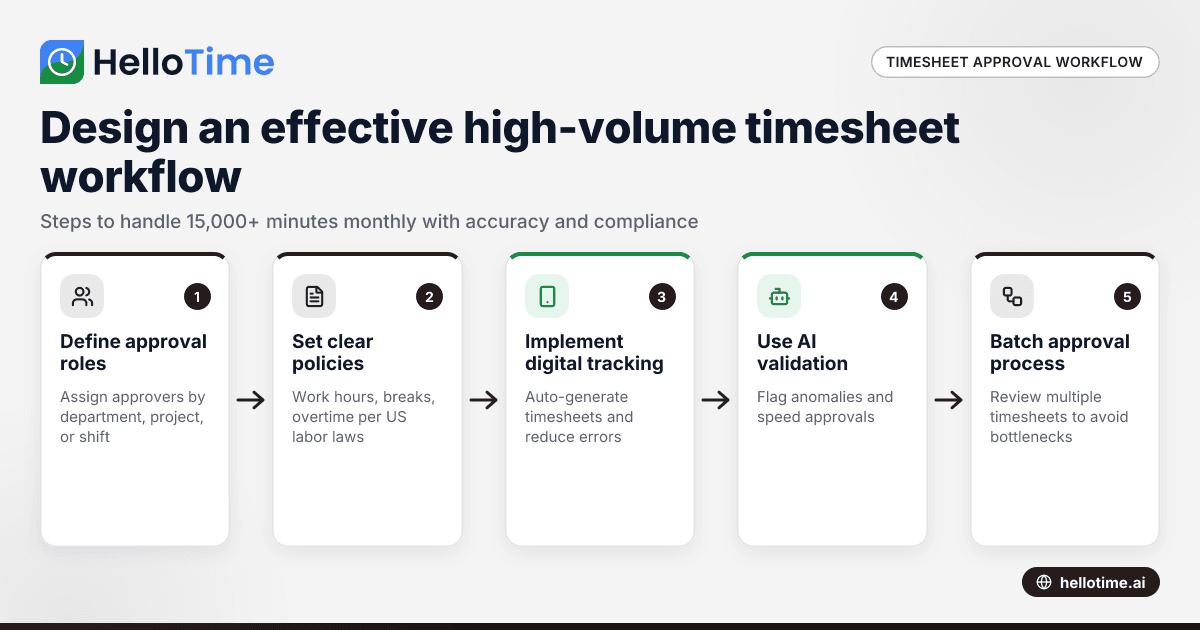
Step-by-step: designing an effective timesheet approval workflow for high-volume businesses
Define approval roles and hierarchy Assign specific approvers based on departments, projects, or shifts. Large teams need multiple layers, such as immediate supervisors followed by HR or finance review.
Set clear policies and conditions Establish rules on working hours, overtime, breaks, and rounding that comply with FLSA and relevant state labor laws (e.g., California’s meal and rest break rules).
Implement digital time tracking and auto timesheet creation Use software that captures raw time data and auto-generates timesheets to reduce manual errors and speed submissions. Geofenced clock-ins can improve field team accuracy.
Leverage AI and automation Apply AI-powered validation to flag inconsistencies immediately, providing alerts and suggested corrections before approval.
Create a batch or tiered approval process Allow approvers to review multiple timesheets at once with filters for attention-required items, minimizing bottlenecks with volume.
Integrate payroll and invoicing Link approvals with payroll systems and client billing tools like QuickBooks and Stripe to automate payments and revenue recognition.
Communicate and train staff Ensure all employees and managers understand timesheet policies, how to use tracking tools, and approval timelines.
Audit periodically Conduct regular spot checks and compliance audits to identify potential fraud, errors, or inefficiencies.
What are the best practices for managing timesheet approvals in US businesses?
Best practices include:
- Keep policy simple but compliant: Overly complex rules create confusion. Align with Department of Labor guidelines and state laws.
- Timely submission deadlines: Enforce regular cutoffs (e.g., weekly or biweekly).
- Transparent dispute resolution: Provide clear channels for employees to correct errors or contest entries.
- Mobile access for on-the-go teams: Field, retail, and healthcare workers benefit from mobile time capture and approvals.
- Real-time reporting and dashboards: Help managers monitor approvals and exceptions instantly.
How can integration with payroll and project management systems improve the workflow?
Connecting timesheet approvals directly to payroll reduces duplication and risk of errors in wage calculations, tax deductions, and overtime rules. For billable teams in agencies and professional services, linking to project management ensures hours are billed correctly to clients, facilitating faster invoicing and accurate profitability analysis.
Using tools like HelloTime paired with QuickBooks or Stripe can automate entire cycles from clock-in to payment, saving hours of manual reconciliation and enhancing financial accuracy.
How to deal with compliance and legal risks in timesheet management?
The US Department of Labor enforces strict wage and hour laws under FLSA. State-specific rules around breaks, overtime, and record-keeping add complexity. Key steps:
- Document and enforce breaks and overtime properly.
- Retain timesheet records for at least three years.
- Ensure transparent approval trails for audits.
- Keep timesheets shielded with secure access to comply with privacy norms.
- Regularly update policies according to changing laws or regulations.
Remember: This is general information, not legal or tax advice. Consult a labor attorney to ensure full compliance.
What are common mistakes to avoid with large-volume timesheet approval workflows?
- Relying on manual approvals and paper spreadsheets.
- Ignoring employee training on time capture policies.
- Overlooking audit trails and proper documentation.
- Neglecting integration with payroll and billing.
- Allowing bottlenecks by having insufficient approvers.
- Not updating workflows when team size or legislation changes.
Good process design anticipates growth and complexity.
How do you measure the success of your timesheet approval workflow?
Key metrics include:
- Average approval turnaround time.
- Percentage of approved timesheets with errors or corrections.
- Number of payroll adjustments linked to timesheet issues.
- Employee compliance rates with timely submissions.
- Dispute resolution timeframes.
Improving these metrics over time signals a robust workflow.
Conclusion
Managing timesheet approval workflow efficiently for US businesses tracking over 15,000 minutes monthly is essential to control labor costs, ensure compliance, and maintain employee trust. Utilizing AI timesheet approval systems and integrated digital tools optimizes accuracy and throughput at scale. To explore features that can streamline your timesheet approvals and more, visit features or compare plans at pricing.
Frequently asked questions
What is a timesheet approval workflow 15000?
It’s a tailored approval process designed for businesses that track more than 15,000 minutes monthly, focusing on speed, accuracy, and compliance to handle large volumes of timesheet data efficiently.
How does AI timesheet approval improve accuracy?
AI automatically reviews and flags unusual time entries, such as missing breaks or overtime, reducing human error and enabling faster approvals for large teams.
Can I integrate timesheet approvals with payroll software?
Yes, integration with payroll tools like QuickBooks streamlines wage calculation and tax compliance based on approved timesheets, making the payroll process more efficient.
How often should timesheet approvals occur?
Most US businesses opt for weekly or biweekly approval cycles aligned with their payroll schedules, allowing timely review and correction of timesheets.
What are the risks of poor timesheet approval management?
Mistakes can lead to payroll errors, overpayment, legal non-compliance, billing disputes, and employee dissatisfaction, posing financial and reputational risks.
How do I keep my timesheet approval process compliant with US labor laws?
Regularly review policies against FLSA and state legislation, maintain thorough records, enforce break and overtime rules, and consult legal counsel when needed.
Read next
This article covers one part of a bigger topic. For the complete picture, read our guide to 15 000.
Keep reading
Related articles
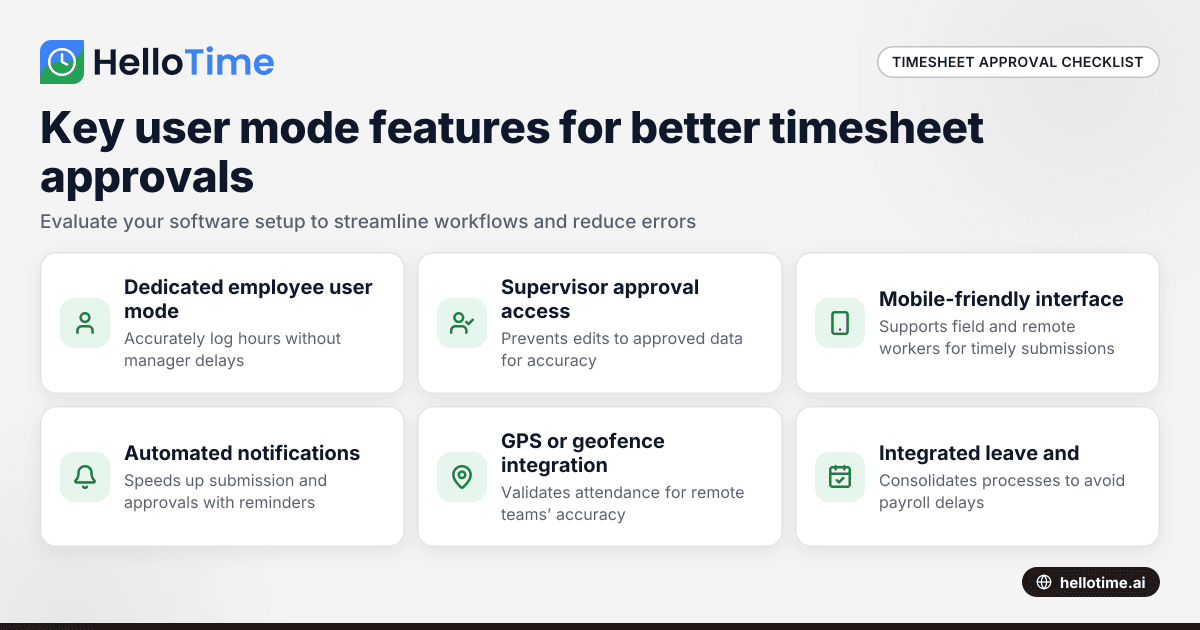
How User Mode Enhances Timesheet Approval Workflow for Indian Small Businesses
How User Mode Enhances Timesheet Approval Workflow for Indian Small Businesses.
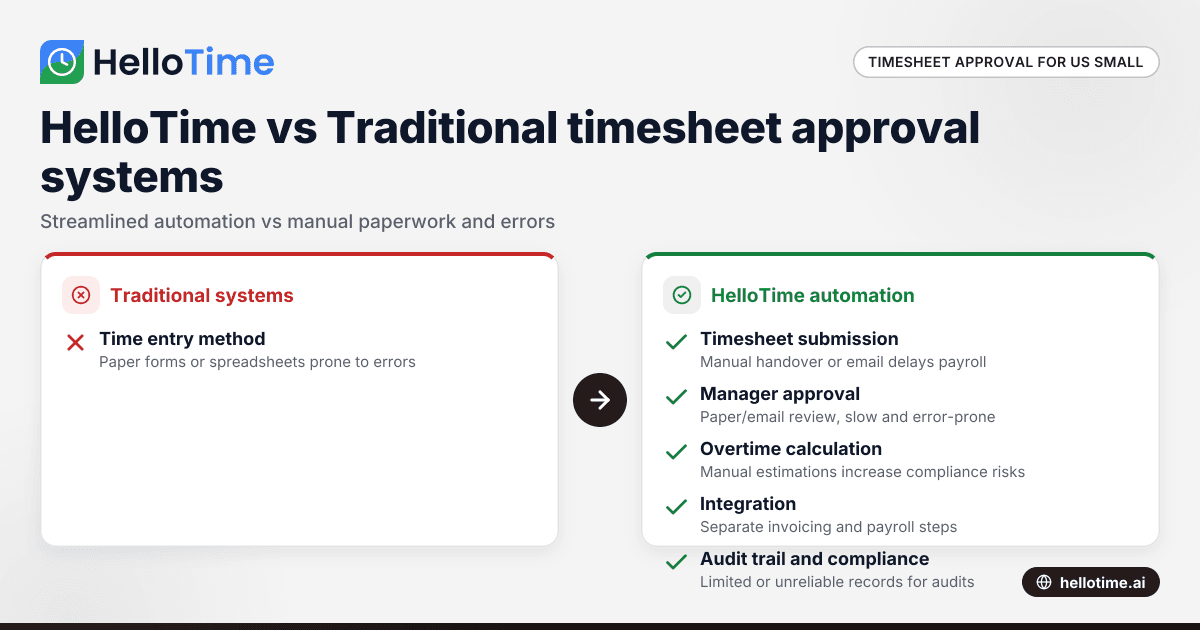
HelloTime vs Traditional Timesheet Approval Systems: Advantages for United States Small Businesses
HelloTime vs Traditional Timesheet Approval Systems: Advantages for United States Small Businesses When comparing HelloTime vs traditional timesheet.
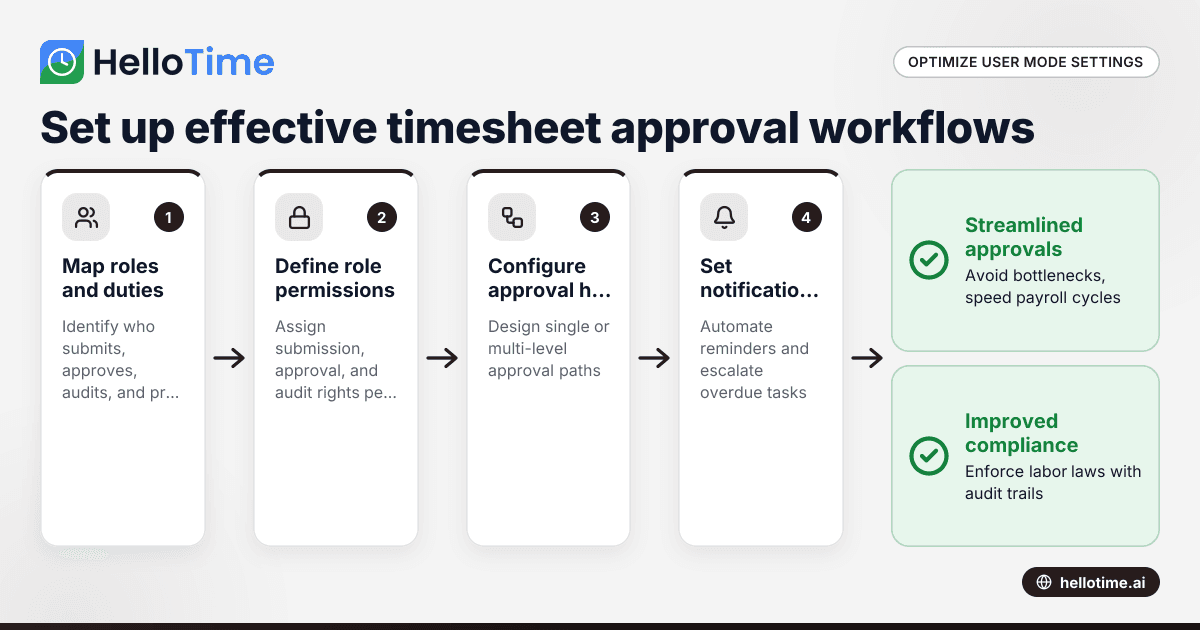
How United States Small Businesses Can Optimize User Mode Settings to Streamline Timesheet Approval Workflows
In timesheet approval workflows, user mode customizes access and approval steps based on employee roles, allowing roles like employees, managers, and.