Leave of Absence Policy for Small Business in United States: How to Set Eligibility, Request Steps, and Manager Approval Rules
A leave of absence policy for a small business in the United States sets clear rules for who can take extended time away from work, how they ask for.
The HelloTime team
12 min read
On this page
A leave of absence policy for a small business in the United States sets clear rules for who can take extended time away from work, how they ask for it, and how managers approve or deny requests fairly. A good policy protects the business, gives employees a predictable process, and reduces confusion around scheduling, pay, benefits, and job protection.
Key takeaways
- A strong leave of absence policy defines eligibility, request steps, approval rules, documentation, and return-to-work expectations.
- Small businesses in the United States should separate legally protected leave from discretionary leave in the policy.
- Manager approval should follow written criteria, not personal preference, to reduce inconsistency and risk.
- Request workflows should include timelines, required forms, coverage planning, and a clear final decision process.
- Leave tracking software can help centralize balances, records, approvals, and scheduling impact across teams.
- This article is general information, not legal or tax advice.
What is a leave of absence policy for a small business in United States?
A leave of absence policy for a small business in the United States is a written policy that explains when an employee may take time away from work beyond routine PTO or sick days, how to request it, what documentation may be needed, and whether the leave is paid, unpaid, or job-protected.
It also explains whether the employee’s job may be protected, how long the leave may last, and what happens when the employee returns. For a small business, this matters even more than it does in a large company. Small teams feel every absence.
One missing shift supervisor in Houston or one absent project coordinator in Chicago can affect service levels, billing, deadlines, and overtime costs. A clear policy helps in three ways:
- It gives employees a fair process.
- It gives managers a consistent decision framework.
- It creates records the business can rely on later.
Your policy should not be a copy of a handbook paragraph pulled from the internet. It should reflect how your business actually works. A five-person design agency, a 25-person HVAC company, and a 40-person restaurant group need different approval and coverage rules.
What should a small business leave of absence policy include?
A small business leave of absence policy should cover eligibility, types of leave, request steps, required notice, documentation, manager review, approval rules, pay status, benefits handling, return-to-work steps, and recordkeeping. It should also explain which leave rights are required by law and which are offered by the company.
Build the policy around the practical questions employees and managers ask first. Then add the legal and administrative detail needed to run it consistently.
1. Policy purpose and scope
Start with a short statement of purpose. Explain that the policy exists to handle extended time away from work in a fair, organized way.
Then define who the policy covers:
- Full-time employees
- Part-time employees
- Temporary employees
- Seasonal employees
- New hires still in an introductory period, if applicable
If different groups have different eligibility, say so clearly.
2. Types of leave covered
List the categories your business recognizes. Keep the language simple. Examples may include:
- Medical leave
- Family caregiving leave
- Parental leave
- Military-related leave, if applicable
- Personal leave
- Bereavement leave, if your company treats longer bereavement absences as a leave of absence
- Jury duty or other civic leave, if you address it here instead of in a separate policy
Also make a clear distinction between:
- Legally protected leave
- Company-approved discretionary leave
That distinction is critical. Managers should not treat all leave requests as if they are optional.
3. Eligibility rules
Eligibility rules should answer basic questions such as:
- How long must an employee work before requesting discretionary leave?
- Are some leave types available on day one?
- Is there a minimum average weekly schedule for part-time employees?
- Are employees on performance warning status eligible for personal leave?
- Can an employee request leave during a peak season?
Write rules that managers can actually apply. Avoid vague standards like “employees in good standing” unless you define exactly what that means.
How do you set eligibility without making the policy too rigid?
Use simple thresholds and a small number of exceptions. Define service time, employee status, and business-need limits in plain language. Then state that legally protected leave will be handled under applicable law, even if the employee does not meet your discretionary leave rules.
After that, decide what is reasonable for your size and staffing model.
Common eligibility standards for small businesses
For discretionary leave, many small businesses set rules around:
- Length of service, such as 90 days or 12 months
- Active employment status
- Prior attendance history
- Current disciplinary status
- Operational feasibility for the requested dates
The goal is consistency, not strictness for its own sake. If your policy is too loose, every manager will improvise. If it is too rigid, you may force good employees to resign when a short unpaid leave could have solved the problem.
Separate legal leave from company leave
This is where many small businesses make mistakes. Your policy should state that some leave may be governed by federal, state, or local law. Those requests should be reviewed separately from discretionary requests.
For example, depending on your location and business size, some leave rights may involve job protection, required notices, or specific documentation rules. Do not let a frontline manager deny a request because it “doesn’t fit the schedule” if the leave may be protected.
If you operate in multiple states, your policy should say that state or local rules may apply based on where the employee works.
Which request steps should every leave policy include?
Every leave policy should require a written request, expected dates, reason category, notice timing, supporting documents if needed, coverage notes, and a final written decision. It should also say who reviews the request and when the employee can expect an answer.
A simple process is better than a complicated one. Most small businesses need a workflow that people will actually follow.
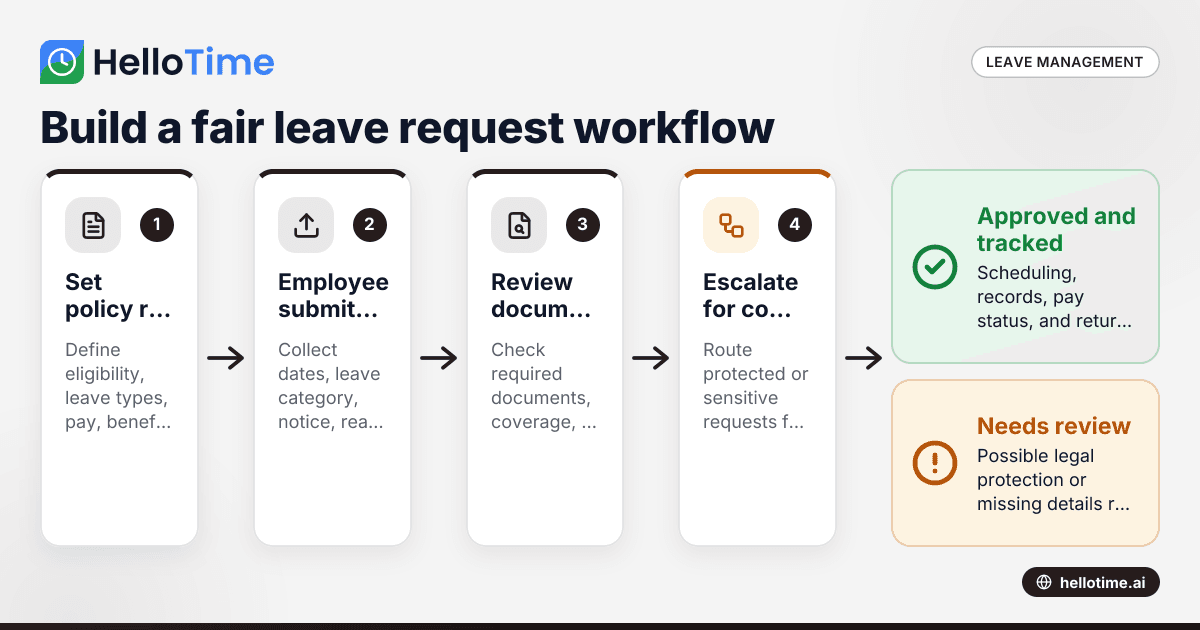
A practical 7-step leave request process
1. Employee submits the request
Require the employee to submit a leave request in writing. That could be through HR software, a form, or email if your business is very small. The request should include:
- Requested start date
- Expected return date, if known
- Leave category
- Whether the leave is continuous or intermittent, if relevant
- Basic reason description
- Contact information during leave
2. Employee provides notice
State how much notice is expected. For planned leave, ask for as much notice as possible. For emergencies, say the employee should notify the company as soon as practical.
Avoid writing notice rules that sound absolute when emergencies are involved.
3. Supporting documentation is requested, if appropriate
Not every leave needs the same level of proof. Your policy should explain when documentation may be required and who can review it.
Keep this limited to what is reasonably necessary. Managers do not need broad access to private medical details.
4. Manager reviews operational impact
The manager should review:
- Scheduled shifts or project deadlines
- Coverage options
- Training needs for temporary backup
- Client or customer impact
- Peak season issues
This review matters for discretionary leave. It may not control the result if leave is protected by law.
5. HR or owner reviews for policy compliance
In many small businesses, this step is the difference between a clean process and a risky one. Even if you do not have a formal HR department, one trained person should review requests for consistency.
This is also where ai leave workflows can help. A system can route requests, prompt for missing information, and create an approval trail without relying on memory or paper files.
6. Final decision is given in writing
The employee should receive a written outcome that includes:
- Approval, denial, or request for more information
- Approved dates
- Pay status
- Benefit handling, if applicable
- Return-to-work expectations
- Any conditions or documentation still needed
7. Leave is tracked and monitored
Once approved, the leave should be visible to the people responsible for scheduling and staffing. This prevents accidental scheduling, payroll errors, and confusion about expected return dates.
Manager approval rules that keep decisions fair
Manager approval rules should tell managers what they can decide, what they must escalate, and what factors they may consider. The policy should prevent personal bias, inconsistent treatment, and informal side deals.
Small businesses often have approval rules in practice but not in writing. That creates avoidable risk.
What managers should be allowed to consider
For discretionary leave requests, managers can usually review factors like:
- Staffing coverage
- Business demand
- Existing approved time off
- Cross-training availability
- The length of the requested leave
- The employee’s role and responsibilities
These are operational factors. They should be documented.
What managers should not decide on their own
Managers should not make legal calls about whether a leave may be protected. They also should not request unnecessary medical details, retaliate against an employee for asking, or deny a request because they are frustrated with attendance in general.
Create escalation rules such as:
- All medical-related leave requests go to HR or ownership review.
- Any request involving more than 5 business days requires a second reviewer.
- Any denial must be documented with a business reason.
- Any request with possible legal protection must be paused for compliance review.
Use approval criteria, not manager opinion
A good approval framework asks the same questions every time:
- Is the employee eligible under company policy?
- Is the leave potentially protected by law?
- Is documentation complete?
- Can the business reasonably cover the absence?
- Is the request during a restricted operational period?
- Has a similar request been handled the same way before?
When managers answer these questions in the same order, you get better consistency.
Should leave of absence be paid or unpaid?
Most small businesses treat a leave of absence as unpaid unless the policy or applicable law says otherwise. The policy should also explain whether employees may or must use available PTO, sick time, or other paid leave during the absence.
This is one area where confusion spreads fast. If one manager says, “You can use vacation first,” and another says, “This leave is fully unpaid,” employees will quickly lose trust in the process.
Set clear pay rules
Your policy should answer:
- Is the leave paid, unpaid, or partly paid?
- Can accrued PTO be used?
- Must accrued PTO be used before unpaid leave starts?
- Will holidays during leave be paid?
- How are exempt employees handled for partial-week absences, where applicable?
If your business uses billable time, shift differentials, or commission-heavy pay structures, be especially clear. Employees should know what happens to earnings during the leave period.
Explain benefits and job status
If your business offers benefits, state what happens during leave in general terms. For example:
- Whether benefits may continue during approved leave, subject to plan terms
- Whether employee contributions are still required
- Whether seniority or tenure calculations are affected
- Whether the employee remains active in your scheduling system
Do not guess on plan details. Confirm them before finalizing the policy.
How should small businesses handle documentation and privacy?
Collect only the documents needed to evaluate the request or administer the leave. Keep those records separate from general personnel notes when appropriate, and limit access to people who truly need it.
For many small businesses, the risk is not bad intent. The risk is loose handling. A doctor’s note gets forwarded to three managers. A text message screenshot gets saved in the wrong folder. A paper form sits on a front desk.
Build a basic documentation standard
Your policy should say:
- What documents may be required
- Who receives them
- When they are due
- What happens if they are missing
- Who can view them
If you use software, keep the process in one place. This helps with version control and reduces the “I thought someone else had it” problem.
Keep the approval trail
You need a record of:
- The original request
- Follow-up questions
- Documentation received
- Decision date
- Decision maker
- Conditions of approval
- Return-to-work date
This is where a leave management system becomes useful. If your business already tracks time, attendance, and schedules digitally, leave records should live in the same operational flow. You can explore features if you want to see how one system can connect leave, attendance, and scheduling.
What should happen when an employee asks for leave?
Use a written process with dates, documents, reviewers, and a final written decision. The goal is consistency. Employees should know what to submit, managers should know what to review, and the business should keep a clear record from request to return.
Under that simple rule, define exactly how requests move through your business. A good process starts with the employee request, then checks notice, documentation, staffing impact, and policy compliance before a final answer is given. This is where ai leave tools can reduce follow-up emails and missing details.
Create one path for every request
Even very small businesses should avoid side conversations that replace the real process. If one supervisor accepts text messages, another wants email, and the owner decides by memory, employees will get different results for similar requests.
A basic standard should tell employees:
- Where to submit the request
- What dates to include
- What reason category to choose
- When documents are required
- When to expect a response
That consistency matters in offices, stores, restaurants, field teams, and production environments.
How should a small business handle return to work after leave?
The policy should require the employee to confirm a return date, provide any required documentation, and notify the right manager before being placed back on the schedule. It should also explain how extensions are reviewed if the employee cannot return on time.
This section often gets skipped. That leads to avoidable confusion.
Include these return-to-work points
Write down:
- How many days before return the employee should check in
- Whether any fitness-for-duty documentation is required, if applicable
- Who updates the work schedule
- Whether the employee returns to the same role, if the leave is protected or company policy says so
- How extension requests must be submitted
Decide extension rules in advance
Extensions should not be handled casually. Your policy should require:
- A written extension request
- A reason for the additional time
- Updated supporting documents, if needed
- A business review and written response
That protects both the business and the employee from mixed messages.
Common mistakes small businesses make
Small businesses usually do not struggle because they do not care. They struggle because the process is too informal.
Here are common mistakes:
Keep reading
Related articles
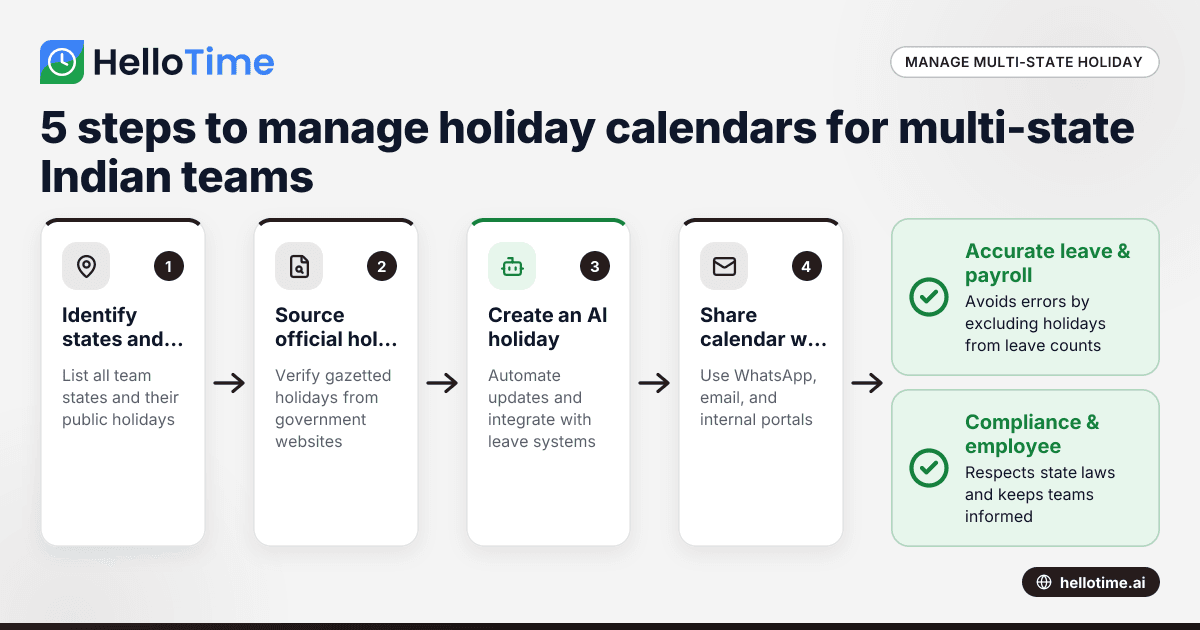
How to Manage Holiday Calendars for Multi-State Teams in India
Managing holiday calendars for multi-state teams in India can be complex due to different state-specific holidays and observances. By the end of this.
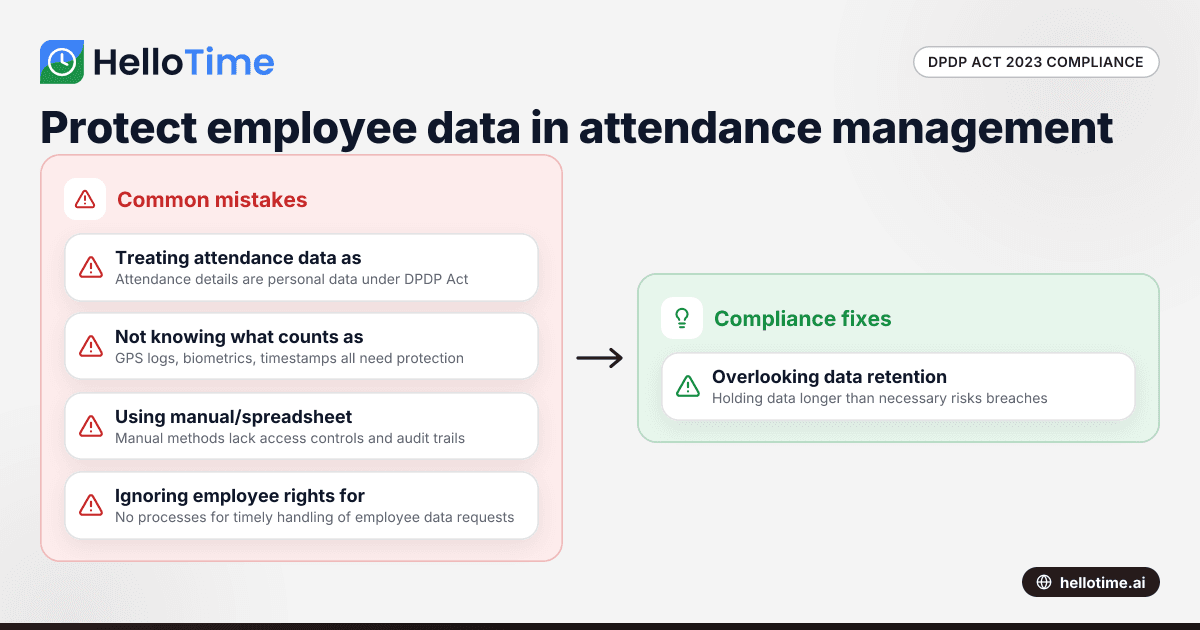
What Indian Businesses Need to Know About Data Protection Under the DPDP Act 2023 When Managing Attendance and Timesheets
Businesses tracking employee attendance and timesheets in India face growing risks if they overlook the DPDP Act 2023’s mandate for protecting.
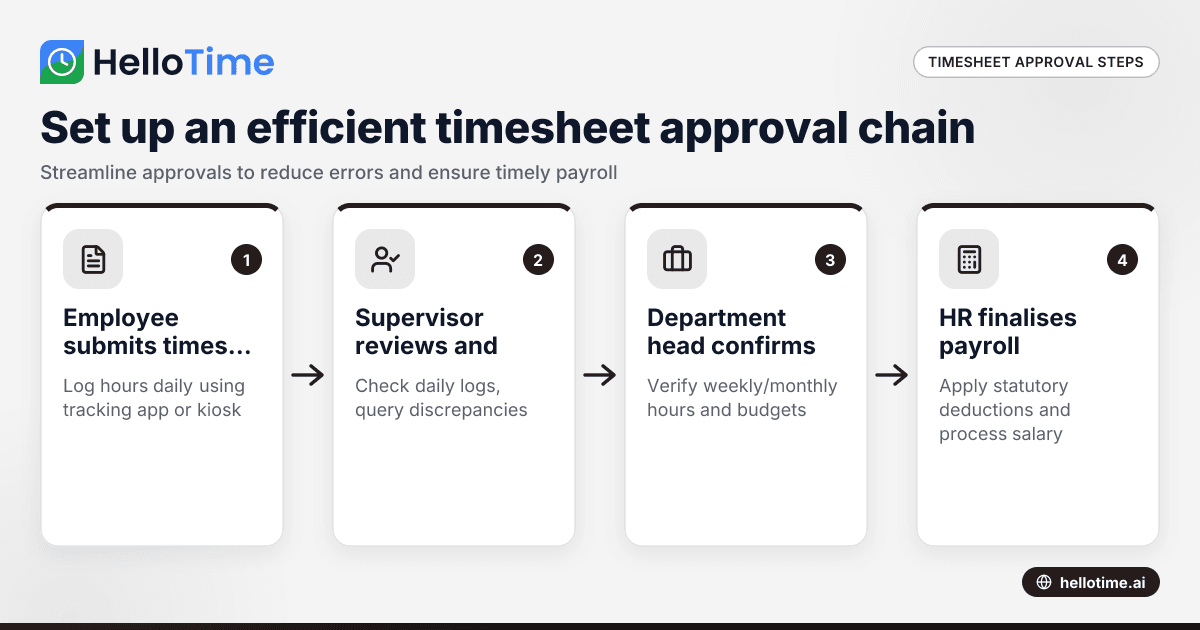
How to Set Up an Efficient Timesheet Approval Chain for Indian SMEs
How to Set Up an Efficient Timesheet Approval Chain for Indian SMEs This guide is for owners, HR, and operations managers at Indian small and.