Leave Policy for Small Manufacturing Business in Maharashtra, India: How Factory Owners Can Set Leave Rules, Approval Steps and Records
A leave policy for a small manufacturing business in Maharashtra should do three things clearly: define who can take which type of leave, explain how.
The HelloTime team
12 min read
On this page
A leave policy for a small manufacturing business in Maharashtra should do three things clearly: define who can take which type of leave, explain how approval works on the shop floor, and create simple records that stand up during payroll and inspections. If your factory still handles leave on paper, a written policy reduces disputes, last-minute absenteeism and payroll errors.
Key takeaways
- A good leave policy for small business in India must be practical for shifts, contract workers, supervisors and payroll teams.
- In Maharashtra, factory owners should align their leave rules with applicable state and labour laws, then document company processes clearly.
- Your policy should cover leave types, eligibility, notice rules, approval authority, weekly offs, holidays, attendance records and payroll treatment.
- Manufacturing units need a clear approval chain so production does not stop when operators, helpers or maintenance staff go on leave.
- Leave records should match attendance, overtime, wages and payslips to avoid disputes during month-end processing.
- Software can help automate balances, approvals and records, but the policy itself must still be clear and easy to follow.
Why does a small factory in Maharashtra need a written leave policy?
A small factory in Maharashtra needs a written leave policy because production depends on headcount by shift, skill and machine availability. If leave is handled informally on WhatsApp or paper slips, supervisors often approve requests differently, balances become unclear and payroll gets questioned.
In a manufacturing setup, even one unplanned absence can affect dispatch, preventive maintenance, quality checks or loading schedules. This is common in industrial belts around Pune, Nashik, Aurangabad, Nagpur and Mumbai’s surrounding manufacturing clusters.
A written policy helps you:
- set the same rules for all workers in similar roles
- reduce arguments over leave balance
- plan replacements or shift swaps
- connect leave with attendance and wages
- prepare better records during audits or inspections
This is general information, not legal or tax advice. Leave rules can depend on your type of establishment, workforce category and applicable law in Maharashtra. If you are unsure, confirm the legal position with your labour consultant.
What should a leave policy for small business in India include?
It should clearly define leave types, eligibility, accrual or entitlement, how to apply, who approves, notice periods, emergency leave handling, leave during probation, treatment of unpaid leave, and recordkeeping. For a Maharashtra factory, also explain how leave interacts with shifts, weekly offs, attendance and payroll.
After that core summary, build the policy section by section so supervisors and workers can actually follow it.
1. Scope and who the policy applies to
Start by stating:
- business name and factory location in Maharashtra
- effective date in DD/MM/YYYY format
- which employees are covered
- whether separate rules apply for staff, workers, trainees or fixed-term employees
For example, a unit in Chakan may have machine operators, welders, helpers, quality inspectors, store staff and office staff. Their work patterns differ. Your policy should say whether leave rules are common or role-specific.
2. Leave types
List each leave type in simple language. Depending on your setup and legal applicability, many factories use categories such as:
- casual leave
- sick leave
- earned or privilege leave
- unpaid leave
- holiday and weekly off treatment
- maternity or other statutory leave, where applicable
Do not just name the leave. Explain how it works in daily operations.
For each leave type, mention:
- who is eligible
- how many days are available
- whether it accrues or is given yearly
- minimum and maximum days per request
- whether supporting documents are needed
- whether it can be carried forward
- whether encashment applies, if your company allows it or law requires it
3. Probation and new joiners
Small factories often forget this section. That creates disputes quickly.
State clearly:
- whether probationers can take leave
- whether any leave is prorated
- whether unpaid leave can be approved during probation
- what happens if a worker is absent without approval
This matters when attrition is high and hiring happens monthly.
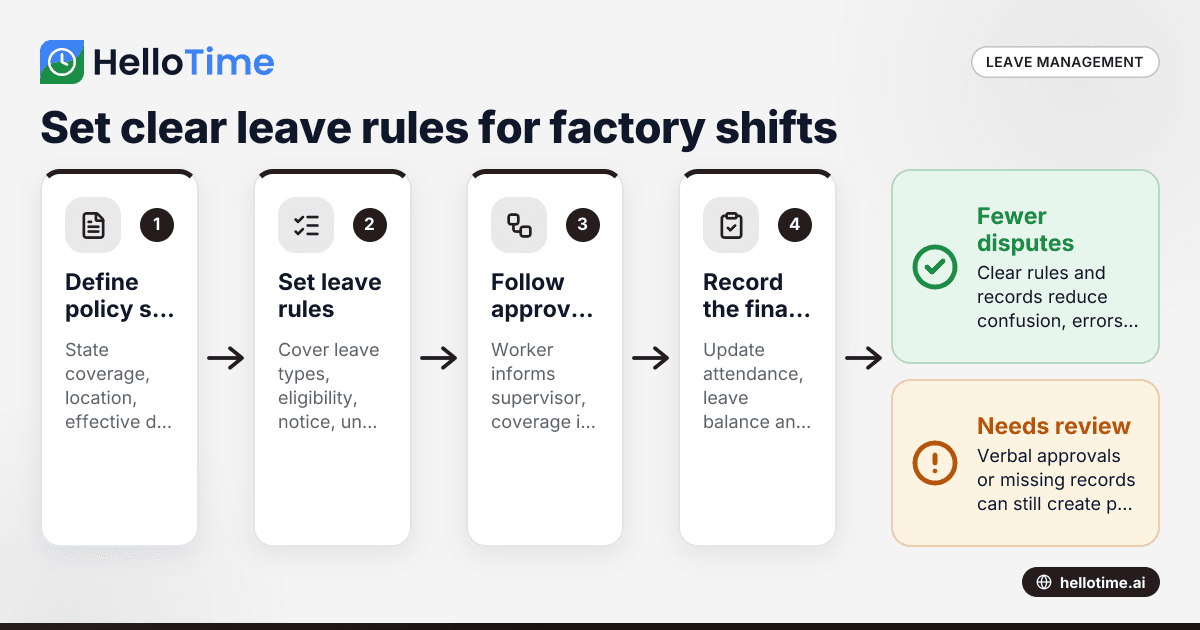
4. Approval authority
In a manufacturing business, this is one of the most important parts of the policy.
Define:
- who receives the request
- who checks shift impact
- who gives final approval
- who updates attendance and payroll
A typical chain could be:
- Worker submits request to line supervisor.
- Supervisor checks manpower for the shift.
- Production manager or HR approves based on coverage.
- Attendance or payroll team records the leave.
- Employee gets confirmation on paper, WhatsApp or app.
Without this structure, one supervisor may approve leave verbally while another asks for a written form. That inconsistency causes trouble.
How should leave approval work in a Maharashtra factory?
Keep it short, fixed and shift-friendly. Workers should know whom to inform, how much notice is needed, and when leave becomes approved. Supervisors should not rely on verbal approvals alone. HR or payroll must record the final decision before wages are processed.
Build approval rules around factory reality
A factory cannot run leave approvals like an office desk job. You need to account for:
- shift timing
- machine-specific skills
- replacement availability
- dispatch deadlines
- maintenance schedules
- peak production dates
For example, if your unit in Pune has three CNC operators on the evening shift and one requests leave, the supervisor must know whether another trained operator can cover. If not, approval may depend on alternate staffing.
Use separate rules for planned and emergency leave
Your policy should distinguish between:
Planned leave
This includes festival travel, family functions, exams, medical appointments and personal work. Ask for advance notice. State the minimum notice period in your policy.
Emergency leave
This includes sudden illness or urgent family situations. In these cases, allow intimation through a quick channel such as WhatsApp call or message to the supervisor before shift start, followed by formal submission later.
Avoid common approval mistakes
Many small manufacturers make these mistakes:
- no cut-off time for informing absence
- supervisors approving leave but not informing payroll
- leave entered after salary is processed
- no clear backup approver
- no distinction between leave and absent days
These gaps lead to disputes during wage calculation and can affect overtime and incentive payout.
Which leave records should a factory owner in Maharashtra maintain?
Maintain one consistent record that links leave request, approval, attendance, balance and payroll outcome. For small factories, the goal is simple proof and easy retrieval. If a worker questions a deduction, you should be able to trace the request, approval and final entry quickly.
Keep records simple but complete
For every leave request, capture:
- employee name and code
- department and shift
- leave type
- dates requested
- reason, where needed
- date of request
- approver name
- approval or rejection status
- date of decision
- final payroll treatment
If your factory uses paper forms, number them properly. If you use Excel, make sure one person owns the file. If approvals happen on WhatsApp, move the final decision into your main record. Do not rely only on chat history.
Match leave with attendance and payroll
This is where many errors happen in manufacturing.
Suppose a worker in Nagpur was marked absent on 14/08/2026 but had approved sick leave. If attendance and leave records do not match, wages may be cut incorrectly. That creates mistrust and takes time to fix.
At month-end, check these items together:
- attendance register
- leave applications
- approved balances
- unpaid leave days
- overtime days
- final wage sheet
Keep employee data carefully
Leave records include personal data and, in some cases, health-related information. Handle this carefully and limit access to supervisors, HR and payroll staff who need it. If you store leave data digitally, review your practices in light of the DPDP Act 2023 and keep records only for legitimate business use.
How do you set fair leave rules without hurting production?
Set minimum staffing rules first, then design leave around them. Fair leave does not mean every request gets approved. It means employees know the rules in advance, approvals are consistent, and business-critical shifts have a backup plan.
Start with your production plan
Before writing the policy, map your actual factory needs:
- number of workers per shift
- critical machines and skilled operators
- weekly peak load days
- month-end dispatch pressure
- maintenance shutdown days
- seasonal demand periods
A plastic moulding unit in Aurangabad may need full staffing near dispatch dates. A fabrication workshop in Nashik may be busiest before vendor delivery deadlines. Your leave policy must reflect that reality.
Create a simple staffing rule
Many small factories benefit from a rule such as:
- only a certain number of workers from the same line can be on planned leave on the same day
- critical roles need replacement confirmation before approval
- long leave during peak production needs manager approval
These are internal business rules. Keep them written and apply them evenly.
Define notice periods
Notice periods reduce confusion. For example, your policy may set one notice standard for planned leave and a separate process for emergencies. Keep the rule easy to understand for workers with different literacy levels.
Train supervisors, not just HR
A leave policy fails when only HR understands it.
Supervisors should know:
- what they can approve
- when to escalate
- how to record emergencies
- how to avoid verbal-only approvals
- how leave affects daily manpower planning
A 20-minute toolbox-style briefing can prevent repeated errors.
Should a small manufacturer use paper forms, Excel or an ai leave policy system?
If your headcount is very small, paper or Excel can work for a while. But once shifts, multiple supervisors and month-end payroll are involved, errors rise fast. An ai leave policy system is useful when you want standard rules, quicker approvals and cleaner records without chasing forms.
When paper still works
Paper can work if:
- your team is under 15 to 20 people
- there is one location
- one person handles attendance
- leave requests are low and easy to track
Even then, you should use a standard format and file everything by month.
When Excel starts breaking
Excel becomes risky when:
- multiple supervisors send separate files
- balances are updated manually
- workers ask for history often
- payroll depends on accurate leave data
- you have more than one shift or unit
This is common in growing units across Maharashtra’s industrial areas.
When software helps most
Leave software becomes useful when your factory needs:
- live leave balances
- approval workflows
- attendance-linked leave entries
- records for payroll
- fewer disputes over deductions
If you are evaluating time tracking software in India, check whether leave workflows, attendance and payroll records work together. That matters more than fancy dashboards.
A practical leave policy format for small manufacturing units in Maharashtra
You do not need a long legal document. You need a clear working document.
Use this structure:
Policy header
Include:
- company name
- factory address in Maharashtra
- policy name
- effective date
- version number
Purpose
State that the policy exists to manage leave fairly while maintaining production, attendance discipline and payroll accuracy.
Coverage
List employee categories covered by the policy.
Leave types and eligibility
Create a table with:
- leave type
- eligibility
- days available
- notice needed
- document needed
- approver
Application process
Write the exact steps:
- Employee informs supervisor.
- Employee submits request in approved format.
- Supervisor checks shift coverage.
- HR or authorised manager confirms.
- Attendance and payroll records are updated.
Emergency absence process
Add a separate rule for sudden illness or urgent situations.
Unauthorised absence
State what happens if an employee remains absent without approval or proper intimation.
Holidays, weekly offs and payroll treatment
Explain how leave is counted alongside weekly offs, holidays and unpaid leave according to your company practice and applicable law.
Recordkeeping
State who maintains records and how long internal records are retained as per your business process and legal guidance.
Common leave policy mistakes in small factories in Maharashtra
These mistakes create the most friction:
Copying a generic office policy
A factory is shift-based. A leave policy copied from an office business usually ignores machine coverage, shift replacement and shop-floor communication.
Not defining who approves what
If every request goes to the owner, approvals slow down. If everyone can approve, records become unreliable.
No link between leave and wages
If leave and attendance are separate, payroll errors will keep repeating. Your wage sheet should reflect approved leave correctly.
Leaving contract and support staff unclear
If your unit depends on housekeeping, loading or maintenance support, clarify how leave is tracked for each category you directly manage.
No audit trail
If a worker disputes a salary deduction, “supervisor said okay” is not enough. You need a visible record.
A simple rollout plan for a Maharashtra manufacturer
If you do not have a policy today, roll it out in one week.
Day 1: Map current practice
List how leave is currently requested, approved and entered in wages.
Day 2: Identify problems
Find repeated issues such as missing forms, balance confusion, or supervisor-level inconsistency.
Day 3: Draft the policy
Write simple rules in plain English and, if needed, a local-language version for shop-floor communication.
Day 4: Set approval authority
Decide exactly who can approve each type of leave.
Day 5: Standardise the form or system
Choose paper, spreadsheet or software. Use one method only.
Day 6: Train supervisors
Explain examples from your own factory. Keep it practical.
Day 7: Start and review
Start from a fixed date, such as 01/04/2027, and review after one full payroll cycle.
For growing manufacturers, software can make this easier by combining leave, attendance and approvals in one workflow. You can explore HelloTime’s features or compare plans on pricing if you want to move beyond paper and spreadsheets.
Frequently asked questions
Is a leave policy mandatory for a small factory in Maharashtra?
A written policy is strongly advisable even when the team is small. It helps you apply rules consistently and maintain better records. The exact statutory position depends on the type of establishment and the laws that apply to your unit.
Can leave approvals happen on WhatsApp?
WhatsApp can work for quick intimation, especially for emergency leave before a shift starts. But final approval should still be entered into one formal record for attendance and payroll. Chat alone is not a reliable leave register.
Should probationers get leave?
That depends on your company policy and the legal framework applicable to your workforce. Many small manufacturers set specific rules for probation so supervisors and payroll teams handle new joiners consistently. The key is to write the rule clearly.
How often should leave balances be updated?
Update balances regularly and certainly before payroll is closed each month. In factories, delayed updates lead to wage disputes quickly. A monthly reconciliation between leave, attendance and payroll is the minimum good practice.
Keep reading
Related articles
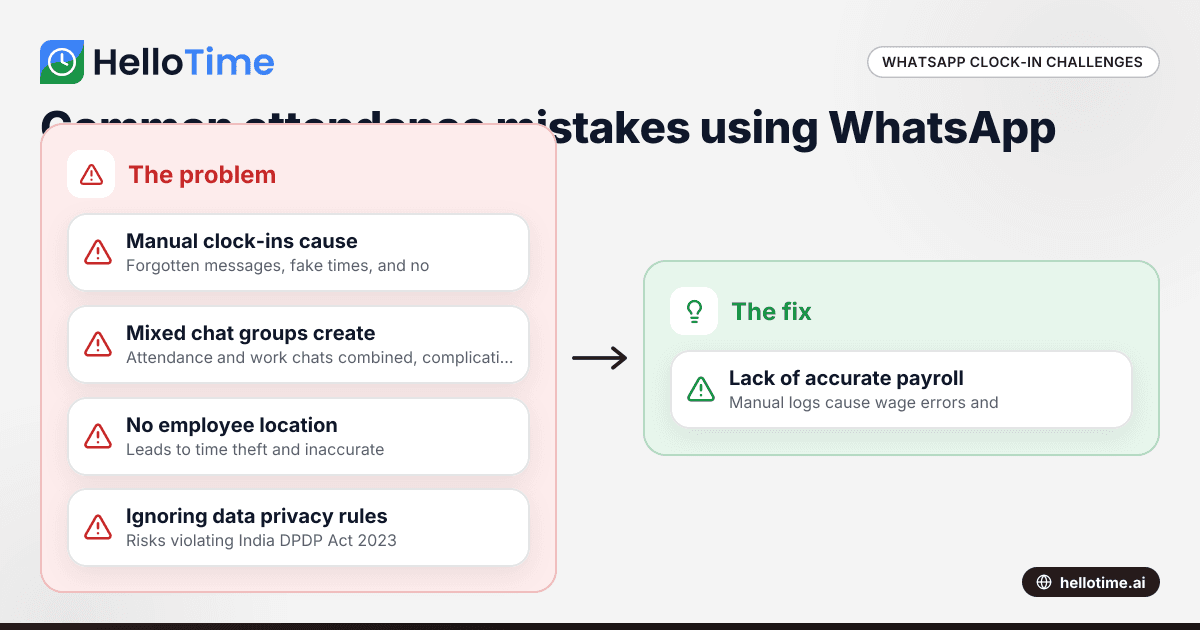
Using WhatsApp for Clock-In and Attendance Tracking in Indian Small Businesses
Using WhatsApp for Clock-In and Attendance Tracking in Indian Small Businesses The cost of managing attendance poorly can be high for small.
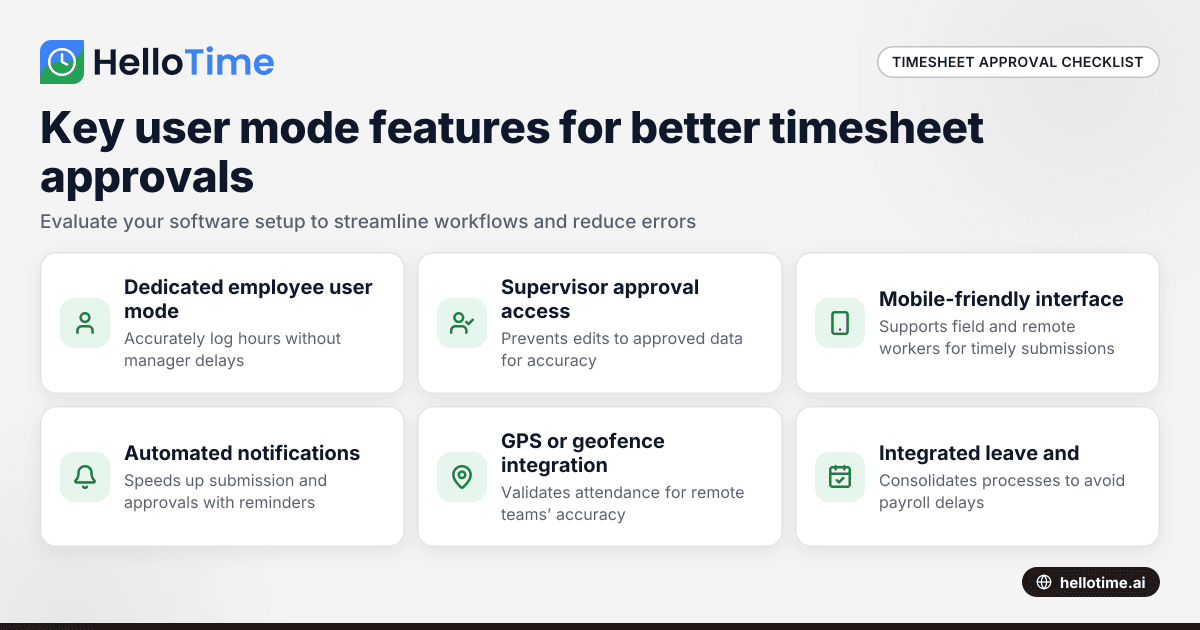
How User Mode Enhances Timesheet Approval Workflow for Indian Small Businesses
How User Mode Enhances Timesheet Approval Workflow for Indian Small Businesses.
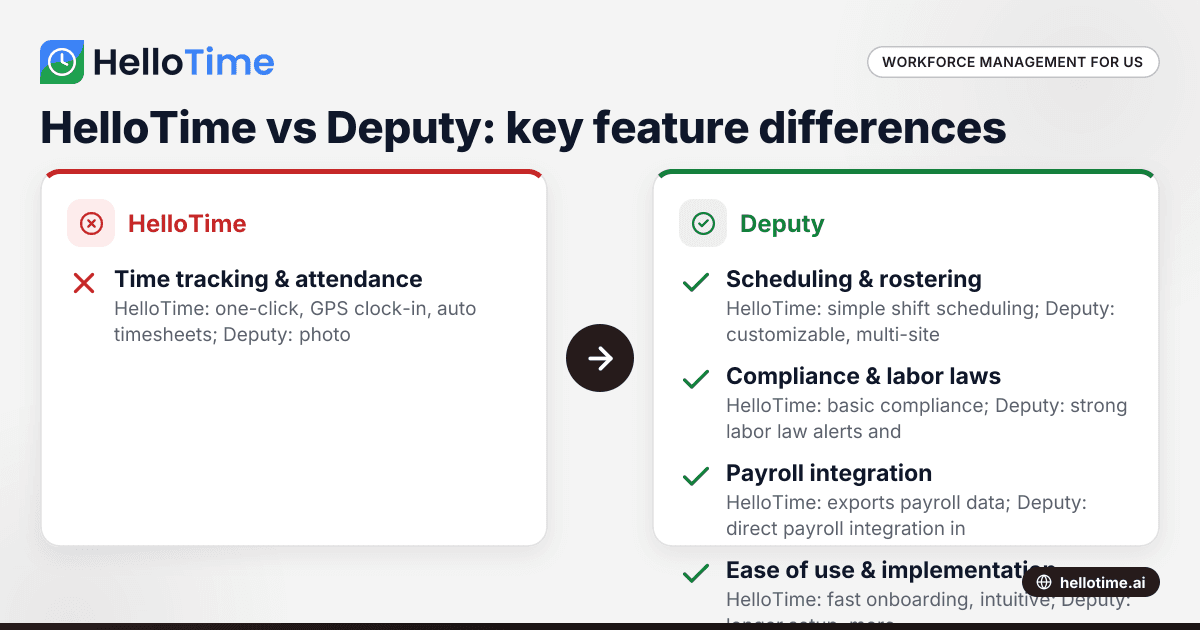
HelloTime vs Deputy: Which Workforce Management Software is Best for United States Small Businesses?
HelloTime and Deputy are popular workforce management tools offering employee scheduling, time tracking, and attendance solutions for US small.