Navigating Employee Data Privacy Under United States Laws in Timesheet Approval Workflows
Navigating employee data privacy in timesheet approval workflows requires careful attention to US laws, as well as awareness of international.
The HelloTime team
7 min read
On this page
Navigating employee data privacy in timesheet approval workflows requires careful attention to US laws, as well as awareness of international standards like the GDPR. While GDPR directly applies only to entities handling data of EU citizens, its principles influence privacy best practices everywhere. US businesses that handle employee timesheets must focus on compliance with domestic laws such as the Fair Labor Standards Act (FLSA), state privacy statutes, and cybersecurity regulations.
Key takeaways
- The GDPR influences global data privacy standards but does not directly govern employee data in the US.
- US companies must comply with federal and state data privacy laws when handling employee timesheets.
- Protecting employee data in timesheet approval workflows includes secure collection, storage, and access controls.
- Clear policies and employee consent can mitigate risks tied to data privacy in HR processes.
- AI-powered tools, including those with ai gdpr capabilities, can help automate compliance and enhance data protection.
- Using software with built-in privacy features aligned to US laws ensures safer workforce management.
What are the main US laws governing employee data privacy?
Data privacy for employees is not governed by a single overarching federal law, but rather a patchwork of regulations depending on state and context. At the federal level, the Fair Labor Standards Act (FLSA) requires employers to keep accurate records of hours worked but does not specify privacy requirements. Other pertinent federal laws include:
- The Health Insurance Portability and Accountability Act (HIPAA), applicable mainly when health information is processed.
- The Electronic Communications Privacy Act (ECPA), which limits employer monitoring of electronic communication but has exceptions.
- The Americans with Disabilities Act (ADA), which governs how sensitive medical data related to disabilities is handled.
Meanwhile, several states have enacted their own data privacy laws, which often cover employee personal information more explicitly. For example, the California Consumer Privacy Act (CCPA) extends certain protections to employees and job applicants. Illinois’s Biometric Information Privacy Act (BIPA) regulates biometric data collection, often relevant when attendance systems use face recognition.
Employers in cities like Chicago, Houston, or Detroit should check state or municipal requirements affecting employee data privacy and prioritise compliance steps accordingly.
Why must businesses protect employee data in timesheet approval workflows?
Employers collect substantial personal information through timesheets, including names, job locations, hours worked, and sometimes GPS data or biometric identifiers. This data facilitates payroll, invoicing, and labor regulation compliance but is also sensitive and at risk of unauthorized access or misuse.
Failing to protect employee data can lead to:
- Legal penalties from privacy law violations or labor law audits.
- Erosion of employee trust and morale.
- Increased vulnerability to data breaches that may expose payroll or biometric data.
- Risks in audits, disputes, or litigation over hours worked or wage payments.
Especially when timesheet workflows are digitized, with approval routed through mobile apps or cloud software, safeguarding this data becomes critical. Configuring systems with role-based access and encryption protects employee privacy throughout approval and record retention.
How can AI tools comply with workplace privacy laws and GDPR principles?
AI-powered workforce management software often incorporates features supporting compliance with existing laws and internationally recognized privacy standards like GDPR. This includes data minimization, secure storage, access audit trails, and transparent policy controls.
In the United States, while GDPR does not apply directly, AI GDPR-aligned functionalities help businesses adopt stronger data governance practices. For example, AI models that automate timesheet approvals should ensure:
- Only necessary employee data is processed.
- Access to sensitive information is limited to authorized personnel.
- Data retention policies align with US labor regulations.
- Employees are informed about how their data is used and protected.
Such AI-powered compliance assists HR and operations managers in managing risk without slowing workflows.
How do I ensure employee consent and transparency in timesheet data handling?
Obtaining employee consent is a foundational step in lawful data processing. While US laws may not require explicit employee approval for timesheet data, transparency about data usage builds trust and may preempt disputes.
Best practices include:
- Clearly communicating what employee data is collected, why, and how it is used.
- Publishing privacy notices accessible via employee portals or onboarding documents.
- Allowing employees to review and correct inaccurate timesheet entries.
- Informing employees of third-party vendors or AI tools processing their time and attendance data.
Documenting consent efforts and maintaining open channels for employee questions make privacy management proactive.
What features should I look for in timesheet software to reduce data privacy risks?
When selecting or upgrading your workforce management solution for timesheet approvals, ensure it has privacy-conscious features such as:
- End-to-end encryption of employee data during capture and storage.
- Role-based and multi-factor authentication controlling who can approve or edit timesheets.
- Audit logs that track timesheet changes, approvals, and data access.
- Integration options for secure connection with payroll or invoicing systems.
- Configurable data retention settings compliant with relevant regulatory requirements.
- Capabilities to use biometric recognition secured under applicable state laws.
HelloTime’s features include many of these controls, helping businesses in the US manage timesheet approval workflows securely.
How can I integrate data privacy into my timesheet approval workflow practically?
Implementing privacy begins with mapping each step in your timesheet process to identify where personal data is collected, stored, and transmitted. Then:
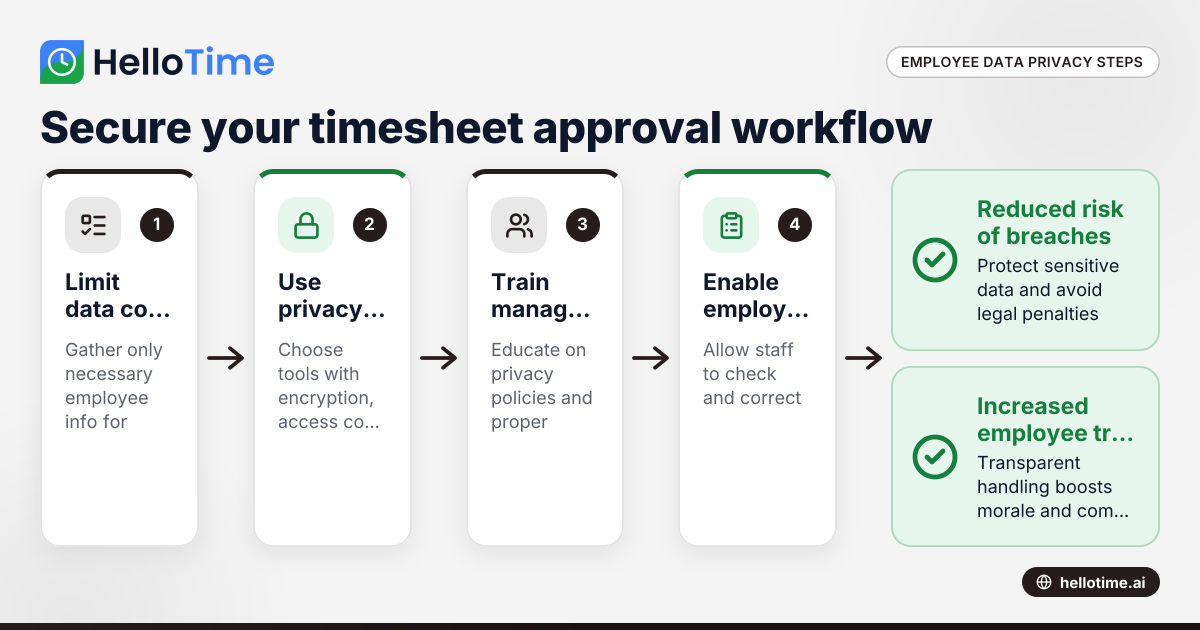
- Limit data collection to only what is necessary for payroll and compliance.
- Use software that enforces access restrictions and encryption.
- Train managers and HR staff on data handling policies.
- Establish protocols for employee review and correction of hours.
- Regularly audit timesheet data and access logs for anomalies.
- Update privacy policies periodically to reflect legal changes.
This layered approach reduces risks while promoting efficiency and accuracy.
Frequently asked questions
Does the GDPR apply to US businesses handling employee timesheets?
The GDPR mainly applies to companies processing the data of individuals in the European Union. US businesses typically fall outside its jurisdiction unless they have employees or customers in the EU. However, GDPR principles such as data minimization and security offer valuable guidelines for protecting employee data.
Are biometric time tracking methods legal in the US?
Biometric data collection is legal but regulated in certain states like Illinois under BIPA. Employers must provide clear notice, obtain informed consent, and secure biometric data from unauthorized use. Using biometric attendance technology requires attention to state laws and privacy best practices.
What consequences can arise from poor employee data privacy in timesheets?
Risks include legal penalties, lawsuits, and reputational damage. Unauthorized data disclosure could lead to identity theft or wage disputes. Employers also risk failing labor compliance audits if timesheet data integrity is compromised.
Can AI improve timesheet data privacy?
Yes. AI-powered workforce management tools can automate data access controls, detect anomalies, and ensure compliance with privacy frameworks. AI GDPR-enabled systems help enforce data minimization and audit trails, saving time while enhancing security.
What is the role of employee consent in timesheet data handling?
While not always legally required, obtaining employee consent and maintaining transparency about purpose and use strengthens trust. Clear communication about data collection and protection reduces misunderstandings and legal risk.
How does HelloTime address employee data privacy in timesheet approvals?
HelloTime implements encrypted data storage, granular role-based access controls, audit logs, and options for biometric clock-in secured under US laws. These features simplify maintaining privacy compliance in workforce management. Learn more about the full features and compare pricing.
Exploring workforce management software that prioritizes data privacy can streamline your timesheet approval workflows while protecting your employees. Discover HelloTime’s features and compare plans on pricing to find a solution tailored for your US business.
Read next
This article covers one part of a bigger topic. For the complete picture, read our guide to gdpr dpdp dpa.
Keep reading
Related articles
How the DPDP Act 2023 Affects Timesheet Approval Workflow for Manufacturers in Maharashtra, India
How the DPDP Act 2023 Affects Timesheet Approval Workflow for Manufacturers in Maharashtra, India The Digital Personal Data Protection (DPDP) Act 2023
How United States Small Businesses Can Ensure Compliance with Data Privacy in Timesheet Approval Workflows
Timesheet approval workflows handle sensitive employee data. United States small businesses must ensure compliance with data privacy laws to protect.
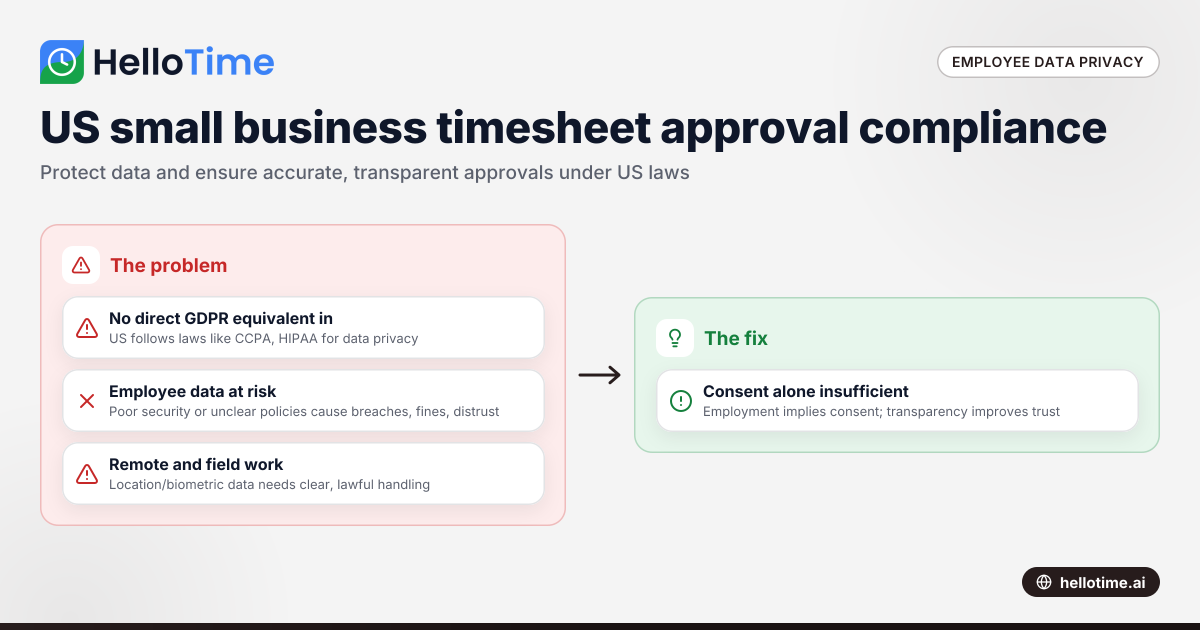
GDPR Equivalent Compliance in United States Timesheet Approval Workflows: What Small Businesses Need to Know
GDPR is a European data privacy law not enforced in the U.S., but American businesses must still protect employee data and maintain transparent.