Paid Sick Leave Policy for Small Business in United States: How to Set Accrual, Frontloading, Carryover, and Approval Rules
A paid sick leave policy for a small business in the United States should explain who is eligible, how leave is earned or granted, when employees can.
The HelloTime team
12 min read
On this page
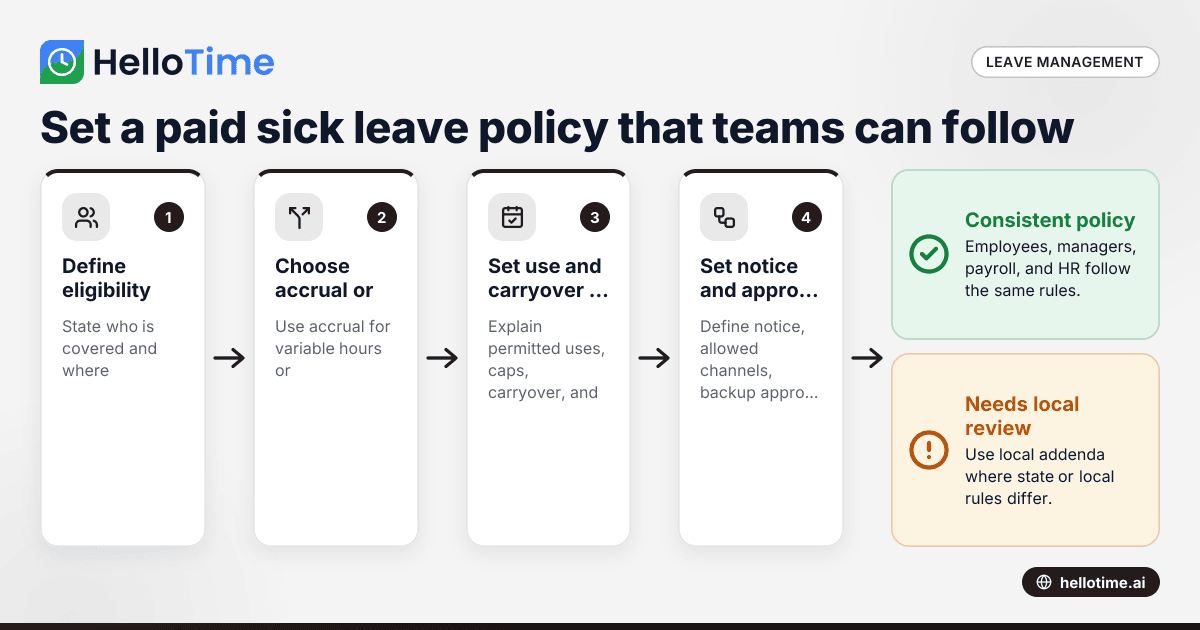
A paid sick leave policy for a small business in the United States should explain who is eligible, how leave is earned or granted, when employees can use it, what approvals are required, and how balances carry over. The right policy is simple, consistent, and aligned with the state or local rules that apply where your employees work.
Key takeaways
- Your policy should cover eligibility, accrual or frontloading, carryover, usage caps, notice, and approvals.
- State and local paid sick leave laws can differ, so one national policy may need local addenda.
- Accrual works well for variable-hour teams, while frontloading is easier to explain and administer.
- Clear approval rules should focus on notice and documentation, not creating barriers to legitimate leave.
- Good records matter. You need accurate time, attendance, and leave balances for audits and disputes.
- This article is general information, not legal or tax advice.
What is a paid sick leave policy for small business in United States?
A paid sick leave policy for small business united states employers is the written rule set that tells employees how paid sick time works. It explains how leave is earned, when it can be used, how much can be carried into the next year, and what managers can and cannot ask for.
For a small business, the policy does two jobs at once. First, it helps employees understand what they can expect when they are sick, need preventive care, or need to care for a covered family member where required by law. Second, it gives managers a consistent process so they do not make case-by-case decisions that create confusion or risk.
A good policy is practical. It fits your staffing model. A Chicago retail store has different needs than a Houston field service company or a Detroit design agency with hourly staff. But the structure is the same in each case: define the rules clearly, document them, and apply them consistently.
Why do small businesses need a written paid sick leave policy?
A written policy reduces avoidable problems. Employees know how balances build. Supervisors know what to approve. Payroll and HR know what to record. Owners spend less time settling disputes over "I thought I had time left" or "My manager told me something different."
Small businesses often start with informal practices. That can work when you have five people in one office. It breaks down when you have multiple supervisors, part-time staff, field employees, or workers in different cities and states.
A written policy also helps when your business grows. If you hire in more than one location, you may need different rules for accrual, carryover, permitted uses, or notice. A base policy with local supplements is easier to maintain than verbal exceptions.
What should your policy include?
At minimum, most small businesses should define these items:
- Who is eligible
- When accrual starts
- How accrual works, or whether leave is frontloaded
- When employees can begin using leave
- What reasons qualify
- How much can be used in a year
- What carries over to the next year
- What notice is expected
- When documentation may be requested
- How managers approve and record leave
If your workforce is hourly, shift-based, mobile, or spread across job sites, the policy should also explain how leave requests are tracked and who approves them when a direct manager is unavailable.
Accrual or frontloading: which approach is better?
Accrual means employees earn sick leave over time, often based on hours worked. Frontloading means you grant the full amount at the start of a benefit year or other defined period.
Neither method is always better. The right one depends on your staffing model, your compliance needs, and how much administrative work you can handle.
Accrual is often best for variable-hour teams
Accrual usually fits businesses with changing schedules. Think restaurants, retail, construction crews, cleaning services, and field service teams. If hours change week to week, accrual can feel fair because balances grow with hours worked.
Accrual also tends to align better with laws that are written around hours worked. But accrual requires more tracking discipline. If timesheets are late or inaccurate, leave balances can be wrong too.
Accrual can be a strong fit if you already track hours closely and approve timesheets every pay period.
Frontloading is often simpler for small teams
Frontloading is easier to explain. Employees start the year with a known balance. Managers do not have to answer as many questions about earned hours versus available hours.
For small office teams or stable full-time workforces, frontloading can reduce admin effort. It may also help with recruiting because the benefit is easy to understand on day one.
The tradeoff is that frontloading can create unused balances on the books, and in some jurisdictions you still need to pay close attention to carryover rules and usage rules.
How do you choose between accrual and frontloading?
Choose accrual if employee hours vary a lot and you already have reliable time records. Choose frontloading if you want simpler communication and administration. Then verify that the method works with the state and local rules where your employees work.
A practical test is to ask three questions:
- Do employee hours change significantly each pay period?
- Can we maintain accurate balances without manual spreadsheets?
- Do we operate in places with specific paid sick leave rules?
If the answer to the first is yes, accrual may be easier to defend. If the answer to the second is no, frontloading may be simpler to manage. If the answer to the third is yes, legal review becomes more important than convenience.
How should you set sick leave accrual rules?
Your accrual rule should be easy to explain and easy to calculate. If employees cannot understand how they earn time, they will not trust the balance.
Start with four decisions:
Define the accrual basis. Many employers tie accrual to hours worked.
Define the benefit year. Use a clear 12-month period, such as a calendar year or anniversary year.
Define usage caps. State how much can be used in the year, if your applicable law allows a cap.
Define the minimum increment. Explain whether leave is tracked in hours, partial hours, or another increment allowed by law.
Keep the math visible in your handbook and manager guide. Avoid hidden exceptions. If one group follows a different rule, write that separately.
Keep accrual rules tied to real records
Accrual only works when your source data is clean. For hourly teams, that means time punches, approved timesheets, and a clear process for corrections. If supervisors still text hours at the end of the week, leave balances can drift fast.
This is where systems matter. Time tracking, leave balances, and approvals should connect. If your managers approve shifts in one place and employees request leave somewhere else, errors multiply.
Some buyers now search for ai paid sick workflows because they want fewer manual handoffs. The useful version of that idea is not magic. It is simply software that uses accurate attendance and leave records to reduce mistakes and prompt managers to follow the right process.
What carryover rules should a small business use?
Carryover rules tell employees what happens to unused sick leave at the end of the benefit year. Your policy should state whether unused time carries forward, whether a cap applies, and whether carried time affects annual usage limits.
Keep this section short and exact. Employees mainly want one answer: "If I do not use it this year, what happens next year?"
Then confirm that your rule matches the state and local laws where employees work. Some employers assume carryover and annual use are the same thing. They are not. A policy may allow carryover of one amount and limit use in a year to another amount, depending on the rule that applies.
How to write a carryover rule clearly
Use plain language. For example:
- Define the year-end date
- Define what carries over
- Define any maximum balance
- Define any annual use limit
- Define whether frontloaded leave changes the carryover treatment
Do not bury carryover terms inside payroll language or PTO language unless your sick leave policy is fully combined with PTO and reviewed for compliance.
Avoid the most common carryover mistakes
Small businesses often make these errors:
- Resetting balances without checking the law
- Mixing PTO and sick leave terms carelessly
- Letting managers promise exceptions informally
- Failing to record carryover correctly after year-end
- Using one rule for every location without reviewing local requirements
If you have employees in several jurisdictions, carryover is one of the first areas to standardize centrally and document locally.
What approval rules should your policy include?
Approval rules should support operations without discouraging legitimate use of sick leave. Your policy should tell employees who to notify, how soon to notify them, how to submit the request, and when documentation may be requested under applicable law.
The tone matters here. A sick leave policy is not an attendance punishment policy. It should help your team report absences quickly so work can be covered, while respecting employee rights.
Build approval rules around notice, not friction
A practical small-business policy usually answers these questions:
Who does the employee contact first? Direct supervisor, dispatch, store manager, or HR.
What channels are allowed? Phone, text, email, or an employee app.
What notice is expected? As soon as practical, or before shift start when foreseeable.
How is the leave recorded? Through a request form, app, or manager entry.
When can documentation be requested? Only as allowed by applicable law and your policy.
If you run shifts, include a backup approver. A restaurant manager in Chicago or a service manager in Houston will not always be available before a 6:00 a.m. callout.
Can managers deny paid sick leave requests?
Managers should not make ad hoc decisions. They should follow the written policy and the law that applies in the employee’s work location. Approval rules usually govern notice and recording, not whether a valid use of protected sick leave is "convenient" for the schedule.
Underneath that principle, train managers on what they can ask and what they should avoid. They should focus on coverage, not medical details.
How should small businesses handle documentation and doctor’s notes?
Your policy should state when documentation may be requested and who reviews it. Keep this process narrow. Medical details should not flow freely through frontline managers.
For many small businesses, the simplest approach is:
- Employee notifies the manager or scheduling contact
- Leave is recorded
- HR or an authorized admin handles any allowed documentation request
- Managers receive only the operational information they need
That approach protects privacy and reduces inconsistent demands. It also helps if a dispute arises later.
Keep doctor’s note rules practical
Do not require notes in situations where the law limits that practice. Even where documentation is allowed, think carefully before creating a burden for short absences. A rule that looks strict on paper often causes resentment and does little to improve attendance reliability.
A better approach is to combine clear notice rules with clean records. When patterns need review, handle them through a documented attendance process, not through improvised requests for medical details.
How should you track balances, requests, and approvals?
You need one source of truth. Spreadsheets can work for a very small team in one location. They usually fail when you add shifts, managers, or multiple leave types.
The minimum system should show:
- Current available balance
- Accrued or frontloaded amount
- Used amount
- Carryover amount
- Pending requests
- Approved requests
- Audit trail of changes
For shift-based teams, the leave system should also connect to the schedule. If a cashier, server, technician, or machine operator is out, the scheduler needs to see the gap quickly.
Why tracking matters more for hourly and shift-based teams
Hourly businesses feel leave mistakes immediately. A wrong balance leads to payroll questions. A missed approval leads to a shift gap. A late update leads to employee distrust.
Good tools reduce those problems by linking attendance, schedules, and leave in one workflow. If you are evaluating options, HelloTime’s features page shows how time tracking, scheduling, attendance, and leave management can work together for small teams in the United States.
What should a simple paid sick leave policy template cover?
A strong small-business policy does not need to be long. It needs to be complete. Use this outline as a checklist when drafting or revising your policy:
1. Purpose and scope
Explain that the policy provides paid sick leave and applies to eligible employees in the United States, subject to state and local requirements where applicable.
2. Eligibility
Define which employees are covered. If treatment differs by location or classification, say so clearly.
3. Benefit year
State the 12-month period used for accrual, frontloading, carryover, and annual use.
4. Accrual or frontloading method
Explain exactly how leave is earned or granted, and when balances become available for use.
5. Permitted uses
List the reasons leave may be used, based on the rules that apply to your locations.
6. Request and notice process
State how employees notify the business, who receives the notice, and how requests are recorded.
7. Approval and documentation
Explain manager responsibilities, documentation rules, and where sensitive information goes.
8. Carryover and caps
State what carries over, any maximum balance, and any annual use limit allowed by law.
9. Separation and rehiring
If your policy addresses reinstatement or payout treatment, make sure it is reviewed for the jurisdictions involved.
10. Non-retaliation and policy updates
State that employees will not be retaliated against for lawful use of leave, and that the company may update the policy to meet legal requirements.
How often should you review your paid sick leave policy?
Review it at least once a year and again whenever you hire in a new state or city. Also review it after any operational change, such as moving from office staff to shift coverage or opening a second location.
The practical trigger is not just legal change. It is process drift. If managers are handling callouts differently, if balances are being corrected manually every month, or if employees keep asking the same questions, your policy or workflow needs attention.
What is the easiest way to administer paid sick leave?
Use one system for time, leave, and approvals, with local policy rules documented clearly. That reduces manual balance fixes, inconsistent manager decisions, and end-of-pay-period surprises.
Keep reading
Related articles
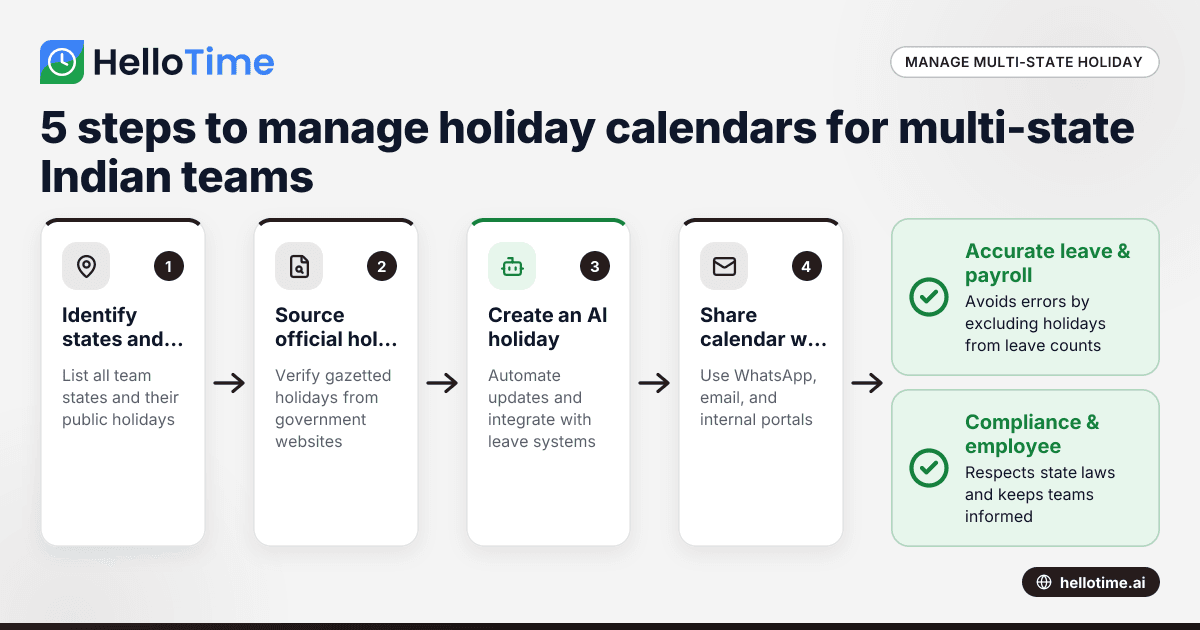
How to Manage Holiday Calendars for Multi-State Teams in India
Managing holiday calendars for multi-state teams in India can be complex due to different state-specific holidays and observances. By the end of this.
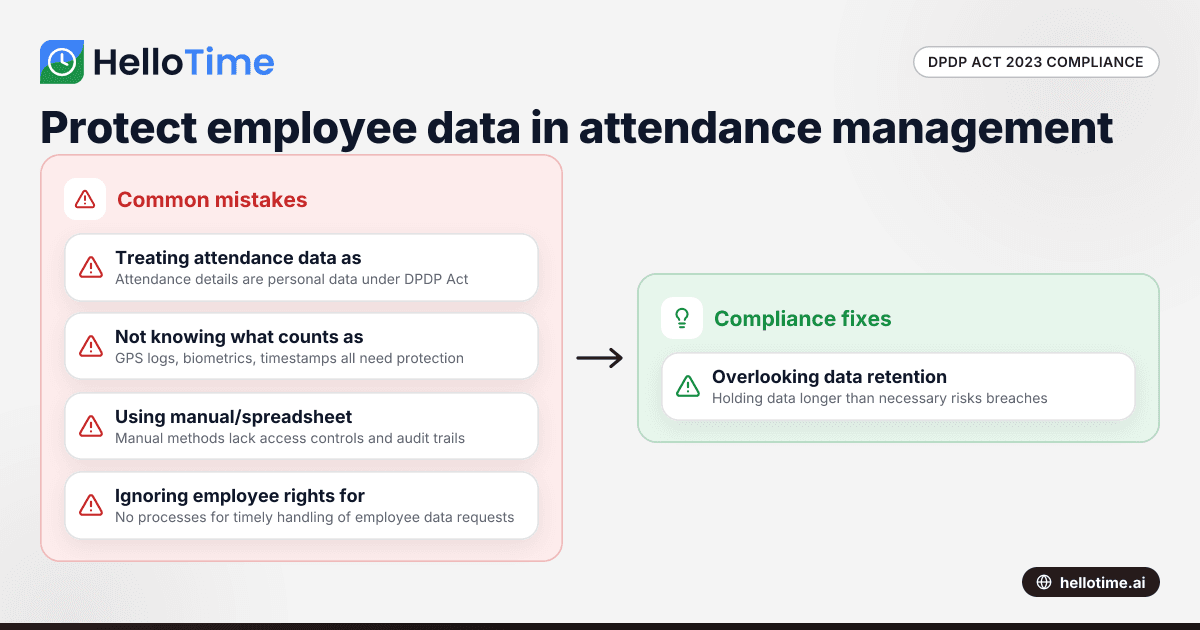
What Indian Businesses Need to Know About Data Protection Under the DPDP Act 2023 When Managing Attendance and Timesheets
Businesses tracking employee attendance and timesheets in India face growing risks if they overlook the DPDP Act 2023’s mandate for protecting.
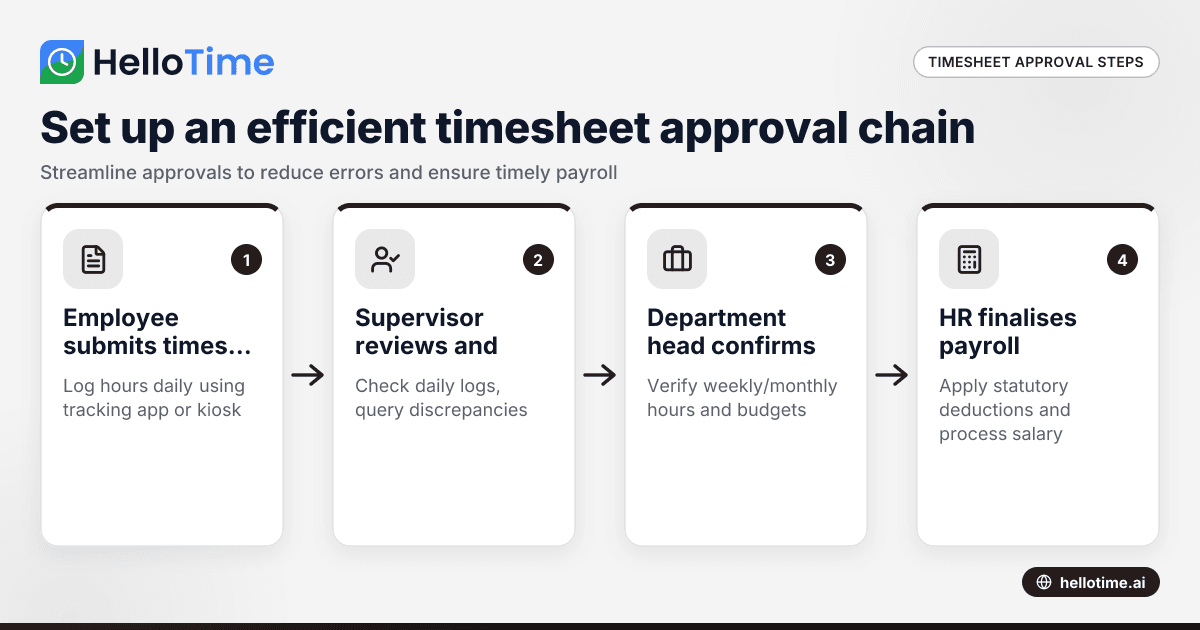
How to Set Up an Efficient Timesheet Approval Chain for Indian SMEs
How to Set Up an Efficient Timesheet Approval Chain for Indian SMEs This guide is for owners, HR, and operations managers at Indian small and.