PTO Policy Template for Small Business in United States: How to Set Accrual, Carryover, Holidays, and Approval Rules
A PTO policy template for a small business in the United States should do four things clearly: define who gets paid time off, how time is earned, when
The HelloTime team
12 min read
On this page
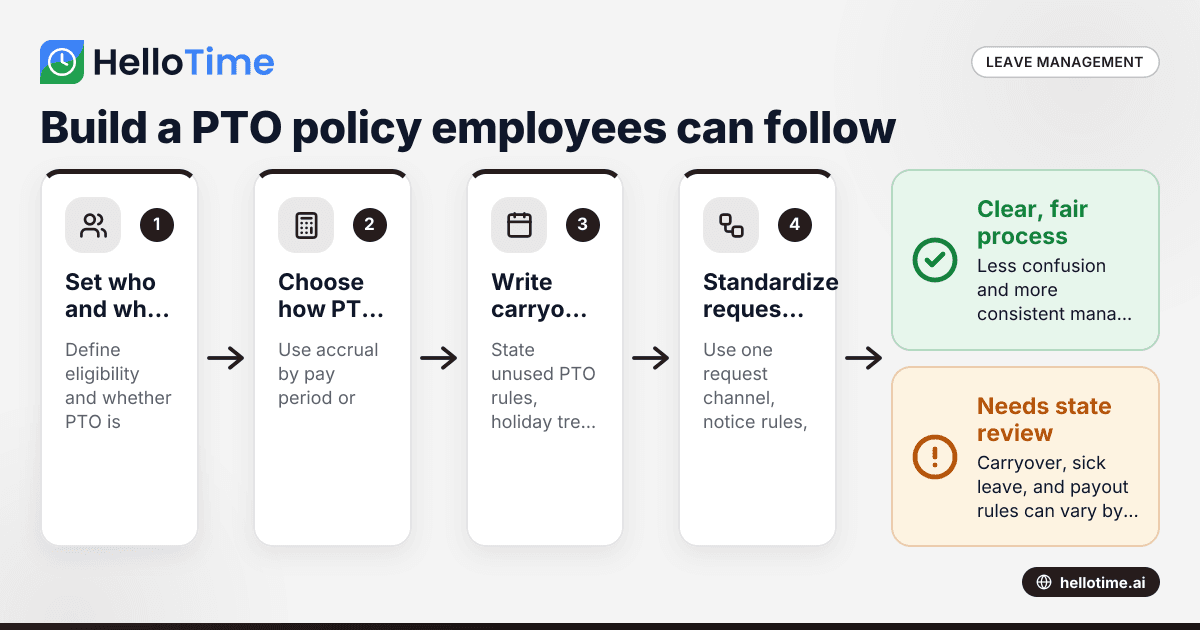
A PTO policy template for a small business in the United States should do four things clearly: define who gets paid time off, how time is earned, when it can be used, and who approves it. A simple policy reduces confusion, helps managers stay fair, and gives employees a clear process they can actually follow.
Key takeaways
- A strong PTO policy should cover eligibility, accrual, carryover, holidays, approval rules, and payout rules.
- Small businesses in the United States often choose between accrual-based PTO and front-loaded annual PTO.
- Carryover and rollover rules must be written clearly and checked against state and local requirements.
- Approval rules should balance employee flexibility with business coverage, especially for shift-based teams.
- A good PTO policy template is easier to manage when leave balances, requests, and approvals are tracked in one system.
What is a PTO policy template for small business in United States?
A pto policy template for small business united states is a written policy that explains how your business handles paid time off. It gives you a starting structure that you can adapt for your team size, industry, and operating schedule.
For many small businesses, PTO includes vacation, personal time, and sometimes sick time in one shared bank. In other businesses, vacation and sick leave are tracked separately. Your policy should state exactly which model you use.
A practical PTO policy usually answers these questions:
- Who is eligible for PTO
- When new hires start earning PTO
- How PTO accrues or is granted
- Whether unused PTO carries over
- Which paid holidays the company observes
- How employees request time off
- Who approves requests
- What happens when two people ask for the same dates
- Whether unused PTO is paid out at separation, where required
If your business has hourly teams, field crews, retail staff, restaurant workers, or office employees, a written PTO policy matters even more. Verbal rules often create inconsistent approvals, payroll mistakes, and last-minute staffing gaps.
Why does a small business need a written PTO policy?
A written PTO policy helps a small business stay consistent. Employees know what to expect, managers know how to review requests, and HR does not need to answer the same questions over and over.
It also helps with planning. If you run a warehouse in Houston, a dental office in Chicago, or a manufacturing shop in Detroit, time off affects staffing, customer service, and payroll. Without clear rules, one approved vacation can create a scheduling problem for the whole week.
A written policy also supports better recordkeeping. This matters when you are:
- Reviewing attendance patterns
- Building schedules
- Calculating billable hours
- Preparing payroll data
- Handling disputes over balances
Where leave laws apply, your policy should be reviewed for compliance. State and local sick leave, payout, and carryover rules can differ. This article is general information, not legal or tax advice.
What should be included in a PTO policy template?
A good template should be short enough to use and detailed enough to prevent confusion. Start with the basics, then add rules that fit your operations.
1. Policy purpose
State why the policy exists. Keep it simple. For example, say that PTO is provided to support rest, personal needs, and planned time away from work while maintaining business coverage.
2. Eligibility
Define which workers are eligible. This might include:
- Full-time employees
- Part-time employees
- Temporary employees
- Seasonal employees
- Exempt and nonexempt employees
If eligibility differs by employment type, say so directly. Do not assume managers will apply the rule the same way.
3. Types of leave covered
Explain whether PTO is one combined bank or separate categories. If separate leave programs exist for sick time, jury duty, bereavement, or unpaid leave, note where those policies sit.
4. Accrual or front-loading
This is the heart of the policy. Explain whether employees:
- Earn PTO over time each pay period, or
- Receive a fixed amount at the start of the year
Also explain when accrual starts and whether there is a waiting period before use.
5. Carryover rules
State what happens to unused PTO at year-end. Does it carry over fully, partially, or not at all? If there is a cap, define it clearly.
6. Paid holidays
List the holidays your company observes. State whether the office closes, whether hourly staff are paid for the day, and what happens when a holiday falls on a weekend.
7. Request and approval rules
Define:
- How employees request PTO
- How much notice is needed
- Who approves requests
- How conflicts are resolved
- Whether blackout dates exist
8. Separation and payout
State what happens to unused PTO when employment ends. Rules on payout can vary by state, so review this section carefully.
How should you set PTO accrual?
Choose a method your team can understand and your managers can apply consistently. For most small businesses, that means either accrual by pay period or front-loading an annual amount.
Option 1: Accrual by pay period
This method works well for businesses with hourly employees, variable schedules, or new hires throughout the year. Employees earn PTO gradually as they work.
Example:
- An employee earns 80 hours of PTO per year
- You run payroll every two weeks
- The employee earns a set portion each pay period
This approach feels fair because PTO builds over time. It also limits large negative balances early in the year.
Option 2: Front-loaded PTO
This method gives the full annual PTO amount at the start of the year or on the employee’s anniversary date.
Example:
- An employee receives 10 PTO days on 01/01/2027
- They can use those days at any time, subject to approval rules
This is simpler to explain. It also reduces balance questions. But it can create issues if employees use all PTO early and then leave.
Service-based tiers
Some businesses increase PTO based on tenure. For example, employees with more years of service may receive more PTO than newer hires. If you use tiers, write the service milestones clearly and apply them evenly.
Should you allow borrowing?
Some small businesses allow employees to use unearned PTO. If you do this, define:
- The maximum negative balance
- Manager approval requirements
- What happens if the employee leaves before earning it back
If you want a simpler process, do not allow borrowing.
How much PTO should a small business offer?
There is no single required amount for every business in the United States. Your policy should fit your budget, hiring market, and operating needs.
A small creative agency might offer a fixed annual bank to stay competitive in hiring. A field service company might use accrual to match hours worked. A restaurant or retail operation may need stricter peak-season rules because coverage matters more than office flexibility.
When deciding on PTO levels, consider:
- Your industry
- Local hiring competition
- Whether your team is hourly or salaried
- Your peak and slow seasons
- Administrative complexity
- Expected overtime or weekend work
Keep the plan easy to explain. If employees need a spreadsheet to understand their balance, the policy is too complex.
What carryover rules should you use?
Set a carryover rule that supports both fairness and staffing. Employees want flexibility. Employers need predictable scheduling and manageable leave balances.
Common carryover approaches include:
- Full carryover up to a cap
- Limited carryover, such as a set number of hours
- Use-by deadline after year-end
- No carryover, where allowed
If you set a cap, define whether it is:
- An accrual cap, where earning stops at a balance limit, or
- A year-end carryover cap, where excess balance is removed at a set time
These are not the same thing. Your policy should say which one applies.
Practical example
A landscaping company in Houston might allow employees to carry over a limited balance into the next year because spring staffing ramps up fast. A professional services firm in Chicago might allow a higher cap because projects are planned further in advance.
Watch state rules carefully
Carryover and payout rules can be affected by state law and, in some places, local requirements. Do not copy another company’s wording without checking whether it fits your state.
How should you handle paid holidays?
Paid holidays should be listed separately inside the policy. Do not leave this to manager discretion.
A holiday section should state:
- Which holidays are observed
- Which employees are eligible for holiday pay
- What happens if the holiday falls on a weekend
- Whether employees must work the scheduled day before or after the holiday
- What applies to teams that work on holidays
If your business runs seven days a week, explain how holiday shifts are assigned. If offices close but field teams continue working, say so clearly.
Keep holiday rules simple
Many small businesses observe a standard list of company holidays and pay eligible employees for those days. Others offer floating holidays instead of a larger fixed holiday calendar.
If you use floating holidays, define:
- How many are offered
- Whether they expire
- Whether manager approval is required
- Whether certain blackout periods apply
How do you set PTO approval rules?
Use one approval process for the whole business unless there is a strong operating reason not to. The simpler the process, the more likely managers will follow it.
Short answer
Set clear notice periods, one approval owner, conflict rules, and blackout dates. Approvals should depend on staffing coverage, not manager preference. Employees should know how to request time off, when they will get an answer, and what happens if multiple people ask for the same dates.
Build approval rules around coverage
Approval rules should protect operations first. That does not mean saying no to every request. It means defining how you will say yes fairly.
Include rules such as:
Request channel Employees must submit PTO requests through one system or one written process.
Notice requirement Example: one week of notice for single-day requests and two weeks for longer requests.
Approver State whether the direct manager, department head, or HR approves leave.
Conflict resolution If two employees request the same dates, decide whether priority goes by submission time, role criticality, rotation, or seniority.
Blackout dates If your busiest dates are predictable, list them clearly.
Response time State how quickly managers should approve or deny requests.
Avoid common approval mistakes
These mistakes create frustration fast:
- Different managers using different standards
- Verbal approvals with no written record
- Employees learning too late that a shift is uncovered
- No tie-breaker for overlapping requests
- Allowing one department to hoard vacation during peak periods
Can an ai pto policy help?
Yes. An ai pto policy can help you draft clearer rules, spot missing sections, and simplify wording. It still needs a human review for your business, your state, and your staffing realities before you publish it or hand it to employees.
PTO policy template for small business in United States
Below is a practical template you can adapt. Replace bracketed text with your company details.
Short answer
Use a PTO policy that names eligibility, accrual, carryover, holidays, request steps, approvals, and payout rules. Keep the wording plain. If your team cannot understand it in one read, simplify it before rollout.
Sample PTO policy template
Policy name: Paid Time Off Policy
Effective date: [MM/DD/YYYY]
Purpose [Company Name] provides paid time off to eligible employees for vacation, personal time, and other approved absences. This policy explains how PTO is earned, used, approved, and tracked.
Eligibility This policy applies to [full-time employees / part-time employees / other categories]. Temporary, seasonal, and contract workers are [eligible / not eligible] for PTO unless stated otherwise in writing.
PTO accrual Eligible employees earn PTO [each pay period / monthly / annually]. PTO begins accruing on [hire date / first day of employment / other date]. Employees may begin using accrued PTO on [date or waiting period].
Annual PTO amount or accrual rate Eligible employees receive [X hours / X days] of PTO per year, subject to the accrual schedule in this policy. PTO balances are shown in [pay stubs / HR system / time tracking system].
Carryover Unused PTO [may / may not] carry over into the next year. Employees may carry over up to [X hours]. Any balance above this amount [is forfeited on MM/DD / remains subject to an accrual cap], where permitted by law.
Accrual cap Employees stop accruing PTO when their balance reaches [X hours]. Accrual resumes when the balance falls below the cap.
Paid holidays The company observes the following paid holidays: [list holidays]. Holiday eligibility and scheduling rules are described as follows: [insert details].
How to request PTO Employees must request PTO through [system or written process]. Requests for planned PTO should be submitted at least [X days] in advance. Same-day or emergency absences must be reported to [manager/HR contact] as soon as possible.
Approval rules PTO requests are approved based on staffing needs, business demands, and the order in which requests are received, unless another business rule applies. Approval is not final until confirmed by [manager/HR/system].
Blackout dates The following blackout dates or peak business periods apply: [insert dates or departments, if any].
Partial-day and minimum increments PTO may be used in increments of [1 hour / half day / other]. Partial-day requests are [allowed / not allowed].
Unpaid leave If PTO is exhausted, employees may request unpaid time off, subject to manager approval and business needs.
Separation from employment Upon separation, unused PTO will be [paid out / not paid out], as required by applicable law and company policy.
Policy changes [Company Name] may update this policy at any time, subject to applicable law.
How do you roll out a new PTO policy without confusion?
Announce the policy in writing, explain the basics in one meeting, and show employees how balances and requests will be tracked. Give managers a simple approval checklist. Most confusion comes from unclear transitions, not from the policy itself.
If you are replacing paper forms or spreadsheets, rollout matters as much as policy design. A messy launch creates more questions than the old system did.
1. Set a clear effective date
Pick one date when the new policy starts. State what happens to existing balances before that date.
2. Explain the transition
Tell employees:
- Whether current balances carry forward
- Whether old vacation rules still apply
- When they can start using the new system
- Who to contact with questions
3. Train managers first
Managers need examples, not just policy text. Show them how to handle:
- Overlapping requests
- Emergency absences
- Peak-season denials
- Negative balances, if allowed
Keep reading
Related articles
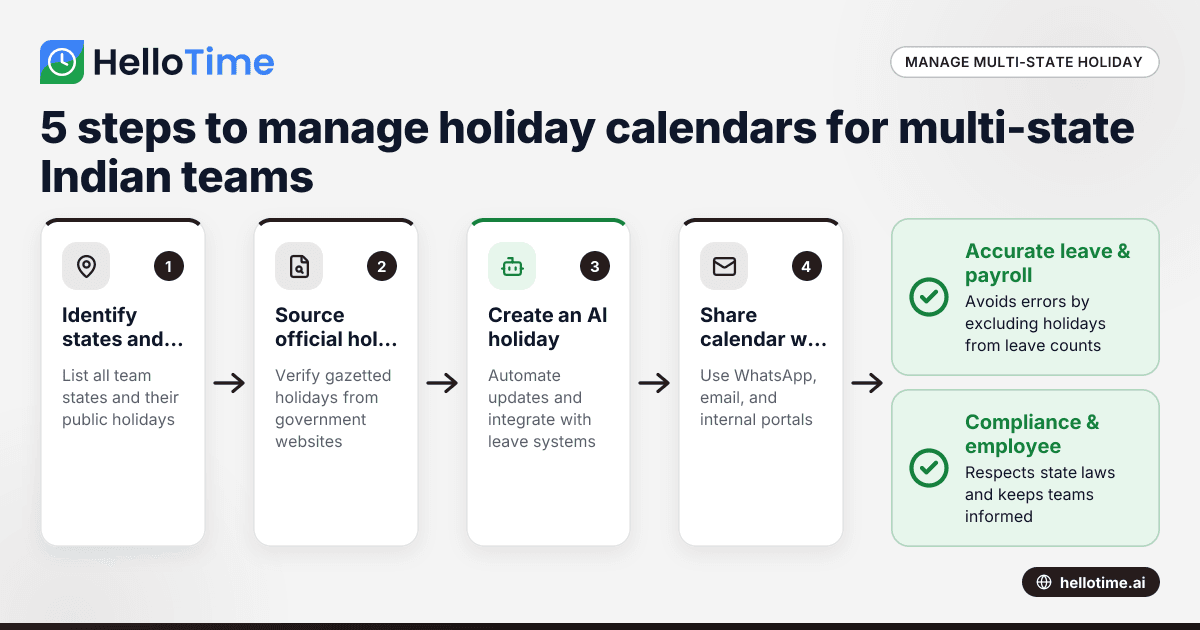
How to Manage Holiday Calendars for Multi-State Teams in India
Managing holiday calendars for multi-state teams in India can be complex due to different state-specific holidays and observances. By the end of this.
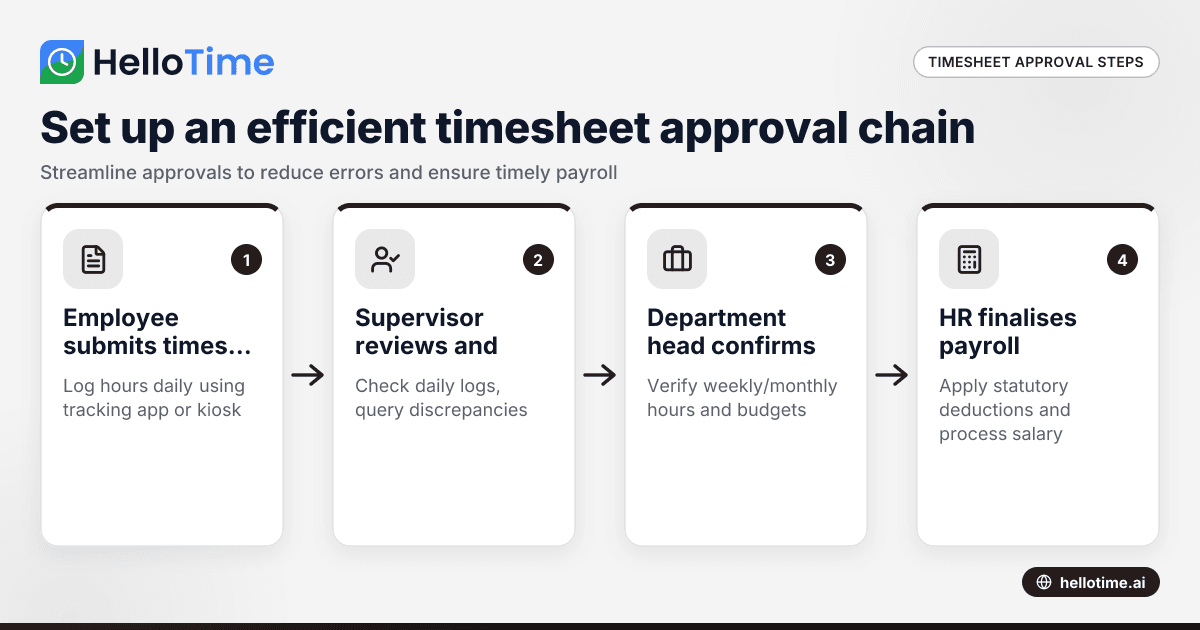
How to Set Up an Efficient Timesheet Approval Chain for Indian SMEs
How to Set Up an Efficient Timesheet Approval Chain for Indian SMEs This guide is for owners, HR, and operations managers at Indian small and.
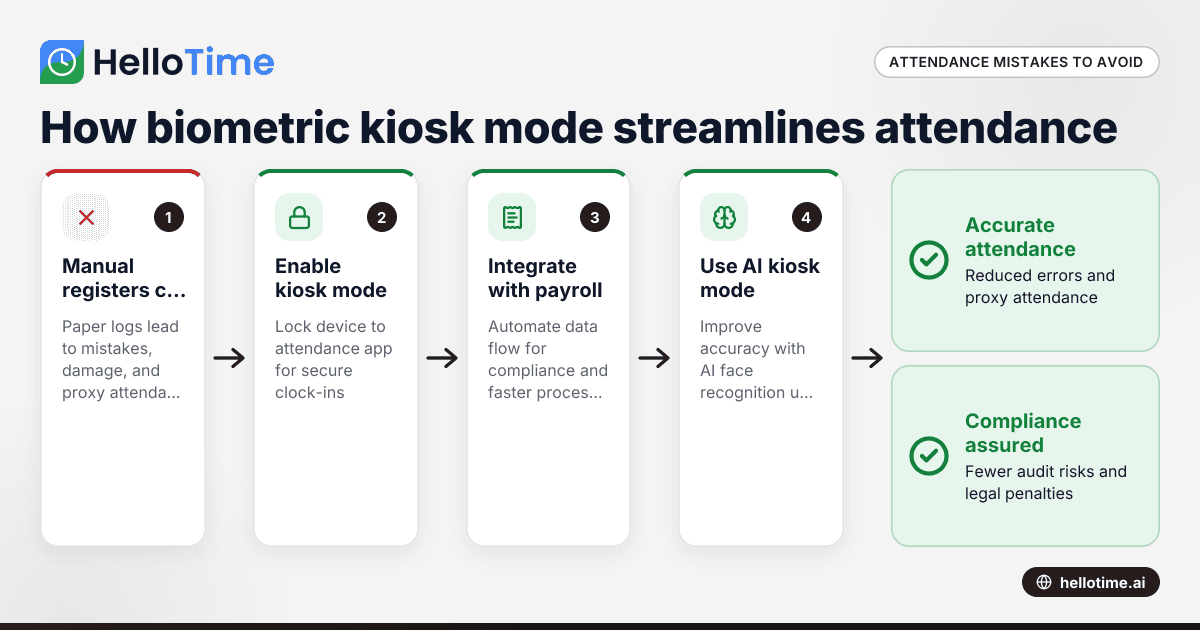
How Biometric Attendance Kiosk Mode Can Streamline Workforce Management for Indian Manufacturing Units
Manufacturing units in India often struggle with managing workforce attendance accurately and efficiently. Errors in attendance tracking lead to.