Small Business Payroll Deductions in UAE: How to Calculate Gross-to-Net Pay from Timesheets and Overtime
Payroll deductions in the UAE start with a simple flow: turn approved work hours into gross pay, add any overtime or fixed allowances, then subtract.
The HelloTime team
12 min read
On this page
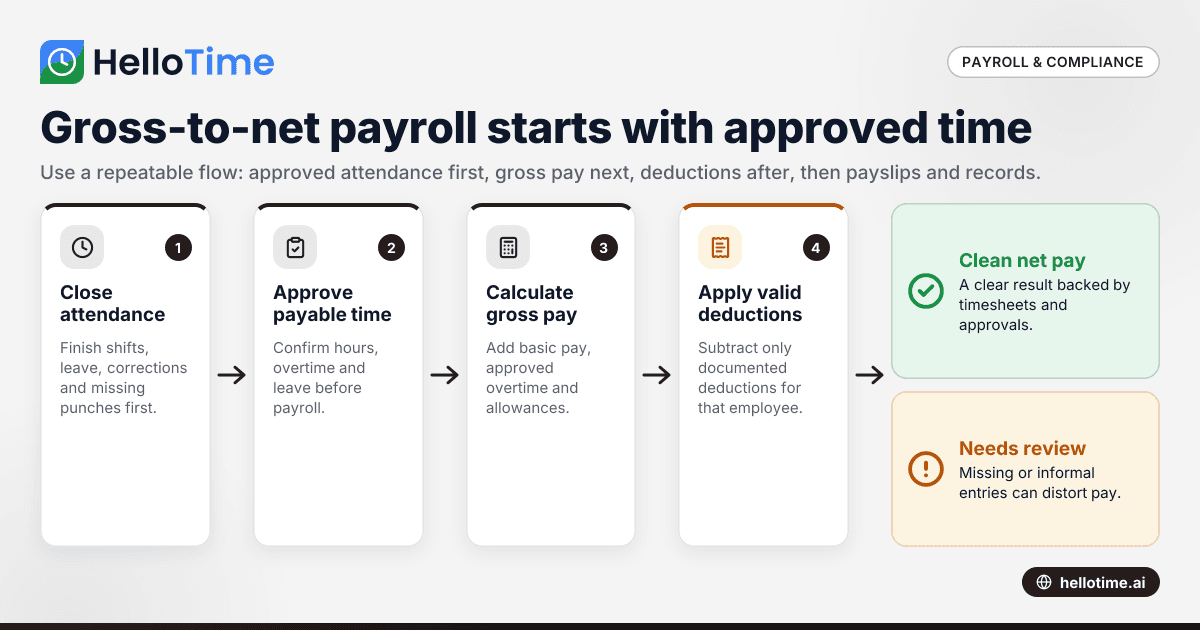
Payroll deductions in the UAE start with a simple flow: turn approved work hours into gross pay, add any overtime or fixed allowances, then subtract only the deductions that actually apply to that employee. For most small businesses, the hard part is not the maths. It is keeping timesheets, overtime approvals and employee records accurate enough to produce a clean gross-to-net result each pay cycle.
Key takeaways
- Small business payroll deductions in UAE depend on the employee, contract terms and your company setup.
- Timesheets and overtime records should be approved before payroll is calculated.
- Gross-to-net pay usually includes basic pay, any approved overtime, allowances and then applicable deductions.
- Deductions must be documented clearly on payslips and backed by payroll records.
- Free-zone rules and data protection duties can affect how you store payroll and attendance data.
- This article is general information, not legal or tax advice.
What are small business payroll deductions in UAE?
Small business payroll deductions in UAE are the amounts subtracted from an employee’s gross earnings to arrive at net pay. Gross earnings can include basic salary, approved overtime and any regular allowances your business pays through payroll.
The exact deductions depend on the worker and the company. Not every deduction applies to every employee. That is why small businesses should avoid copying a generic spreadsheet from another firm in Dubai, Abu Dhabi or Sharjah.
For a practical payroll process, think in five parts:
- Collect approved time data.
- Calculate gross earnings.
- Identify valid deductions.
- Review the gross-to-net summary.
- Issue payslips and keep records.
This sounds simple, but payroll errors usually begin earlier. A missed shift, an unapproved extra hour, a duplicated attendance entry or a wrong salary component can all change net pay.
If your team still manages hours on paper, WhatsApp messages and manual spreadsheets, payroll deductions become harder to defend. You need a clear audit trail that shows where each number came from.
How do you calculate gross-to-net pay from timesheets and overtime?
Start with approved hours, convert them into earnings using the employee’s pay structure, add approved overtime and allowances, then subtract any applicable deductions. The result is net pay. Good payroll depends on accurate attendance, approved timesheets and clear records of every adjustment.
In practice, the gross-to-net process works best when you separate time capture from payroll review. That lets operations managers confirm actual hours before finance or HR runs payroll.
Step 1: Lock the attendance period
Begin with a defined payroll period. Make sure all shifts, clock-ins, clock-outs, leave entries and manual corrections are completed before payroll starts.
For example, if your business pays monthly, close the period only after:
- all field staff hours are submitted
- supervisors approve overtime
- leave is marked correctly
- missing clock-ins are resolved
- duplicate entries are removed
If this step is rushed, gross pay will be wrong before deductions are even considered.
Step 2: Convert approved time into payable hours
Next, identify which hours are payable. This can include:
- regular worked hours
- approved overtime
- paid leave, if your policy and employment terms require it
- shift-based attendance that qualifies for payment in that cycle
For hourly teams, this is direct. Hours worked are multiplied by the agreed rate.
For salaried teams, timesheets still matter. They help verify attendance, unpaid absences, overtime eligibility and client-billable work. That is especially important for agencies, maintenance teams, hospitality operators and construction subcontractors that need both payroll accuracy and project costing.
Step 3: Calculate gross earnings
Gross pay is the total earnings before deductions. Depending on your setup, this may include:
- basic salary
- housing or transport allowance, if paid through payroll
- approved overtime pay
- shift pay or other fixed payroll items
- attendance-linked earnings for hourly staff
A simple example for an hourly employee in Sharjah:
- Regular hours: 208 hours × AED 18 = AED 3,744
- Approved overtime: 10 hours × overtime rate = AED 240
- Fixed transport allowance: AED 300
Gross pay = AED 4,284
A salaried example for a small design firm in Dubai:
- Basic salary: AED 5,000
- Fixed allowance: AED 1,000
- Approved overtime: AED 350
Gross pay = AED 6,350
At this stage, gross pay is not yet what the employee receives in hand. Deductions come next.
Which deductions usually apply to payroll in the UAE?
Only valid, documented deductions that apply to that employee should be subtracted from gross pay. Small businesses should not assume every worker has the same deductions. The right setup depends on employment terms, company policy and any legal obligations that apply to your business.
Common deduction categories
The exact list varies, but small businesses often review deductions under categories like these:
- advances or salary recoveries
- unpaid leave or absence-related adjustments
- loans or agreed repayments
- deductions required under company policy where lawfully applied
- other documented employee-specific deductions
The key point is control and documentation. Every deduction should have a reason, a record and an approval path.
Be careful with one-off deductions
Small businesses often make payroll harder by adding one-off deductions informally. A manager sends a WhatsApp message saying an amount should be held back. Finance then updates a spreadsheet without supporting paperwork.
That creates risk. If the employee questions the payslip later, the business may struggle to explain the deduction clearly. It is better to use a standard approval process for any non-routine change.
What about tax, registration and compliance records?
Payroll itself sits alongside other business obligations, but they are not the same thing. For example, your company may already be registered with the Federal Tax Authority for VAT or corporate tax. That does not remove the need for a separate, disciplined payroll process.
You should also think about data handling. Payroll and attendance records contain personal data. Businesses in the UAE should manage employee data carefully and consider any applicable requirements under the Federal PDPL, as well as any rules relevant to their free-zone setup such as DIFC or ADGM if those apply to the business.
What should be on a gross-to-net payroll worksheet?
A good gross-to-net worksheet should show each employee’s pay inputs, additions, deductions and final net pay in one place. It should also show where the numbers came from, including timesheets, overtime approvals, leave records and any manual adjustments.
A worksheet can be built in a spreadsheet, but it needs structure. At a minimum, include these columns:
- employee name or ID
- payroll period
- regular hours or salary basis
- overtime hours and amount
- allowances
- gross pay
- each deduction line with description
- total deductions
- net pay
- approval status
- notes or supporting reference
Why this matters for a small business
When payroll is handled by one person, errors can stay hidden for months. A worksheet forces consistency. It also helps when someone asks a basic question such as:
- Why was this person paid less this month?
- Was this overtime approved?
- Was this unpaid leave already accounted for?
- Did we deduct this amount twice?
For an ai small business workflow, the value is not replacing judgement. The value is reducing manual copying and highlighting exceptions before payroll is finalised.
Build a clear audit trail
An audit trail matters even in a ten-person company. If your team operates across multiple sites in Dubai or Abu Dhabi, or if staff work in the field, attendance disputes become more common.
Your payroll records should link back to:
- timesheets
- shift schedules
- approved leave
- attendance corrections
- overtime approvals
- any deduction authorisation
This reduces confusion at month-end and makes payroll easier to review.
How do timesheets affect payroll deductions?
Timesheets decide the pay inputs that deductions are applied to. If timesheets are wrong, gross pay is wrong, and every deduction calculation that follows can also be wrong.
That is why payroll and attendance should not be treated as separate systems in practice.
Timesheets affect more than hourly pay
Many owners assume timesheets matter only for hourly workers. In reality, they also affect:
- overtime tracking for salaried staff
- absence and lateness records
- unpaid leave treatment
- job costing and project profitability
- evidence for payroll adjustments
A restaurant in Abu Dhabi may need shift-level attendance. A maintenance company in Dubai may need GPS-backed clock-in at customer sites. A small consultancy may need billable time and internal time tracked separately. Each business uses timesheets differently, but payroll accuracy depends on the same principle: approved time first, payroll second.
Typical timesheet mistakes that distort net pay
Watch for these common issues:
- Missing clock-out times.
- Overtime counted without approval.
- Leave marked as absence.
- Duplicate attendance from manual entry.
- Shift swaps not updated in the roster.
- Manual deductions entered without reference.
These mistakes can either overpay or underpay staff. Both cause problems. Overpayments create recovery issues later. Underpayments damage trust quickly.
What process should a UAE small business follow each pay cycle?
Use a fixed monthly process: close attendance, approve overtime and leave, calculate gross pay, apply valid deductions, review exceptions, then issue payslips. A repeatable process reduces payroll errors and makes responsibilities clear between operations, HR and finance.
A repeatable cycle matters more than a fancy template. Small businesses often improve payroll simply by assigning each step to the right person.
A practical 7-step payroll process
1. Close the period
Set a cut-off date for attendance updates. Tell managers that late changes after the cut-off need escalation.
2. Review exceptions
Check missing punches, odd overtime spikes, overlapping leave and duplicate entries.
3. Approve overtime and leave
Do not move any unapproved item into payroll. Keep one approval source.
4. Calculate earnings
Convert salary or hours into gross pay. Add allowances and approved overtime.
5. Apply deductions
Subtract only the deductions that are valid, documented and assigned to that employee.
6. Review gross-to-net summaries
Look for outliers. Compare this month with the previous month. Large changes need explanation before payroll is final.
7. Issue payslips and store records
Keep payslips and supporting payroll records organised and accessible to authorised staff only.
Who should approve what?
A small business should separate duties where possible:
- supervisors approve worked time and overtime
- HR confirms employee status and leave data
- finance reviews pay calculations and deductions
- owners or senior managers approve exceptions if needed
Even a lean team can create this control structure. It reduces mistakes and discourages informal payroll changes.
Can software reduce payroll deduction errors for small teams?
Yes. The biggest gains come from fewer manual entries, cleaner approvals and a clearer link between attendance and payroll inputs. Software does not remove the need for review, but it can make the process much easier to manage.
For small teams, the main benefit is operational clarity. Instead of chasing timesheets across paper forms, chat messages and multiple spreadsheets, you have one place to review hours, leave and approvals.
Where software helps most
A practical system can help with:
- one-click time tracking
- auto-built timesheets
- shift scheduling and rosters
- leave management
- GPS and geofenced clock-in
- tablet kiosk attendance with face recognition
- approval workflows
- billable time linked to invoicing
- project profitability reporting
For a UAE business with mobile staff, multilingual teams and multiple worksites, these features can reduce payroll disputes significantly. If you want to see how that looks in practice, you can explore HelloTime in the UAE and review the available features.
Good software still needs good policy
Even with automation, you still need clear internal rules:
- who can edit attendance
- when overtime must be approved
- which deductions require written support
- who can reopen a closed payroll period
- how long payroll records are retained
Software improves consistency. Policy provides control.
A simple gross-to-net example for a UAE small business
Let us use a straightforward example for a facilities support company in Dubai.
Employee payroll inputs for the month:
- Basic salary: AED 3,500
- Fixed allowance: AED 500
- Approved overtime: AED 325
- Unpaid absence adjustment: AED 200
- Employee advance recovery: AED 300
Calculation:
- Basic salary = AED 3,500
- Add allowance = AED 500
- Add overtime = AED 325
- Gross pay = AED 4,325
- Subtract unpaid absence adjustment = AED 200
- Subtract advance recovery = AED 300
- Net pay = AED 3,825
What matters here is not only the result. It is the supporting record:
- attendance shows the days worked
- overtime has supervisor approval
- the absence is recorded correctly
- the advance recovery is documented
That is what makes the payroll figure reliable.
How can you prepare payroll records for growth?
Start with standard inputs, standard approvals and standard reports. A process that works for 12 employees should still work when you reach 50, with fewer manual edits and better visibility.
Standardise your pay elements
Create a short list of pay items and deduction types. Use the same names each month. This keeps reports clean and avoids confusion.
Examples include:
- basic salary
- regular hours
- overtime
- transport allowance
- unpaid leave adjustment
- advance recovery
Avoid free-text labels that change every cycle.
Keep employee master data current
Payroll errors often come from stale employee records, not just bad timesheets. Review:
- joining and leaving dates
- salary and allowance structure
- work location
- reporting manager
- shift pattern
- deduction setup
When HR updates employee data late, payroll teams usually feel the impact last.
Use month-end reports to spot issues early
A simple review report can flag:
- staff with no attendance
- overtime above normal levels
- negative net pay
- unusual deductions
- repeated manual edits
This is where an ai small business setup can help operations teams. It can surface exceptions quickly, but managers still need to verify the reason behind each one.
Frequently asked questions
Are small business payroll deductions in UAE the same for every employee?
No. Deductions depend on the employee’s pay structure, attendance, approved overtime, leave records and any valid documented adjustments. Small businesses should avoid using one deduction template for everyone.
Do salaried employees still need timesheets for payroll?
Often, yes. Timesheets help confirm attendance, overtime, absences and project time, even when the employee is on a monthly salary. They also provide evidence for any payroll adjustments.
Should overtime be approved before payroll is processed?
Yes. Overtime should be checked and approved before it is included in gross pay. This reduces disputes and prevents payroll from being reopened after processing.
Can I run payroll from spreadsheets only?
You can, but spreadsheets become risky as the team grows or work happens across sites. Manual edits, version confusion and weak approval trails often lead to payroll errors.
What records should I keep for gross-to-net payroll calculations?
Keep timesheets, attendance records, leave entries, overtime approvals, payslips and documents supporting any deductions. Access to these records should be limited to authorised staff because they contain personal data.
Keep reading
Related articles
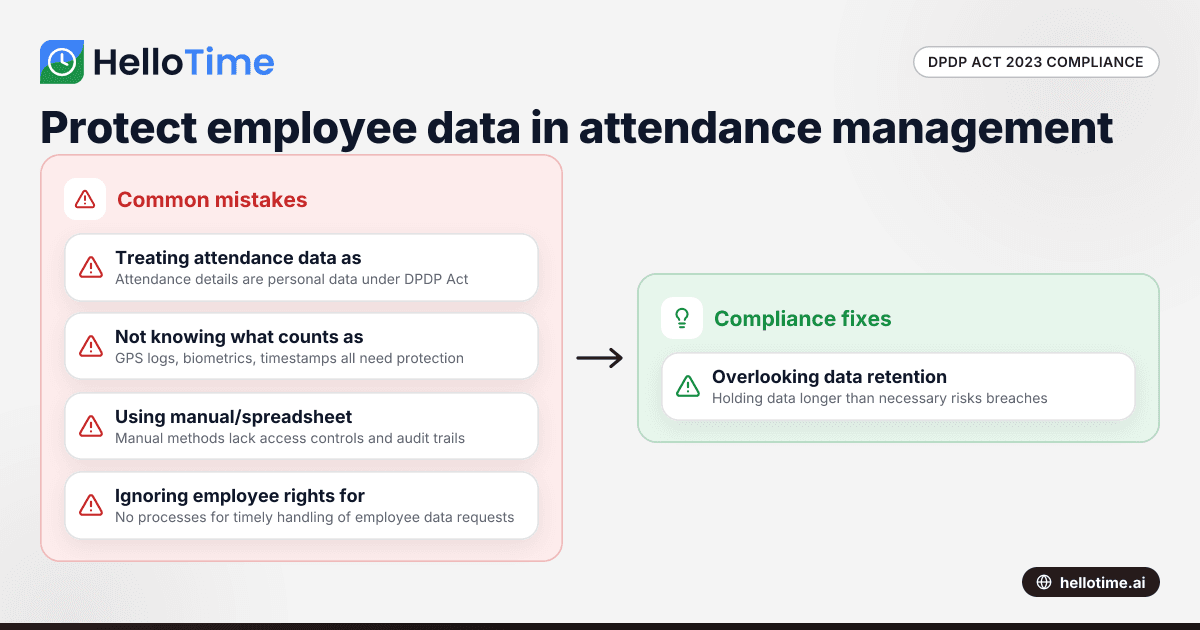
What Indian Businesses Need to Know About Data Protection Under the DPDP Act 2023 When Managing Attendance and Timesheets
Businesses tracking employee attendance and timesheets in India face growing risks if they overlook the DPDP Act 2023’s mandate for protecting.
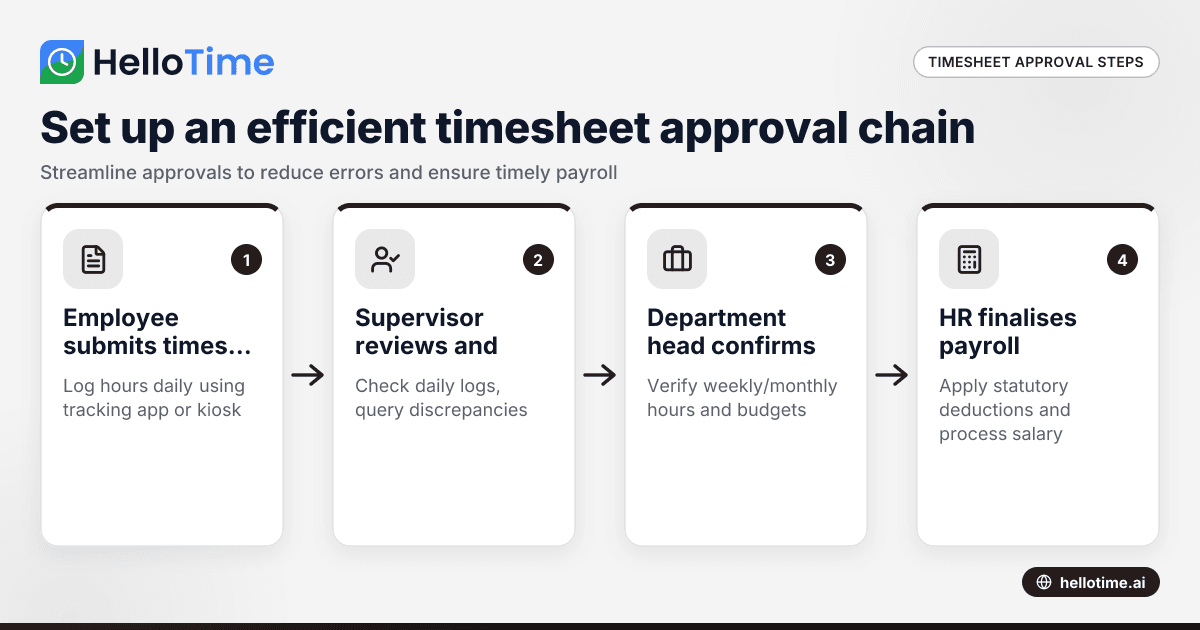
How to Set Up an Efficient Timesheet Approval Chain for Indian SMEs
How to Set Up an Efficient Timesheet Approval Chain for Indian SMEs This guide is for owners, HR, and operations managers at Indian small and.
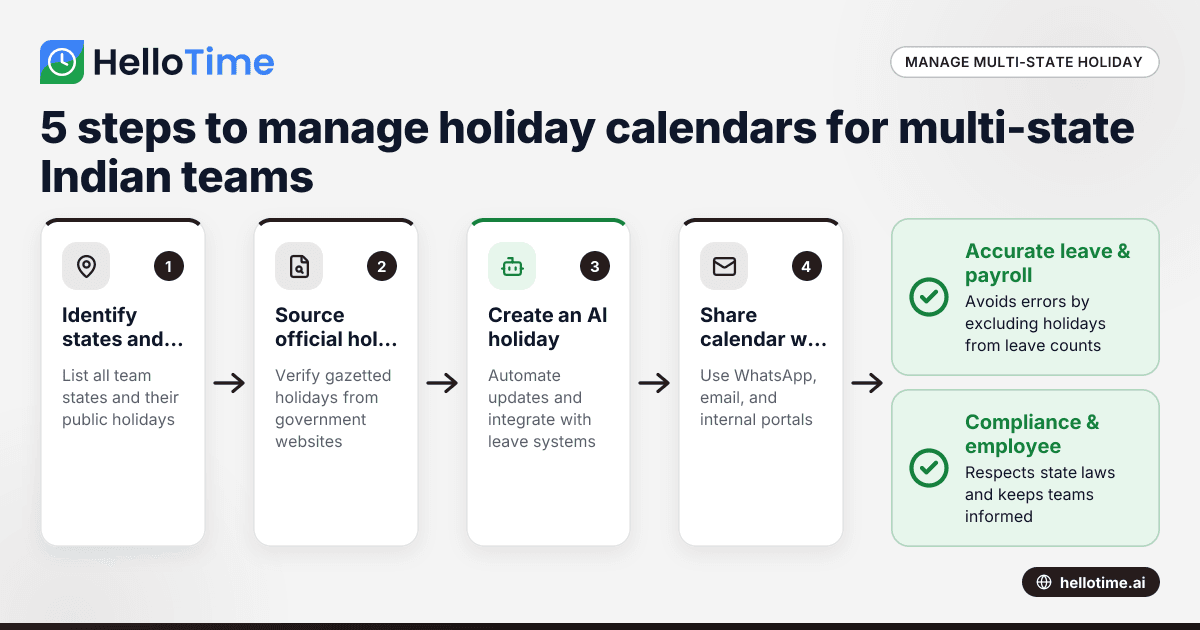
How to Manage Holiday Calendars for Multi-State Teams in India
Managing holiday calendars for multi-state teams in India can be complex due to different state-specific holidays and observances. By the end of this.