Choosing the Right Attendance App for Small Businesses in Bengaluru
Choosing the Right Attendance App for Small Businesses in Bengaluru ===================================================================== If you run.
The HelloTime team
8 min read
On this page
Choosing the Right Attendance App for Small Businesses in Bengaluru
If you run a small business in Bengaluru, picking the right attendance app is a key step to managing your workforce efficiently. Although ease of use often drives the choice, it's equally important to consider factors like local compliance, cost, and technology capabilities. For a city like Bengaluru — a tech-savvy hub with a diverse workforce ranging from office staff in Koramangala startups to field teams serving clients across Electronic City — selecting the right attendance system means aligning with your unique business needs and regulatory environment.
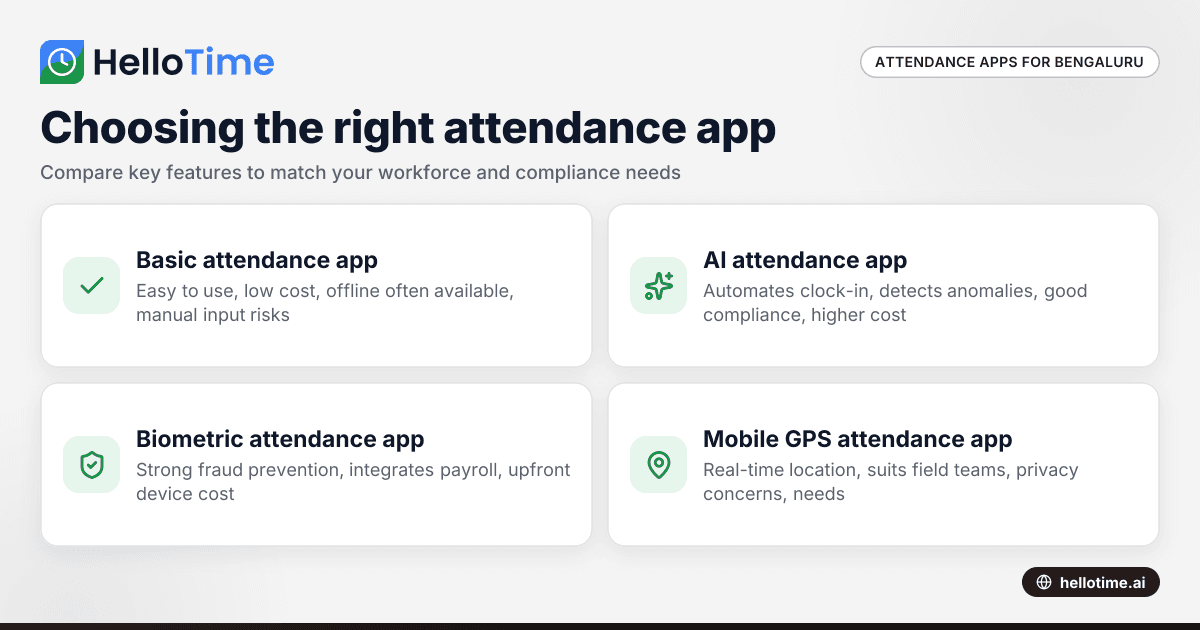
Here is a detailed comparison of attendance apps suited for small businesses in Bengaluru based on important criteria:
| Criteria | Basic Attendance App | AI Attendance App | Biometric Attendance App | Mobile GPS Attendance App |
|---|---|---|---|---|
| Ease of Use | High | High | Medium | Medium |
| Technology | Manual clock-in/out | AI-enabled face recognition, anomaly detection | Fingerprint/face scan hardware | GPS location-based clock-in |
| Cost (₹) | Low | Medium | Medium-High | Medium |
| Local Labour Law Compliance | Varies | Usually good | Usually good | Varies |
| Offline Functionality | Usually yes | Yes | No | Depends |
| Integration with Payroll | Limited | Often available | Often available | Limited |
| Device Requirement | Any smartphone, tablet, or computer | Smartphone or tablet with camera | Specialized biometric device | Smartphone |
When to choose a Basic Attendance App
Basic attendance apps provide simple, low-cost solutions suitable for businesses prioritizing straightforward tracking over automation. If your team in Bengaluru operates mostly from a fixed location with reliable power and internet, this may be enough. For example:
Example: A small advertising agency in Koramangala with 15 employees uses a basic app where staff manually clock in and out via a shared tablet or desktop. This manual input feeds into monthly payroll calculation. The low cost and simplicity fit their budget and workflow.
Benefits:
- Minimal hardware investment.
- Simple for even non-technical staff.
- Offline mode often available, helpful for intermittent connectivity.
Pitfalls:
- No automatic fraud prevention, so “buddy punching” can be a risk.
- Manual errors in attendance data entry.
- Timesheets may require manual approval, slowing down HR processes.
- Limited integration with payroll and leave systems means more administrative overhead.
Basic apps may suffice until your team grows or you need real-time attendance analytics, automated approvals, or compliance-ready reporting.
When does an AI attendance app work best?
AI attendance apps automate attendance tracking using technologies like tablet-based face recognition and anomaly detection. They suit Bengaluru businesses wanting to reduce errors and improve compliance with moderate investment.
Example: A SaaS startup in Whitefield with 40 employees combines office and remote field workforces. They use an AI-enabled attendance system on tablet kiosks and smartphones that logs time and alerts HR of unusual absenteeism or late arrivals. The app also integrates attendance data into payroll software, speeding up salary processing and statutory deductions like PF and TDS.
Advantages:
- Automates clock-in/out with minimal manual input.
- Detects proxy attendance and alerts irregularities.
- Supports Karnataka’s Shops and Establishments Act requirements.
- Integrates leave, payroll, and compliance workflows.
- Works offline to a degree, syncing when connected.
Limitations:
- Needs compatible hardware like smartphones or tablets.
- Costs more than basic apps.
- Some users may face a learning curve with AI features.
AI attendance apps suit businesses with mixed work environments and moderate staffing levels who want to move beyond manual errors and spreadsheet chaos.
Why choose biometric attendance apps?
Biometric apps capture fingerprints or facial data via specialized devices to create tamper-proof attendance records. Small to mid-size manufacturers, hospitality businesses, and retail chains in Bengaluru often use them where security and strict attendance enforcement matter.
Example: A manufacturing unit in Peenya employs 100 shift workers who clock in using fingerprint scanners at entry points. The biometric app links instantly with payroll, calculating shift hours and overtime in compliance with Karnataka labour laws.
Strengths:
- Strong fraud prevention: impossible to fake biometric data.
- Ideal for environments with many shift workers or high absenteeism risks.
- Often integrates with payroll for statutory deductions (ESI, PF).
Drawbacks:
- Requires upfront capital for biometric devices.
- Limited offline functionality—may fail if devices or network have issues.
- Not suited for remote or mobile workers.
Biometric systems provide rigid control but at the cost of less flexibility and higher initial investment.
Is a mobile GPS attendance app right for you?
Mobile GPS attendance apps are tailored for businesses with field or remote employees clocking in from various sites. India's growing field service sector—such as cleaning services, delivery companies, and construction teams in Bengaluru’s outskirts—benefit from this approach.
Example: A mid-sized electrical contracting company with crews in Bengaluru and Electronic City installs a GPS-enabled mobile attendance app ensuring workers clock in only at approved client sites. GPS geofencing confirms presence, and the app links with payroll after verifying hours worked.
Pros:
- Real-time location verification boosts accountability.
- Works for mobile and scattered teams.
- Often integrates with leave and payroll modules.
Cons:
- Privacy concerns require employee consent under the DPDP Act 2023.
- May drain smartphone battery or require constant internet.
- Not optimal for office-based teams.
If parts of your workforce rarely visit a fixed office, GPS attendance helps manage hours accurately without manual tracking.
How do AI attendance apps improve workforce management?
AI attendance apps leverage face recognition and machine learning to track attendance accurately and flag irregularities for proactive HR action. They reduce manual errors, automate approvals, and help keep compliance in check.
AI apps often include:
- Face recognition kiosks for quick clock-ins.
- Automated detection of attendance anomalies.
- Real-time syncing with leave and payroll systems.
- Predictive reports on overtime and absenteeism.
For Bengaluru’s billing-by-hour agencies or mixed workforce businesses, AI attendance apps streamline linking time tracking to invoicing and payroll, cutting down disputes and administrative delays.
What questions should I ask before choosing an attendance app?
Focus on the essentials: compliance, usability, privacy, and integration. Ask: Does the app comply with Karnataka’s labour laws and the DPDP Act 2023? Can it work offline where internet is unreliable? What devices are supported? Does it integrate with payroll systems like Tally? What is the total cost including hardware and training? Will it scale as my business grows?
More detailed considerations:
- How does the app handle employee data privacy and consent under the DPDP Act?
- What offline capabilities exist for power or network outages common in tier-2 or tier-3 city operations?
- Can the app generate compliance-ready reports for PF, ESI, TDS, and Karnataka Shops and Establishments filings?
- How user-friendly is the app for your workforce, especially if hiring from different skill levels?
- Does it support multiple shift patterns and automated leave approvals?
- Is customer support available locally, and are updates aligned with Indian labour regulations?
Choosing the right attendance app means balancing these factors to fit your business size, sector, and workforce type.
Balancing compliance, cost and usability for Bengaluru SMEs
Bengaluru’s tech-forward environment means that even small businesses can access advanced attendance solutions. UPI and Razorpay enable seamless payment for software subscriptions, and affordable smartphones make AI or GPS-enabled apps practical. Still, balancing features with cost control is crucial.
Steps to make the right choice:
- Assess workforce profile: number of employees, field vs office ratio, shift patterns.
- Determine core needs: attendance only or combined with leave and payroll.
- Set budget range including hardware, monthly fees, and training.
- Verify legal compliance particularly under Shops and Establishments Karnataka rules and DPDP Act 2023.
- Test user experience with a trial—ease of clock-in/out, manager approvals.
- Evaluate integration with your accounting or payroll software (e.g., Tally).
- Plan for growth: can the app handle more users or locations without large upgrades?
Explore detailed features that match your business needs, including AI, GPS, biometrics, and payroll integration, on our features page. To compare plans and pricing that fit your team size and budget, visit pricing.
How do I know if an AI attendance app fits my business needs?
An AI attendance app fits businesses wanting accurate, automated attendance with minimal manual work. It’s best if your workforce is a mix of office and remote staff needing compliance and payroll integration. However, it requires some technology investment and user adaptation.
More detail: If your Bengaluru business faces issues like time theft, attendance fraud, or inefficient manual approvals, AI attendance apps can streamline attendance with features like face recognition, anomaly alerts, and seamless payroll syncing. They are ideal for teams scaling beyond 20 employees across multiple sites or working remotely, where automated accuracy and compliance ease HR workload.
Choosing the right attendance app in Bengaluru means matching your business’s workflows, workforce type, and compliance requirements with technology that delivers accuracy without complexity. Whether a basic manual app or an AI-driven system, thoughtful evaluation ensures efficient workforce management and legal compliance under Karnataka’s labour laws.
Related reading
- How Delaware Small Businesses Can Choose the Best Attendance App to Improve Workforce Management
- How United States Small Businesses Can Use Attendance Apps to Streamline Workforce Management
Read next
This article covers one part of a bigger topic. For the complete picture, read our guide to attendance app.
Keep reading
Related articles
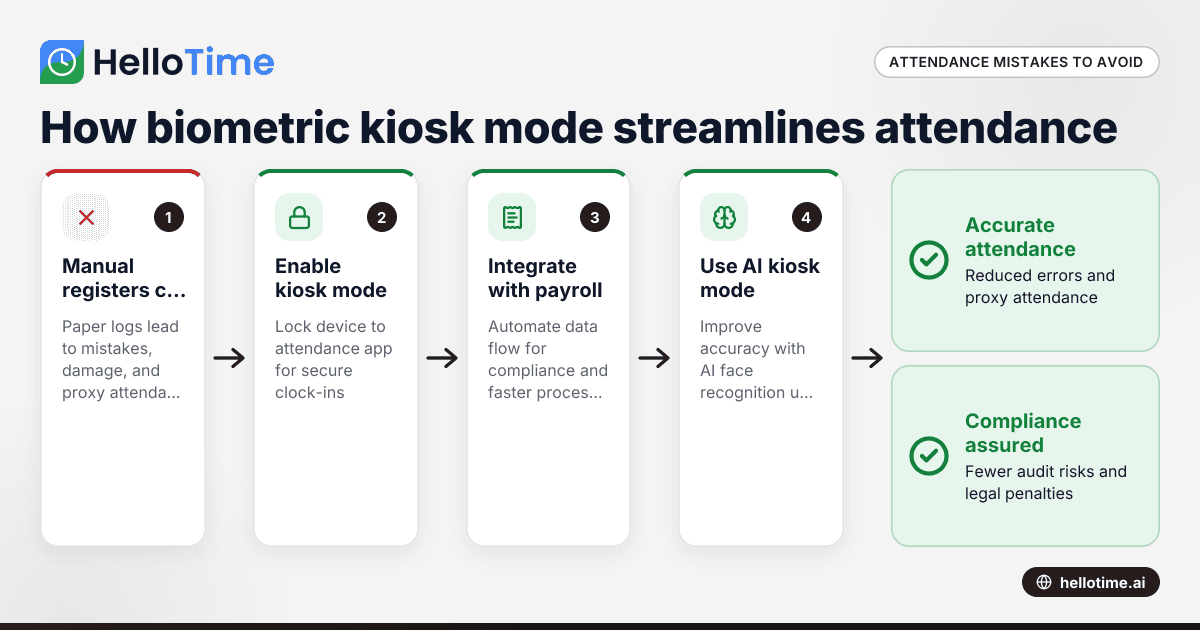
How Biometric Attendance Kiosk Mode Can Streamline Workforce Management for Indian Manufacturing Units
Manufacturing units in India often struggle with managing workforce attendance accurately and efficiently. Errors in attendance tracking lead to.
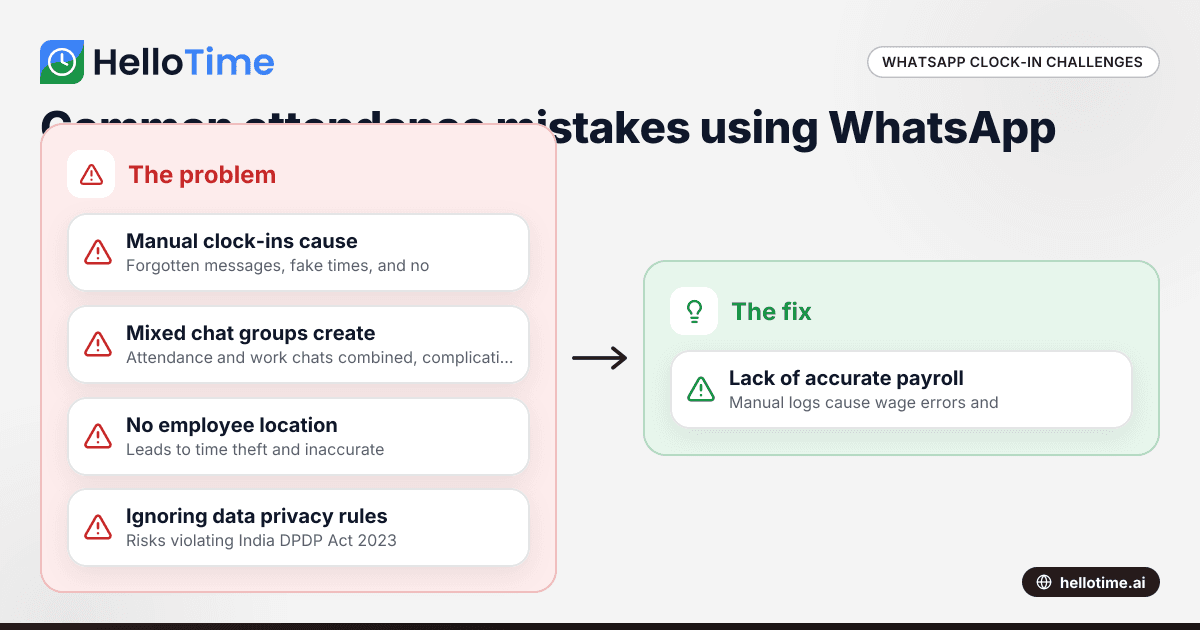
Using WhatsApp for Clock-In and Attendance Tracking in Indian Small Businesses
Using WhatsApp for Clock-In and Attendance Tracking in Indian Small Businesses The cost of managing attendance poorly can be high for small.
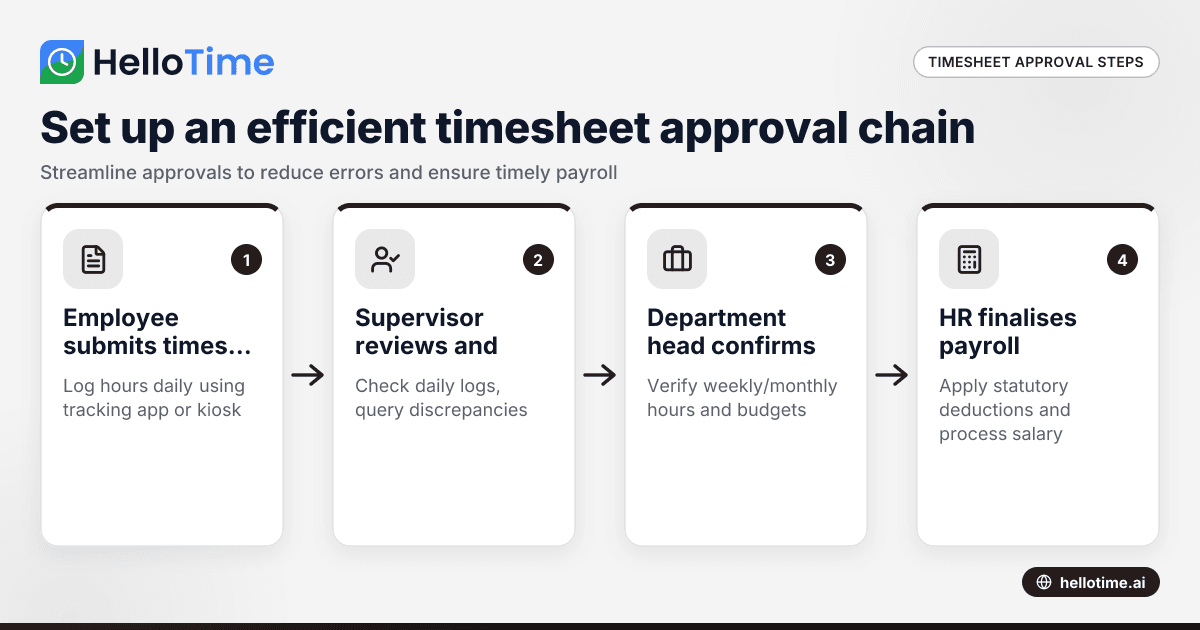
How to Set Up an Efficient Timesheet Approval Chain for Indian SMEs
How to Set Up an Efficient Timesheet Approval Chain for Indian SMEs This guide is for owners, HR, and operations managers at Indian small and.