How Geofence Attendance Works for Field Staff Within 100 Meters in United States Businesses
Geofence attendance uses GPS to track employees clocking in within a roughly 100-meter radius of a worksite. This technology helps U.S. businesses.
The HelloTime team
6 min read
On this page
Geofence attendance uses GPS to track employees clocking in within a roughly 100-meter radius of a worksite. This technology helps U.S. businesses ensure accurate timekeeping and reduce fraud, especially for field or remote teams. It streamlines workforce management and payroll by confirming physical presence at job locations.
Key takeaways
- Geofence attendance sets a virtual boundary around a worksite, typically about 100 meters.
- It helps prevent time theft and false clock-ins in mobile or shift-based teams.
- Ideal for industries like construction, field service, retail, and healthcare.
- Requires GPS-enabled employee devices and compatible time tracking apps.
- Integrates well with payroll, scheduling, and attendance approval workflows.
- Must respect employee privacy and comply with U.S. regulations on data use.
What is geofence attendance, and why is it important for U.S. businesses?
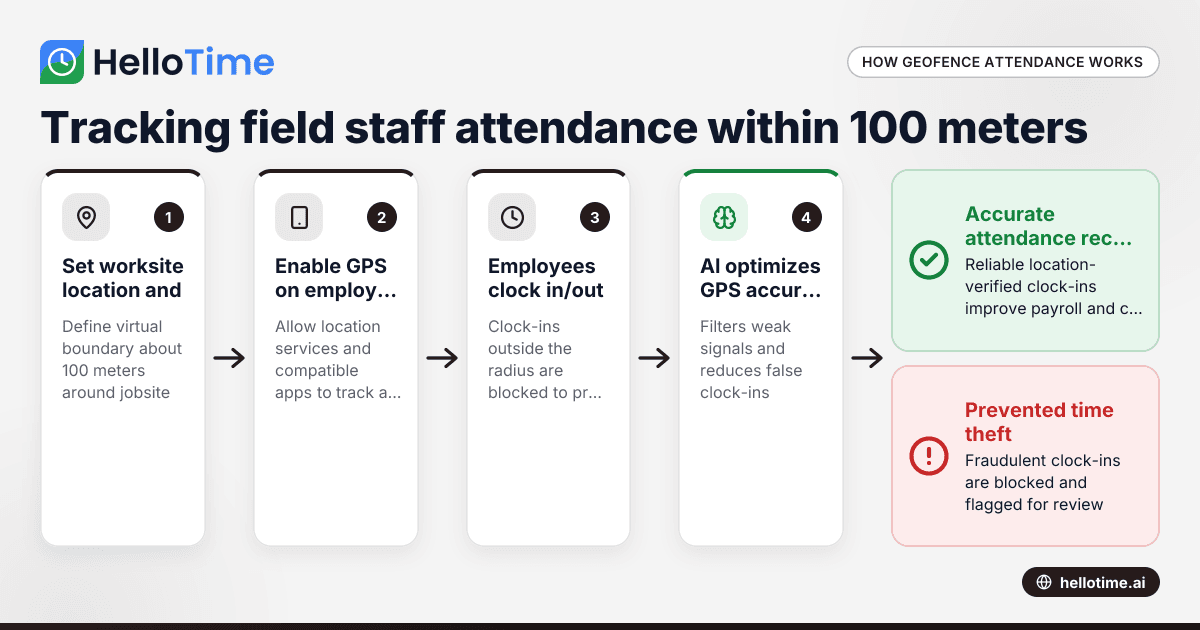
Geofence attendance is a GPS-based system that allows employees to clock in or out only when they are within a virtual boundary around a designated location, generally about 100 meters from the worksite. This ensures accurate and verifiable attendance tracking.
For U.S. businesses in cities like Houston, Chicago, or Detroit, geofence attendance improves accuracy for payroll and billing by confirming employees’ physical presence during working hours. It reduces time fraud and errors common in manual or spreadsheet-based timesheets, benefiting companies that rely on hourly billing or shift pay.
How does AI around 100 improve geofence attendance?
AI around 100 refers to artificial intelligence algorithms optimizing geofence attendance accuracy within approximately 100 meters. AI analyzes GPS signal inconsistencies and clock-in patterns to reduce false positives and missed punches caused by weak signals or device issues.
With AI, businesses get reliable attendance data without using overly large geofences that may allow inaccurate clock-ins. This enhances trust and operational efficiency by keeping the monitoring precise and fair.
How do businesses set up geofence attendance within about 100 meters?
Setting up geofence attendance typically involves:
- Selecting worksite geographic coordinates using a map.
- Defining a virtual boundary roughly 100 meters around the site.
- Ensuring employees enable GPS/location services on their devices.
- Deploying a compatible time tracking app with geofence features.
- Activating AI-enhanced location accuracy if available.
- Monitoring attendance data regularly and adjusting the radius if needed.
Using HelloTime’s features, businesses can automate geofence attendance with seamless timesheets and approvals, eliminating the need for manual tracking.
Do geofence attendance systems respect employee privacy?
Geofence attendance balances accurate tracking with privacy by limiting location access strictly to work hours and designated sites. U.S. businesses must be transparent and obtain employee consent about when and how location data is used.
Systems typically do not track employees continuously but activate location checks only when clocking in or out. Policies should clarify data use, secure data storage, and restrict access to authorized personnel only, ensuring compliance with privacy expectations and regulations.
How does geofence attendance integrate with payroll and compliance in the U.S.?
Geofence attendance provides verified data on hours worked at specific locations, simplifying payroll calculations. This reduces errors and disputes, particularly in hourly or 1099 contractor pay.
Industries in Chicago, Detroit, and other cities rely on accurate records to comply with labor laws like the Fair Labor Standards Act (FLSA). Although HelloTime’s U.S. payroll is coming soon, current integration with payroll platforms like QuickBooks makes attendance data export straightforward.
How do mobile devices and GPS accuracy affect geofence attendance?
GPS accuracy can vary due to urban structures or indoor conditions. Setting the geofence at about 100 meters provides a buffer accommodating these variations. AI helps by filtering out anomalies caused by signal fluctuations.
Employees should keep GPS enabled and avoid power-saving modes that disable location during working hours to ensure accurate attendance.
What industries benefit the most from geofence attendance around 100 meters?
Industries with mobile or multi-site workforces gain the most:
- Construction and manufacturing project sites
- Field service and repair technicians
- Retail and hospitality staff clocking in store-side
- Healthcare and home care visiting patients
- Delivery and logistics teams at warehouses or hubs
A roughly 100-meter radius balances accuracy with practicality to deter time theft.
Can businesses use geofence attendance to manage shift scheduling and approvals?
Yes. Geofence data automates timesheets and attendance approvals. Managers get real-time updates when employees clock in within the designated area, simplifying shift tracking.
Combining geofence attendance with scheduling software reduces administrative work and improves payroll accuracy. HelloTime offers these integrated workforce management tools.
How much does geofence attendance cost for businesses?
Costs vary by provider and features like AI support or multi-location capability. Geofence attendance often comes bundled in modern time tracking software plans.
Investing in such technology saves money long-term by reducing payroll errors and manual tracking burdens. View plan options on HelloTime’s pricing page.
Wrap-up
Geofence attendance helps U.S. businesses track hours accurately within about 100 meters of job sites. AI around 100-meter geofences enhances signal reliability, providing trustworthy attendance verification. This technology improves payroll accuracy, labor compliance, and privacy protections for mobile teams. Explore HelloTime’s features to simplify attendance and workforce management.
Frequently asked questions
What exactly does “around 100 metres” mean for geofence boundaries?
It means the virtual boundary is set to a radius of roughly 100 meters (about 328 feet) around the job location. This allows employees to clock in near the site while preventing remote or inaccurate clock-ins.
Can geofence attendance work without continuous GPS tracking?
Yes. Most systems check location only during clock-in and clock-out events, not continuously, protecting privacy while ensuring correct attendance.
How do I handle employees who work in areas with poor GPS signal?
You can slightly increase the geofence radius or enable AI features that correct GPS inaccuracies. Encourage employees to clock in at reliable signal points like entrances.
Is geofence attendance compliant with U.S. labor laws?
When transparent and with employee consent, geofence attendance complies with labor laws such as the Fair Labor Standards Act. It supports accurate time records but is not legal advice.
Do employees need special devices for geofence attendance?
No. Most smartphones support GPS and location services necessary for geofence attendance. The key is having the required time tracking app with location enabled.
What happens if an employee tries to clock in outside the geofence?
The clock-in is blocked, preventing false records. Managers receive alerts for any such attempts, allowing investigation if needed.
Read next
This article covers one part of a bigger topic. For the complete picture, read our guide to around 100 metres.
Keep reading
Related articles
How Biometric Attendance Kiosk Mode Can Streamline Workforce Management for Indian Manufacturing Units
Manufacturing units in India often struggle with managing workforce attendance accurately and efficiently. Errors in attendance tracking lead to.
Choosing the Right Attendance App for Small Businesses in Bengaluru
Choosing the Right Attendance App for Small Businesses in Bengaluru ===================================================================== If you run.
Using WhatsApp for Clock-In and Attendance Tracking in Indian Small Businesses
Using WhatsApp for Clock-In and Attendance Tracking in Indian Small Businesses The cost of managing attendance poorly can be high for small.