Understanding Employer Payroll Taxes for Small Businesses in the United States: A Guide to FICA, FUTA, and State Unemployment
Understanding Employer Payroll Taxes for Small Businesses in the United States: A Guide to FICA, FUTA, and State Unemployment Employer payroll taxes.
The HelloTime team
7 min read
On this page
Understanding Employer Payroll Taxes for Small Businesses in the United States: A Guide to FICA, FUTA, and State Unemployment
Employer payroll taxes are mandatory contributions businesses must pay to the government based on their employees’ wages. For small businesses in the US, understanding taxes like FICA, FUTA, and state unemployment taxes is essential for compliance and budgeting. These taxes fund Social Security, Medicare, unemployment benefits, and related programs.
Key takeaways
- Payroll taxes for small businesses in the US mainly include FICA (Social Security and Medicare), FUTA (federal unemployment), and state unemployment taxes.
- Employers share FICA taxes with employees, paying an equal amount on wages up to the Social Security wage base.
- FUTA funds federal unemployment benefits and requires certain filing and payment thresholds.
- State unemployment taxes vary by state and business experience rating with claims.
- Staying compliant with payroll taxes avoids penalties and helps good financial planning.
- Payroll software with automation, like those supporting ai payroll taxes, eases accuracy and reporting.
What are the main payroll taxes small businesses must pay in the US?
Payroll taxes are government taxes related to employee wages that employers must withhold and contribute. The three primary payroll taxes for small businesses in the United States include:
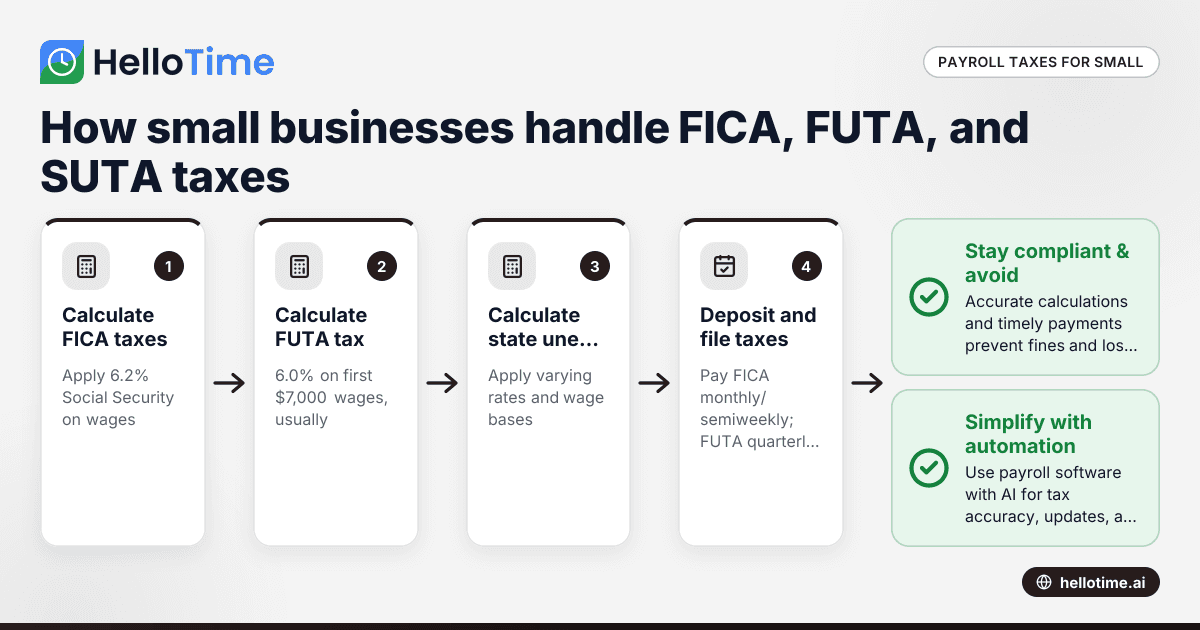
FICA Taxes: The Federal Insurance Contributions Act tax funds Social Security and Medicare programs. Employers pay 6.2% for Social Security on wages up to $160,200 (for 2024) and 1.45% for Medicare on all wages. Employees pay the same rates, but the employer is responsible for submitting both shares.
FUTA Tax: The Federal Unemployment Tax Act tax supports unemployment insurance at the federal level. Employers pay 6.0% on the first $7,000 paid to each employee annually, but most receive a credit reducing this rate to 0.6% if they pay state unemployment taxes on time.
State Unemployment Taxes (SUTA): Each state administers its unemployment insurance program and sets its tax rates and wage bases. Rates vary by state and depend on factors like industry and employer’s claim history.
How do employers calculate and pay FICA taxes?
Employers calculate FICA taxes by applying the specified rates to employee wages each pay period. The process includes:
- Deducting 6.2% Social Security tax up to the $160,200 wage cap per employee for 2024.
- Deducting 1.45% Medicare tax on all wages and paying a matching amount.
- For employees earning more than $200,000, an extra 0.9% Medicare tax is withheld by the employer but not matched.
Employers must remit both the employee’s withheld FICA taxes and their share to the IRS, typically monthly or semiweekly, depending on their deposit schedule.
What is the process for paying FUTA taxes for small businesses?
FUTA taxes require employers to:
- Calculate 6.0% of the first $7,000 wages paid to each employee annually.
- Apply any credit reductions based on timely state unemployment tax payments, usually lowering the effective rate to 0.6%.
- Deposit FUTA tax quarterly if the liability exceeds $500; otherwise, defer until the total reaches that threshold.
- File IRS Form 940 annually to report FUTA tax liabilities and payments.
Most small businesses pay FUTA taxes at the reduced rate, reflecting compliance with state UI tax rules.
How do state unemployment taxes differ across states?
State unemployment tax systems vary widely:
- Tax Rates: Depending on your state and your “experience rating,” rates can range from under 1% to over 10%. Experience rating assesses how many former employees claimed benefits.
- Wage Base Limits: States set their own wage limits for taxable wages, from a few thousand dollars to over $40,000.
- Filing and Payment: States have different reporting schedules, forms, and deposit deadlines.
- Thresholds and Penalties: Failure to pay can result in penalties or lose FUTA tax credit.
For example, businesses in Illinois and Texas have very different SUTA rates and wage bases than those in California or New York.
How can small businesses make payroll tax compliance easier?
Payroll tax compliance can be complex, but there are ways to simplify:
- Automate calculations and filings using payroll software that complies with IRS and state guidelines.
- Use solutions incorporating ai payroll taxes technology for accurate tax computations, real-time regulatory updates, and automated tax form generation.
- Track deadlines for deposits and filings to avoid penalties.
- Keep payroll records organized and up to date.
- Consider outsourcing payroll to professionals for hands-off compliance management.
Why are payroll taxes important for small businesses beyond compliance?
Paying payroll taxes correctly helps small businesses:
- Avoid costly IRS penalties and interest.
- Build employees’ Social Security and Medicare eligibility and benefits.
- Support unemployment programs that protect both employers and workers.
- Maintain good standing with tax authorities and potential lenders or investors.
- Make sound financial forecasts with predictable labor costs.
How do ai payroll taxes help streamline payroll management?
AI payroll taxes automate tax calculations and compliance, saving time and reducing errors. They quickly adapt to changes in FICA, FUTA, and state unemployment rates. By generating reports and filings automatically, AI lets businesses in places like Chicago and Houston focus on growth instead of tax details.
In more detail, integrating ai payroll taxes technology helps small businesses by continuously monitoring federal and state tax laws for updates. This ensures your payroll complies with all applicable rules without manual oversight. The automation also speeds up processing time, eliminates costly mistakes from manual entry, and simplifies audit readiness by keeping tax records organized and accurate.
What happens if a business fails to pay payroll taxes on time?
Failing to pay payroll taxes on time leads to penalties, interest charges, and potentially audits. The IRS can levy fines starting at 2% of the unpaid amount for failure to timely deposit taxes, increasing to 10% or more for longer delays. State unemployment tax noncompliance can result in loss of FUTA credit, increased rates, and legal actions.
For small businesses, prompt and accurate tax payments protect financial health and reputation.
How should a small business owner get started with payroll tax compliance?
Start with these six steps to ensure payroll tax compliance:
- Register for an Employer Identification Number (EIN) with the IRS.
- Register for state unemployment accounts where your business operates.
- Learn the wage bases, tax rates, and due dates for federal and state payroll taxes.
- Select payroll software or service that automates tax calculations, withholdings, deposits, and filings.
- Maintain payroll records for wages, hours, and tax submissions for at least four years.
- Regularly monitor tax law changes affecting your payroll duties.
Following these steps helps you avoid penalties and keep your payroll trustworthy and audit-ready.
Summary
For small businesses in the US, understanding and managing payroll taxes like FICA, FUTA, and state unemployment taxes is mandatory and crucial for smooth operations. Compliance requires timely calculations, withholdings, deposits, and filings. Using modern payroll solutions, especially those leveraging ai payroll taxes, can simplify this essential aspect of workforce management. Explore HelloTime’s features and compare plans on pricing to discover tools tailored for small businesses.
Frequently asked questions
What is the difference between FICA and FUTA taxes?
FICA taxes fund Social Security and Medicare and are shared equally between employer and employee. FUTA taxes fund federal unemployment benefits and are paid only by employers on the first $7,000 of each employee’s wages annually.
Are payroll taxes the same across all states in the US?
No. While FICA and FUTA taxes are federal programs with uniform rules, state unemployment taxes vary widely in tax rates, wage bases, and reporting requirements depending on the state.
Can I deduct employer payroll taxes on my business tax return?
Yes. Employer-paid payroll taxes, including the employer share of FICA and FUTA taxes, are generally deductible as a business expense on your federal tax return.
How often do I have to deposit payroll taxes?
Deposit schedules depend on your tax liability size. Small employers typically deposit monthly, but larger ones may need to deposit semiweekly. FUTA taxes are deposited quarterly when liabilities exceed $500.
What records should I keep for payroll tax purposes?
Keep records of employee wages, tax withholdings, deposits, and filings for a minimum of four years. This is essential for IRS or state unemployment audits and compliance verification.
Read next
This article covers one part of a bigger topic. For the complete picture, read our guide to pf esi.
Keep reading
Related articles
What Indian Businesses Need to Know About Data Protection Under the DPDP Act 2023 When Managing Attendance and Timesheets
Businesses tracking employee attendance and timesheets in India face growing risks if they overlook the DPDP Act 2023’s mandate for protecting.
How to Set Up an Efficient Timesheet Approval Chain for Indian SMEs
How to Set Up an Efficient Timesheet Approval Chain for Indian SMEs This guide is for owners, HR, and operations managers at Indian small and.

How to Manage Holiday Calendars for Multi-State Teams in India
Managing holiday calendars for multi-state teams in India can be complex due to different state-specific holidays and observances. By the end of this.